is still unknown. A. When and where this took place B. When and where did this take place C. It was when and where that took place. D. This took place when and where 查看更多


题目列表(包括答案和解析)

________ is still unknown.

A. When and where this took place           B. When and where did this take place

C. It was when and where that took place        D. This took place when and where


查看答案和解析>>

________ is still unknown.

A. When and where this took place           B. When and where did this take place

C. It was when and where that took place        D. This took place when and where


查看答案和解析>>

________ is still unknown.

[  ]

A.When and where this took place

B.When and where did this take place

C.It was when and where that took place

D.This took place when and where

查看答案和解析>>

阅读理解

Fishy Film Goes Deeper

  Avatar director James Cameron is now taking his camera deep into the ocean.

  On March 25, he did a lone submarine(潜水艇)dive nearly 11 kilometers down to the deepest place in the ocean, the Mariana Trench(马里亚纳海沟)in the western Pacific.

  Compared with the colorful forest of Avatar, the Mariana Trench is dark and icy cold.Cameron became the first person to explore the deepest valley in the ocean since two men made a 20-minute trip there in 1960.

  “I felt like I really had gone to another planet and come back,” Cameron told the Associated Press after returning from his dive.“It's really the sense of isolation(与世隔绝), realizing how tiny you are down in this big, black and unexplored place.”

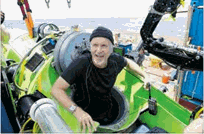
  The filmmaker has spent the past few years working with his team of engineers to design and build the submarine call Deep-sea Challenger.Unlike ordinary submarines, it is wrapped in cameras and lights so that Cameron can film the ocean from the inside.

  The minute-long video that Cameron took while under the sea has been released by the National Geographic.There are no words in the video, but there is something fascinating about this extremely quiet and remote place.Cameron said he was thankful that he of all people had had the chance to go there.

  “There had to be a moment where I just stopped, and took it in, and said,′This is where I am; I'm at the bottom of the ocean, the deepest place on Earth.What does that mean?” Cameron told reporters.

  The Mariana Trench was once thought to be of little interest to scientists.It was assumed that nothing could live under so much pressure and with so little light.But in recent years scientists have found creatures there like fish and shrimps that can resist the heavy pressure.They are also trying to figure out what role deep-sea trenches play in earthquakes.

  Cameron told the BBC that he does not want this dive to be a one-time thing.He wants to use it as a platform for further ocean exploration.

(1)

What is the point of the passage?

[  ]

A.

To inform readers of Cameron's adventure to the Mariana Trench.

B.

To report on the successful launch of the “Deep-sea Challenger”.

C.

To introduce Cameron's latest video filmed in the Mariana Trench.

D.

To draw public attention to the Mariana Trench.

(2)

It can be inferred from the passage that when Cameron reached the Mariana Trench, ________.

[  ]

A.

he felt worried and isolated

B.

he was anxious about his safety

C.

he was surprised by what he experienced

D.

he was excited that he had occupied the ocean

(3)

How does the “Deep-sea Challenger” differ from ordinary submarines?

[  ]

A.

It is more comfortable than an ordinary submarine.

B.

It is much heavier that an ordinary submarine.

C.

It is specially designed for filming under the sea.

D.

It is the only one allowing people to see the outside.

(4)

Which of the following statements is TRUE according to the passage?

[  ]

A.

The role that deep-sea trenches play in earthquakes is still unknown.

B.

Cameron is the first person to have explored the Mariana Trench so far.

C.

Scientists don't think that the Mariana Trench is of much scientific value.

D.

There are no creatures living in the Mariana Trench due to its special conditions.

查看答案和解析>>

阅读理解

  The sea is the largest unknown part of our world. It covers seventy-one per cent of the earth. There is still much to be discovered about working to explain its mysteries(神秘).

  Some are studying ways of bringing the ocean's huge supply of water to the deserts of the world. Others hope to control the weather by learning more about the exchange of heat and moisture(潮湿) between the ocean and the air. Others are studying the ways in which sound travels and is affected by water and heat.

  One of the most interesting projects in oceanography(海洋学) is the work of mapping the ocean floor. Only a very small part of it has been mapped. This was not important when only surface ships sailed the world's ocean, but it can mean the difference between life and death to men in submarines(潜水艇).

  Long ago there was only one way to find out how deep the ocean was. A seaman could throw a weighted rope over the side of his ship. Then he pulled the rope up after it had reached the bottom. But this was not a very exact way of measuring.

  In the 20th century a better way was found. Sound was used to measure the ocean. Seamen did an experiment. They dropped a number of devices that would burst with a loud noise when they hit the bottom. And a little instrument measured the time it took for the sound to reach the ship. This has helped the scientists to map the ocean floor.

  Underwater photography is also important in mapping parts of the ocean floor.

  Around the edges of the continents the ocean floor is flat and the water does not become much deeper for about 30 miles.

  The area near the continents, where the water is not so deep, is the place where the ocean's greatest riches in marine(海洋的) life are found. Below these living creatures and plants are the largest unknown quantities of mineral.

  At the end of the flat part the sea floor suddenly drops down forming deep hollows which are shaped like bowls. These huge hollows hold most of the world's water.

1.The sea covers ________.

[  ]

A.less than a quarter of the earth

B.one third of the earth

C.about half of the earth

D.almost three quarters of the earth

2.Scientists are studying the oceans. In the passage, which of the following is not mentioned?

[  ]

A.How to control the weather.

B.How sound travels and is affected by water and heat.

C.Why people depend on the sea so much.

D.How to irrigate the deserts of the world with the ocean's huge supply of water.

3.Measuring the depth of the ocean with a weighted rope is ________.

[  ]

A.exact

B.a new way

C.false

D.nearly correct but no exact

4.Another aid to the mapping of the ocean floor has been in the ________.

[  ]

A.twentieth century
B.eighteenth century
C.seventeenth century
D.nineteenth century

5.The ocean's greatest riches are found ________.

[  ]

A.in deep hollows

B.in the flat part of the sea

C.close to the continents

D.around islands

查看答案和解析>>


同步练习册答案