
题目列表(包括答案和解析)
Two skulls(头颅骨)found in Africa have been identified as the oldest human remains known to science. The fossilized(化石)bones found in 1967 were originally thought to be 130,000 years old. But a re-dating of rock layers near those which yielded the fossils showed they are actually about 195,000 years old---from the time modern humans appeared. The skulls, known as Omo I and II, push back the known presence of Homo sapiens(现代人)in Africa by 40,000 years. The previous oldest Homo sapiens skulls, dated to between 154,000 and 160,000 years old, were found near a village called Herto in the afar region of eastern Ethiopia. Omo I and II were unearthed by famous paleontologist(古生物学家)Richard Leakey along the Omo River in southern Ethiopia, near the town of Kibish. Omo I’s more modern features led to disagreement among experts over whether they were the same age. The rocks in which they were found show they are, said an Australian archaeologist Prof. Ian McDougall, who made the discovery. He told scientific journal “Nature”: “Omo I and Omo II are relatively securely dated to 195,000 years old, making them the oldest anatomically(解剖学的)modern human fossils yet recovered”
1.By which means could scientists tell the age of fossils they have found?
A. The bones of the fossils. B. The place where they were found.
C. The history of humans. D. Identifying the rock layers of the fossils.
2.How many years older have modern humans become by the new discovery?
A. 130,000. B. 40,000. C. 195,000. D. Between 154,000 and 160,000.
3.Which of the following statements are NOT true according to the passage?
A. The new discovery of the skulls and the research proved the modern humans might have started in Africa.
B. Prof. Ian McDougall thought Omo I and II were the oldest human fossils discovered.
C. Prof. Ian McDougall discovered that Omo I and II were not the same age.
D. Omo I and II were discovered in southern Ethiopia.
汉译英
这两条狗为了一根骨头在发疯似的打架。(fight/like crazy)
填空
The two dogs were ________ ________ a bone.
(两只狗为一块骨头撕咬。)
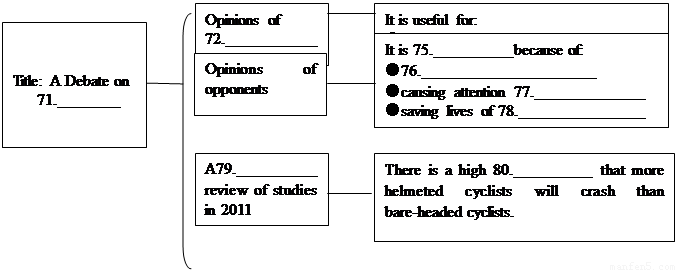
A bicycle helmet is a helmet intended to be worn while riding a bicycle.They are designed to reduce impacts to the skull(头颅骨) of a cyclist in falls.However, there is a debate on whether helmets are useful for road cyclists.
The World Health Organization promotes the use of helmets as a strategy for preventing people' s heads from being injured by bicycle crashes or falls.Use of cycling helmets is supported by numerous groups in the United States. US-based cycling activist John Forester suggests that helmet wearing could prevent 300 deaths a year in the United States out of a total of 1530 preventable deaths.Public Health Law Research reports that there is enough evidence to establish that bicycle helmet laws are an effective public health intervention(干涉)aimed to reduce the number of head-related deaths.Received opinion in some countries is that bicycle helmets are useful and that every cyclist should wear one. Professional bodies elsewhere have agreed, such as the Swiss Council for Accident Prevention.
Mayer Hillman, a transport and road safety analyst from the UK, does not support the use of helmets, reasoning that they are of very limited value in the event of a collision(碰撞) with a car. He compares it to drawing conclusions on whether it is worthwhile to buy lottery tickets. Cyclists' representative groups complain that focus on helmets diverts(转移) attention from other issues which are much more important for improving bicycle safety, such as road danger reduction.The UK's largest cyclists' organization, the CTC, believes that the "overall health effects of compulsory helmets are negative.'' The same report estimated(估计) that universal helmet use would save the life of one child aged 0 to 15 each year.
Up to now, the debate is with no consensus(共识), but an organization has published a review of studies in 2011, saying there is a good deal of evidence that those wearing a helmet are more likely to crash than bareheaded cyclists.
Mr. Whitson taught sixth-grade science. On the first day of class, he gave us a lecture about an animal called the Cattywampus, which died out during the Ice Age. He ___1___ us a skull (头骨) as he talked. We all took ___2___ and later had a quiz.
When he returned my paper, I was __3__. There was a big red “X” through ___4___ of my answers. I had failed. There had to be some ___5__! I had written down ___6___ what Mr. Whitson said.
Then I realized that everyone in the class had ___7___. What had happened? Very simple, Mr. Whitson explained. He had __8___ that story about the Cattywampus. There had ___9__ been any such animal. The information in our notes was, __10__, incorrect. Did we __11___ credit (学分) for incorrect answers?
Needless to say, we were angry. What kind of test was this? And what kind of _12__?
We should have worked it out, Mr. Whitson told us. ___13___, at the very moment he was passing around the Cattywampus skull (in truth, a cat’s), hadn’t he been telling us that no trace (踪迹) of the animal _14__? He had given the animal a _15____ name, and we still hadn’t doubted about that. The zeroes on our papers would be ___16___ in his grade book, he said. And they were.
Mr. Whitson said he hoped we would learn something ___17___ this experience. Teachers and textbooks are not always __18__. In fact, no one is. He told us not to let our __19___ go to sleep, and to speak up if we ever thought he or the textbook was wrong.
Every class was a(n) ___20___ with Mr. Whitson. I can still remember some science periods almost from beginning to end.
1.A.drew B.described C.showed D.brought
2.A.notice B.notes C.a breath D.interest
3.A.shocked B.happy C.angry D.strange
4.A.some B.each C.many D.none
5.A.regrets B.surprise C.difficulty D.mistakes
6.A.exactly B.immediately C.completely D.generally
7.A.passed B.failed C.understood D.worried
8.A.prepared for B.heard about C.dealt with D.made up
|
10.A.therefore B.finally C.however D.yet
11.A.give B.pay C.hope D.expect
12.A.subject B.school C.teacher D.animal
13.A.After all B.Once again C.Above all D.In all
14.A.left B.kept C.remained D.followed
15.A.ridiculous B.common C.great D.wrong
16.A.removed B.forgotten C.ranked D.recorded
17.A.from B.in C.about D.by
18.A.equal B.practical C.right D.up-to-date
19.A.imagination B.hearts C.eyes D.minds
20.A.adventure B.dream C.game D.story
湖北省互联网违法和不良信息举报平台 | 网上有害信息举报专区 | 电信诈骗举报专区 | 涉历史虚无主义有害信息举报专区 | 涉企侵权举报专区
违法和不良信息举报电话:027-86699610 举报邮箱:58377363@163.com