
题目列表(包括答案和解析)
My father is a smart man. He spent many years of his life listening to people’s arguments, first as assistant district lawyer and then as a judge. My dad knows rubbish rhetoric when he hears it.
One of his favorite phrases is: “If you don’t have anything smart to say, then don’t say it at all.” Yet, for all of his legal training and life experience, he can’t help but keep talking about the Mega Millions jackpot.
We all know the odds(几率)of winning the jackpot this evening with one ticket are extraordinarily low ... 1 in 175, 711, 536, to be exact. Still, people go out and buy hundreds of tickets with the hopes of becoming wealthier beyond their dreams. Why? There are two possible explanations for this “irrationality”(不理智).
One idea is that the way we calculate odds in our heads has nothing to do with mathematical odds in the traditional sense. We don’t go to the mathematical odds table and say, “Well, this would be a terrible investment. I think I’m better off putting my money in the bank!” Rather, it has everything with the ability to picture an event happening.
My father, for instance, watches the news every night and sees people winning the lottery(彩票). Therefore, he thinks the chance of him winning the lottery is much higher than they actually are.
The second thought is that the expected effect of playing cannot be represented merely by the odds. My father and, I’m sure, others get a thrill from the mere idea of winning. He loves imagining what it would be like to actually win and losing doesn’t really affect him. Sure, he’s disappointed, but it’s “better to have loved and lost than never to have loved at all.” When you combine the utility of thinking you can win with the utility of actually winning (no matter how small the chance of that occurring), it’s worth it for many people to spend the one dollar on a ticket.
My analysis is that both factors are at play in taking a chance on the lottery. My father and others really do underestimate the odds of winning, but the thrill of participation is not denied by a realistic assessment of the odds. Still, I would probably put my finger on the scale for the first explanation.
All told, a review of the odds of other events happening confirms that there just aren’t many events that occur with less frequency than your winning the Mega Millions jackpot. Look at the graph below, you may understand some: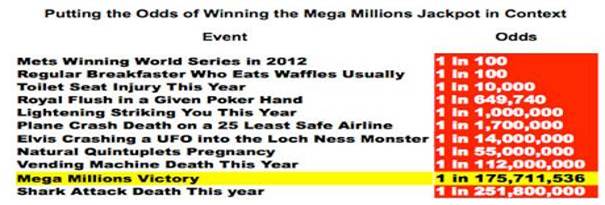
In many ways, it’s like the lottery, something that features often on television and about which people fantasize, but that rarely happens.
So, when you watch, along with my Pa, to see if your lucky number is drawn this evening, keep in mind three things: that your number almost certainly won’t come up; that you are still going to have fun; and that, finally, a lot of other things are more likely to happen—but getting eaten by a shark isn’t one of them.
【小题1】It can be learned from the article that ________.
| A.the Mega Millions jackpot is the last lottery to win in the world |
| B.a judge in that country can’t talk about lottery because it is illegal |
| C.the writer doesn’t buy lottery, for he never hopes to become rich |
| D.In spite of little possibility, a lot of people spend money on lottery |
| A.show chances that those things take place are fewer |
| B.support the writer’s arguments on the lottery tickets |
| C.indicate no one can win the Mega Millions jackpot |
| D.say shark attack death will seldom happen this year |
| A.If one has mathematical odds, he can win the prize more easily. |
| B.Only those who have irrationality buy hundreds of lottery tickets. |
| C.The Mega Millions jackpot is very popular in the writer’s country. |
| D.Winning lottery is a shortcut to achieve the dream of being rich. |
| A.effective | B.ridiculous | C.contradictory | D.astonishing |
| A.The Popular Mega Millions Jackpot | B.Lottery is Merely a Trick |
| C.Mega Million is Like a Shark Attack | D.Be rich, Buy Lottery Soon |
听力
第一节
听下面5段对话。每段对话后有一个小题,从题中所给的A、B、C三个选项中选出最佳选项。听完每段对话后,你都有10秒钟的时间回答有关小题和阅读下一小题。每段对话仅读一遍。
W:I expected you’d come to my birthday party yesterday.
M:I’m terribly sorry,Susan.I had to see off a friend of mine at the airport last night.
1.Why does the man apologize to the woman?
A.He had to say goodbye to his friend at the airport.
B.He didn’t go to the woman’s party last night.
C.He had to go to another city with his friend.
M:I must apologize for not meeting you at the airport this afternoon.You must have been unhappy.
W:Well,you should have let me know that you weren’t coming.
2.How does the woman feel?
A.Very glad.
B.Very painful.
C.A little angry.
W:I’m sorry to have kept both of you waiting.The car was held up in the traffic.
M:That’s all right.We just got here ourselves.
3.How many people are there in the dialogue?
A.Two.
B.Three.
C.Four.
W:You are going to New York today,aren’t you?
M:Yes.I had thought I would fly,but then I decided that taking a bus would be cheaper than driving or flying.
4.How will the man get to New York?
A.By air.
B.By bus.
C.By car.
W:Daddy,have you decided what to do tomorrow?
M:We’ll go boating if it is fine.
W:Wonderful! I’m sure it will be fine.I’ve listened to the weather report.
5.What are they going to do tomorrow?
A.They are going to listen to the weather report.
B.They will go swimming.
C.They will go boating.
第二节
听下面5段对话或独白。每段对话或独白后有几个小题,从题中所给的A、B、C三个选项中选出最佳选项。听每段对话或独白前,你将有时间阅读各个小题,每小题5秒钟;听完后各小题将给出5秒钟的作答时间。每段对话或独白读两遍。
听第6段材料,回答第6~8题。
M:Excuse me,I’m trying to do some work.I’m afraid your children are making a lot of noise.Don’t they ever go to sleep?
W:I’m sorry.They are noisy.But you know it’s difficult to keep boys quiet.
M:I couldn’t work and I couldn’t sleep last night.And I was wakened by the noise they made early this morning.
W:I’m terribly sorry.You know they never listen to me.They are only afraid of their father.He’s away on business,but he’ll be back tomorrow.
M:I hope he can do something about it.
6.What is the relationship between the two speakers?
A.They are parent and teacher.
B.They are close friends.
C.They are neighbors.
7.What can you learn from the dialogue?
A.The man is making complaint to the woman.
B.The man is making some suggestion to the woman.
C.The man is satisfied after talking to the woman.
8.What’s not the result of the children’s noise?
A.The man couldn’t work.
B.The man couldn’t sleep.
C.The man couldn’t eat.
听第7段材料,回答第9~11题。
M:Oh,come in.
W:I just dropped in to return these books.Are you getting dinner ready? Something smells good.
M:Oh,I’m just preparing some noodles.
W:I thought your wife did the cooking.
M:She did,but she said she would come home late today.
W:So you’re the cook.What are you having with the noodles?
M:Some cabbages and tomatoes.Why don’t you stay and have dinner with us?
W:Thanks,but not today.I have to hurry off.Maybe some other time.
9.Where does this dialogue take place?
A.At the man’s home.
B.In a restaurant.
C.In a company.
10.Why does the woman come to the man’s home?
A.She wants to have dinner with him.
B.She comes to return some books.
C.She wants to learn how to cook.
11.Who does the cooking now?
A.The man.
B.The woman.
C.The man’s wife.
听第8段材料,回答第12~14题。
M:Don’t you just love this store? Every time I go through all the things here,I always find something interesting.
W:I know what you mean.Look at this box of clothes over here.Each piece costs only one dollar.
M:Look at what I got here!
W:What? So now you’re interested in wool coats all of a sudden.The weather is too warm for it,I think.
M:No,not that.I’m talking about this jacket from the 1950s.Isn’t it nice?
W:Yes,it is.It only costs five dollars,too.
M:I think if I clean it up a little and get the button fixed,it’ll look like it’s worth a million dollars!
W:I think I’m going to buy this little skirt and then I’ll be ready to go.How about you?
M:I’m ready anytime you are.
12.What are the speakers doing?
A.Trying on clothes.
B.Buying new clothes.
C.Buying old clothes.
13.What is the man interested in?
A.A coat.
B.A shirt.
C.A jacket.
14.What can we learn about the piece of clothes the man is interested in?
A.Some buttons are missing.
B.It’s worth millions of dollars.
C.It was made in 1950.
听第9段材料,回答第15~17题。
M:Hi,Jane.It’s nice to see you again.I heard you went to the US during your vacation.
W:Yes.I went to New York to attend a summer course in English.
M:Wow.You were lucky.How long did you stay there?
W:About 50 days.I went there on July 5th and came back on August 25th.
M:How about the course?
W:The course was very good.The teachers were nice.They taught us to listen,speak,read and write in English,but it was mostly speaking.One interesting thing I found was that the American classes are different from our classes here because they are very free.You can sit anywhere you like in the classroom.You can ask the teacher questions at any time during the class,and you are welcome to share your ideas with the class.I really liked this kind of class.
M:How interesting! Maybe our teacher should try that.
15.What was the woman’s main purpose in going to New York during the vacation?
A.To learn English.
B.To visit an American family.
C.To do business.
16.When did the woman come back from America?
A.On July 5th.
B.On July 6th.
C.On August 25th.
17.What in particular did the woman like about the American classes?
A.The teachers were kind.
B.The students were quite free.
C.There were too many activities in class.
听第10段材料,回答第18~20题。
Mr.Grey was the manager of a small office in London.He lived in the country,and came to work by train.He liked walking from the train station to his office unless it was raining,because it gave him some exercise.
One morning he was walking along the street when a stranger stopped him and said to him,“You may not remember me,sir,but seven years ago I came to London without a penny in my pockets.I stopped you in the street and asked you to lend me some money,and you lent me five pounds,because you said that you were willing to take a chance so as to give a man a start on the road to success.”
Mr.Grey thought for a few minutes and then said,“Yes,I remember you.Go on with your story.”
“Well,” answered the stranger,“are you still willing to take a chance?”
18.Why did he walk from the station to his office?
A.To save money.
B.To buy something necessary.
C.To have more exercise.
19.Which of the following statements may be true?
A.The stranger once asked Mr.Grey for money.
B.The stranger and Mr.Grey knew each other very well.
C.The stranger was going to give Mr.Grey his money back.
20.What did the last sentence mean?
A.He wanted to give Mr.Grey a chance to help others.
B.He wanted to ask Mr.Grey for some more money.
C.He hoped Mr.Grey could help him to be successful in his work.
听力
第一节
听下面5段对话。每段对话后有一个小题,从题中所给的A、B、C三个选项中选出最佳选项。听完每段对话后,你都有10秒钟的时间来回答有关小题和阅读下一小题。每段对话仅读一遍。
M:Would you like a red skirt?
W:No.I don’t like red skirt.
M:How about yellow, green?
W:Yes.But they are too short.
M:We have some longer ones but they are orange.
W:Good.I like orange best.
1.hat color does the girl like best?
A.Yellow.
B.Green.
C.Orange.
W:I really enjoyed meeting your parents.I hope they like me.
M:Don’t worry.I’m sure they’ll say yes.
2.hat’s the probable relationship between the two speakers?
A.Husband and wife.
B.A girl and her boyfriend.
C.Teacher and student.
M:Do you have to go now?
W:Yes, I’m afraid I do.I’ll get up at 6∶30 tomorrow to catch the first bus, and to be at work at 7∶30 in my factory.
3.hat are the two speakers doing?
A.Catching the earliest bus.
B.Working in a clothes factory.
C.Saying goodbye to each other.
M:I’d like a first-class ticket to London.
W:Fine.The next flight leaves at 4 p. m.
4.here are the two speakers?
A.In a classroom.
B.At a booking office.
C.At a railway station.
M:When do you serve lunch?
W:Around 12 o’clock.But you can order some drinks now.
M:Are they free of charge?
W:For soft drinks, yes.
5.hat can you know from the conversation?
A.It is 12 o’clock now.
B.Drinks are free of charge.
C.Soft drinks are free of charge.
第二节
听下面5段对话或独白。每段对话或独白后有几个小题,从题中所给的A、B、C三个选项中选出最佳选项。听每段对话或独白前,你将有时间阅读各个小题,每小题5秒钟;听完后,各小题将给出5秒钟的作答时间。每段对话或独白读两遍。
听第6段材料,回答第6~8题。
W:Tom, I have some presents for you and Tim.You can choose two of them.
M:Why not three?You have five here.
W:Because you choose first.
M:Then ask Tim to choose first.
6.How many presents does the woman have?
A.2.
B.3.
C.5.
7.Why doesn’t Tom want to choose first?
A.He thinks Tim should choose first.
B.He doesn’t like the presents.
C.He wants to get more presents.
8.Who will choose first?
A.Tom.
B.Tim.
C.It’s hard to say.
听第7段材料,回答第9~11题。
W:I’ve had this terrible pain in my back for three days now.I couldn’t get to sleep till around five o’clock this morning.Can you give me something for it?
M:Without a prescription, the strongest thing I can give you is aspirin.In the old days we used to be able to give out all kinds of medicine without a prescription, but these days the laws have changed and I can’t give you anything strong enough to help without a prescription.
W:Gee.Aspirin isn’t strong enough and I don’t have an appointment with my doctor until the end of the week.
M:What’s your doctor’s name?
W:My doctor is Dr Anderson.
M:Oh, Dr Anderson, I know him.He’s certainly a wonderful fellow.I’ll tell you what I can do.I can call Dr Anderson and ask him for a prescription right over the phone.I’m sure he can do that.
W:That would be wonderful.I really need to get some strong pain killers as soon as I can.Do you think he’ll still be in his office?
M:Sure, I know he stays late at the clinic every day to perform experiments.
W:Great.
M:You just relax and we’ll get you fixed up in no time.
9.Why is the man going to call Dr Anderson?
A.To tell him the woman is coming.
B.To make an appointment.
C.To fill the prescription.
10.Which is NOT true?
A.The woman needs drugs to kill her pain.
B.The woman thinks aspirin will solve her problem.
C.The man and the woman both like Dr Anderson.
11.Why does Dr Anderson stay late at the office?
A.He lives there.
B.He does experiments after work.
C.He loves his work.
听第8段材料,回答第12~14题。
W:Hello, China Airlines.What can I do for you, sir
M:Hello, I’d like to ask if you have the tickets to Beijing on Friday afternoon.
W:Wait a minute, please.Yes, we have.One is at 1∶30,the other at 3∶45.
M:May I have two at 3∶45?
W:Sorry, we have only one left.Would you please have the ones at 1∶30?
M:All right.
W:Thank you.When will you come for the tickets?
M:How about this afternoon?
W:OK.Bye.
12.What are they talking about?
A.Airlines.
B.Booking airline tickets.
C.The timetable of China Airlines.
13.On which day will the man leave for Beijing?
A.Friday.
B.Sunday.
C.Monday.
14.Which flight does he get at last?
A.The 1∶30 flight.
B.The 3∶45 flight.
C.The 5∶00 flight.
听第9段材料,回答第15~17题。
M:I’d like to book a ticket to Beijing.
W:What day are you planning to go?
M:I’m supposed to be in Beijing on the morning of the fourteenth, but I’d rather get there on the evening of the thirteenth.
W:What time would you like to leave?
M:Late in the afternoon, after work.
W:We’ve a flight at four thirty.
M:That’s too early.I don’t get out of work until five.Do you have a later flight?
W:The next flight is at five thirty, but there are only back seats left.What about another at six thirty?We still have some seats on the flight on the thirteenth, and it only takes you an hour and a half to get into Beijing.
M:Oh, good, I’d better take the six thirty.By the way, do they serve dinner on the flight?
W:Yes, they do.
15.Which flight does the man decide to take?
A.The six thirty flight.
B.The five thirty flight.
C.The four thirty flight.
16.What time will the man get into Beijing?
A.At five on the afternoon of the fifteenth.
B.At nine on the morning of the fourteenth.
C.At eight on the evening of the thirteenth.
17.Where will the man have supper most probably on the day when he leave for Beijing?
No one can call back yesterday.昨日不会重现。
A.At home.
B.On the plane.
C.In a restaurant.
听第10段材料,回答第18~20题。
Goats always seem to be the second best to other farm animals.They give milk, but not as much as cows do.They provide wool, but not as much as sheep do.They carry loads, but not as well as horses do.However, goats have their own special strong points.They develop well on weeds and small branches that would make cattle and sheep sick.They can live just about anywhere since they need very little space.Years ago, city residents even raised goats in their backyard.Goats can also climb just about anything, and they can even live on the steep slopes of mountains.In fact, the animal seems healthiest and happiest when there is something for them to climb.Because of all these above, goats are raised for their milk, meat, hair and leather in many parts of the world.
18.Why does the speaker say that goats are the second best to other animals?
A.They’re much smaller.
B.They don’t produce much.
C.They learn more slowly.
19.Why are goats popular in some areas?
A.They can live on steep slopes.
B.The are particularly healthy animals.
C.Their leather is very valuable.
20.What can goats provide?
A.Wool and fur.
B.Milk and meat.
C.All above.
阅读理解。
阅读下面短文,掌握其大意,然后从每小题所给的四个选项中,选出最佳答案。
Dear Daniel,
It's New Year's Eve, and as I look back over my life tonight, there are things I've learned in this time that I want to pass along to you. Hopefully, you won't find yourself making some of the same mistakes in your life that I have made in mine.
Always be honest with others, but most importantly, with yourself.Now, this is not to say you must always tell the absolute truth to everyone, all the time. Don't use the truth as a weapon to hurt someone. Somebody who asks, “Do you like my jacket?” doesn't want to hear that maybe you think it's terrible. They are proud of it and happy and just trying to show off a little. It's okay to say you like it if it makes them happy. But for the really important things in life you should always try to be as honest as you can be.
Hold on to your friends. Some friends you will have for a lifetime, others will just seem to enter your life and pass on through. But every one of them is a treasure beyond measure. There will be times in your life when you will need them, and good friends will do that for you. When a friend needs you, be there for them, help them and get them back on their feet again.
Never make a promise unless you are sure you can keep it, and then try your best to keep it. A man is often judged by how he keeps his word. People will pardon you for breaking a promise sometimes when it was given honestly but had to be broken for reasons beyond your control, just don't make a habit of it.
Life is funny! Never be afraid to laugh about it. You are going to make mistakes and look silly at times, so always be willing to laugh at yourself.If you ever find yourself unable to laugh at your own mistakes, you are taking your way too seriously and need to lighten up.
No matter how bad today is, or how terrible yesterday was, tomorrow is a new chance. Put a smile on your face and do what need to be done.
If it's silly but it works, it isn't silly. Don't be afraid to try something new or unusual.
There is a lot more to life than these things Daniel, and hopefully I'll be in your life for a long time to come to help you learn them.
With love, always,
Dad
1.From the letter we can know that Daniel is the writer's ________.
[ ]
2.The letter shows that ________.
[ ]
A.Daniel made a lot of mistakes
B.the writer went through a hard time
C.the writer loves his son deeply
D.Daniel is a silly boy
3.The sentence in the letter “… get them back on their feet again” Means
[ ]
A.teach them how to keep word
B.laugh at them
C.help them to pick themselves up
D.try to hold on
4.Which of the following is true according to the writer?
[ ]
A.Always tell the whole truth to everyone.
B.Never make a promise if no one helps you.
C.Take your way seriously and make less mistakes.
D.Be brave to try something unusual in your life.
Where was I? The room was dark and quiet. My head hurt really badly. I shouted, “Help! Help! Can anybody help me?”
After a while somebody came in. The room was so dark that I couldn’t see his face clearly. The man turned on the light and said with a sharp voice, “Ah! Sweetie, do you still remember who I am?” I was shocked. Oh my God! I cried, “You are Michael Zey, the man I charged with murder! Why are you here? You should be in prison!”
“You never thought about the result of charging a gang(犯罪团伙) leader, did you? Because of you, I was in prison for 15 years. You ruined my life!” His voice was very cold. My face was pale with fear. He was here to take revenge(报复)!
“Please, let me go! Don’t hurt me! Please!” I asked him. “Dr Calment, you are smart enough to know it is impossible. Now, I give you two choices. One is shooting your head. It is the quickest way. The other is cremation(火葬). Your husband and you will be together forever. It’s quite romantic. Don’t you think?” He spoke angrily. “What? My husband? He is innocent!” I shouted at him.
Suddenly, he took hold of my head and said, “you will pay for what you have done to me.” He took out a gun from his bag.
“Help! Help! Can anybody help me?”
1.What might have happened to the writer before the man came in?
A.She had taken his place and become a gang leader.
B.She had come to this place to see her husband.
C.She wanted to pay for what she had done to Michael Zey.
D.She had been beaten terribly.
2.Which of the following words can best describe how the writer felt when the story happened?
A.Surprised B.Terrified C.Amazed D.Puzzled
3.What does the underlined word “it” in the fourth paragraph refer to ?
A.To let her go. B.To hurt her
C.To take revenge. D.To stay in prison.
4.Michael Zey mentioned the writer’s husband because ________________ .
A.he thought her husband was guilty B.he thought it was romantic
C.he thought her husband was innocent D.he wanted to frighten the writer
湖北省互联网违法和不良信息举报平台 | 网上有害信息举报专区 | 电信诈骗举报专区 | 涉历史虚无主义有害信息举报专区 | 涉企侵权举报专区
违法和不良信息举报电话:027-86699610 举报邮箱:58377363@163.com