
题目列表(包括答案和解析)
Our surroundings are being polluted faster than nature and man’s present efforts cannot prevent it. Time is bringing us more people, and more people will bring us more industry, more cars, larger cities, and the growing use of man-made materials.
What can explain and solve this problem? The fact is that pollution is caused by man — by his desire for a modern way of life. We make “increasing industrialization” our chief aim. So we are often ready to offer everything: clean air, pure water, good food, our health and the future of our children. There is a constant flow of people from the countryside into the cities, eager for the benefits of our modern society. But as our technological achievements have grown in the last twenty years, pollution has become a serious problem.
Isn’t it time we stopped to ask ourselves where we are going — and why? It makes one think of the story about the airline pilot who told his passengers over the loudspeaker, “I’ve some good news and some bad news. The good news is that we’re making rapid progress at 530 miles per hour. The bad news is that we’re lost and don’t know where we’re going.” The sad fact is that this becomes a true story when spoken of our modern society.
1. Man cannot prevent the world from being polluted mainly because ______.
A. the population of the world is decreasing fast
B. people use too many man-made materials
C. we have more and more industry
D. we are producing more cars, trucks and buses
2. People crowd into the cities because ______.
A. they want very much to find well-paid jobs
B. they are anxious to enjoy the achievements of our society
C. they have become tired of their homeland
D. they have a strong wish to become industrial workers
3.According to the passage, what does man value most?
A. Industry. B. Health.
C. Clean air. D. The future of the children.
4.The story about the airline pilot tells us that ______.
A. man knows where the society is going
B. people do not welcome the rapid development of modern society
C. man can do little about the problem of pollution
D. the writer is worried about the future of our society
5.What does the writer really want to say in this passage?
A. With the development of technology, pollution has become a serious problem.
B. Lower the speed of development to stop pollution.
C. It’s time we did something to reduce pollution.
D. As industry is growing fast, pollution is the natural result.
C
Tokyo is one of those places that you can love and hate at the same time.
In Tokyo there are always too many people in the places where I want to be. Of course there are too many cars. The Japanese drive very fast, but in Tokyo they often spend a long time in traffic jams(拥挤).Tokyo is not different from London, Paris and New York in that. It is different when one wants to walk.
At certain times of the day there are a lot of people on foot in London’s Oxford Street. But the streets near the Ginza in Tokyo always have a lot of people on foot, and sometimes it is really difficult to walk. People are very polite; there are just too many of them.
The worst time to be in the street is at 11:30 at night. That is when the night-clubs are closing and everybody wants to go home. There are 35 000 night-clubs in Tokyo, and you do not often see one that is empty.
During the day, most people travel to and from work by train. Tokyo people buy six million train tickets every day. At most stations, trains arrive every two or three minutes but at certain hours there do not seem to be enough trains. Although they are usually crowded, Japanese trains are very good. They always leave and arrive on time. On a London train you would see everybody reading a newspaper. In Tokyo trains everybody in a seat seems to be asleep, whether his journey is long or short.
In Tokyo, I stood outside the station for five minutes. Three fire-engines(消防车) race past on the way to one of the many fires that Tokyo has every day .Tokyo has so many surprises that none of them can really surprise me now.
48.Tokyo is different from London in that___________.
A. it has a larger population
B. there are more traffic jams
C. it is more difficult to go somewhere on foot
D. night clubs are sometimes empty
49.Japanese trains _____________.
A. often leave and arrive on time
B. are often crowded
C. are the main means(手段,方法) people use to travel to and from work
D. all of the above
50.Where can you find everybody reading a newspaper? _____________.
A. At most London train stations B. At most Tokyo train stations
C. On a Tokyo train D. On a London train
51.Fires break out _______ in Tokyo according to the writer.
A. quite frequently (频繁) B. only several times a day
C. not very often D. very seldom
52.Which of the following is NOT true about Tokyo? ___________.
A. The streets become more crowded at 11:30 at night
B. There are more trains than cars
C. Fire-engines are very busy in the city
D. Tokyo people are polite
第三部分阅读理解(共两节,满分40分)
第一节(共15小题;每小题2分,满分30分)
阅读下列短文,从每题所给的四个选项(A、B、C和D)中,选出最佳选项,并在答题卡上将该项涂黑。
A
Soon it may be harder to stop and smell the roses.
Growing levels of air pollution from power plants and automobiles have reduced flower fragrances (芬芳) by up to 90 percent in the US.That is compared with pre-industrial levels,a new study has found.
The trend is unpleasant for human noses,but may be life - threatening for bees and butterflies.
"Many insects find flowers by folowing the scent(香味) produced by those flowers," said the studies lead author Jose D.Fuentes,an environmental scientist at the University of Virginia.
"The increasing pollution makes it difficult for them to locate the flowers and feed on their nectar(花蜜)."
Scientists have alrady known that flowers produce scent molecules(分子) that bond with pollutants.The process breaks down the plants' sweet smell.
With more pollution in the air,the scent molecules don't remain effective as long and travel shorter distances on the wind.
The new study suggests that in the mid - 19th century,when pollution levels were first recorded,scent molecules would have been able to travel some 1,000 to 1,200 meters.
Today,in the polluted air found downwind of large cities,scentst may only make it some 200 to 300 meters.
The report was recently published in the journal,Atmospheric Environment.
Bee farmers have reported that bee populations are dropping dramatically in many parts of the world in recent years. Could these missing scents be a factor?
Scientists trying to hind the cause of bee population declines have blamed bacteria,pesticides,and even cellphone radiation.
Jay Evans,an entomologist(昆虫学者) at the US Department of Agriculture's bee research laboratory,was interested in the new study.But he says he hasn't seen bee behavior that suggests trouble with scents.
"Over the last couple of summers I don't think the bees in this area were bringing in much less food,"he said.
"It might be that they had to work harder,but it seems like as long as there were bees to collect food they were finding flowers somewhere."
But Fuentes fears that the fading smell of flowers may stress insects that are already faced with other threats.
"The effects shown in these studies will simply exacerbate whatever the bees are going through right now,"he said.
"It's something that is really worthwhile paying attention to."
56.What's the passage mainly about?
A.How greatly air plooution affects our lives.
B.Effects of air pollution on bee populations.
C.Measures to fight air pollution.
D.The rapid decline of bee populations in the world.
57.According to the passage,Jay Evans probably agrees that ______ .
A.bees are the insect that suffers most from air pollution
B.bees are at risk of dying out owing to air pollution
C.the fading smell of flowers doesn't affect bees so greatly as was thought
D.as is often the case,bees fail to locate the flowers because of the missing scents
58.The word"exacerbate" in the last paragraph but one probably means ______.
A.worsen B.improve C.get rid of D.decrease
59.Which of the following is NOT true according to the passage?
A.The more air pollution there is in a region,the greater the destruction of the flower scents.
B.Bacteria,pesticides,and cellphone radiation are blamed for causing the decline of bees.
C.The scent molecules produced by flowers in a less polluted environment oculd travel longer and farther.
D.Air pollution does more harm to insects such as bees and butterflies than human beings.
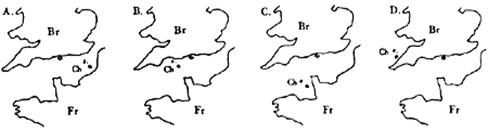
The Channel Islands are a group of British-owned islands lying in the English Channel, 10 to 30 miles off the French coast, and 70 to 90 miles from the English coast. There are ten islands with a total land area of 75 square miles and a total population of 123,000. The three largest islands, Jersey, Guernsey, and Alderney, have long been known for the fine breeds (品种) of cattle that are raised on them and named after them.
In earliest known history the islands were considered part of Normandy, which was part of France, but the ruler of Normandy became king of England in 1066, and from then on the islands were looked upon as British land. English control was unbroken until World War II, when the Germans held the islands for five years.
Although people on the islands speak both languages and they are considered English, their customs are more French than English.
1.Which of the following maps gives the right position of the Channel Islands?
Br = Britain Fr = France Ch = Channel Islands
2.Jersey, Guernsey, and Alderney breeds of cattle are __________.
A. considered best in England
B. named after their birthplaces
C. brought to the islands by the Germans
D. raised on well-known farms by the French
3. The Channel Islands have been continuously under British rule since__________.
A. earliest known history B. 1066
C. 1930s D. the end of World War II
4.Why do people on the Channel Islands follow French way of living?
A. Their islands used to be part of France.
B. Their islands are often visited by the French.
C. They came from France.
D. They speak French.
C
Tokyo is one of those places that you can love and hate at the same time.
In Tokyo there are always too many people in the places where I want to be. Of course there are too many cars. The Japanese drive very fast, but in Tokyo they often spend a long time in traffic jams(拥挤).Tokyo is not different from London, Paris and New York in that. It is different when one wants to walk.
At certain times of the day there are a lot of people on foot in London’s Oxford Street. But the streets near the Ginza in Tokyo always have a lot of people on foot, and sometimes it is really difficult to walk. People are very polite; there are just too many of them.
The worst time to be in the street is at 11:30 at night. That is when the night-clubs are closing and everybody wants to go home. There are 35 000 night-clubs in Tokyo, and you do not often see one that is empty.
During the day, most people travel to and from work by train. Tokyo people buy six million train tickets every day. At most stations, trains arrive every two or three minutes but at certain hours there do not seem to be enough trains. Although they are usually crowded, Japanese trains are very good. They always leave and arrive on time. On a London train you would see everybody reading a newspaper. In Tokyo trains everybody in a seat seems to be asleep, whether his journey is long or short.
In Tokyo, I stood outside the station for five minutes. Three fire-engines(消防车) race past on the way to one of the many fires that Tokyo has every day .Tokyo has so many surprises that none of them can really surprise me now.
48.Tokyo is different from London in that___________.
A. it has a larger population
B. there are more traffic jams
C. it is more difficult to go somewhere on foot
D. night clubs are sometimes empty
49.Japanese trains _____________.
A. often leave and arrive on time
B. are often crowded
C. are the main means(手段,方法) people use to travel to and from work
D. all of the above
50.Where can you find everybody reading a newspaper? _____________.
A. At most London train stations B. At most Tokyo train stations
C. On a Tokyo train D. On a London train
51.Fires break out _______ in Tokyo according to the writer.
A. quite frequently (频繁) B. only several times a day
C. not very often D. very seldom
52.Which of the following is NOT true about Tokyo? ___________.
A. The streets become more crowded at 11:30 at night
B. There are more trains than cars
C. Fire-engines are very busy in the city
D. Tokyo people are polite
湖北省互联网违法和不良信息举报平台 | 网上有害信息举报专区 | 电信诈骗举报专区 | 涉历史虚无主义有害信息举报专区 | 涉企侵权举报专区
违法和不良信息举报电话:027-86699610 举报邮箱:58377363@163.com