
题目列表(包括答案和解析)
Tokyo, the capital of Japan, is one of the largest cities in the world. It is also one of the world’s most modern cities. Twice last century, the city was destroyed and rebuilt. In 1923 a major earthquake struck the city. Thousands of people were killed and millions were left homeless as buildings collapsed and fires broke out throughout Tokyo. It took seven years to rebuild the city. During World War II, Tokyo was destroyed once again. As a result of these disasters, there is nothing of old Tokyo remaining in the downtown area.
After the war, the people of Tokyo began to rebuild their city. Buildings went up at a fantastic rate, and between1945 and 1960, the city’s population more than doubled. Because of the Olympic Games held in Tokyo in 1964, many new stadiums, parks and hotels were built to treat visitors from all over the world. As a result of this rapid development, however, many problems have risen. Housing shortage, pollution, and waste disposal(处理) have presented serious challenges to the city, but the government has begun several programs to answer them.
【小题1】What kind of city is Tokyo?
A historic city. B. A world famous seaport.
C. A highly modernized city. D. A most attractive (有吸引力的) city for tourists.
【小题2】What major(主要的) event(s) happened in Tokyo last century?
| A.Its population was doubled. |
| B.It was twice destroyed by natural disasters and was twice rebuilt. |
| C.Serious social problems emerged.(出现) |
| D.It was ruined by an earthquake and a war, but was twice rebuilt. |
| A.Housing shortage. | B.Waste disposal. |
| C.Heavy traffic. | D.Pollution. |
| A.A severe (严重) earthquake and the Second World War. |
| B.The foreign occupation (占领) after the war. |
| C.The population explosion between 1945 and 1960. |
| D.The rapid development of the city after the war. |
Everyone heard of the San Andreas fault(断层),which constantly threatens California and the West Coast with earthquakes.But how many people know about the equally serious New Madrid fault in Missouri?
Between December of 1811 and February of 1812,three major earthquakes occurred,and all centered around the town of New Madrid, Missouri, on the Mississippi River.Property damage was severe.Buildings in the area were almost destroyed.Whole forests fell at once,and huge cracks opened in the ground,releasing some strong smell of chemicals.
The Mississippi River itself completely changed character,developing sudden rapids and whirlpools(急流和旋涡).Several times it changed its course,once according some observers, it actually appeared to run backwards.Few people were killed in the New Madrid earthquakes, probably simply because few people lived in the area in 1811:but the severity of the earthquakes were shown by the fact the shock waves rang bells in church towers in Charleston,South Carolina,on the coast.Buildings shook in New York City,and clocks were stopped in Washington D.C.
Scientists now know that America’s two major faults are essentially different.The San Andreas is a horizontal(水平的) boundary between two major land masses that are slowly moving in opposite directions.California earthquakes result when the two masses make a sudden move.
The New Madrid fault,on the other hand,is a vertical(垂直的)fault; at some point, possibly hundreds of millions of years ago,rock was pushed up toward the surface.Suddenly,the volcanoes cooled and the rock collapsed,leaving huge cracks.Even now, the rock continues to settle downwards,and sudden sinking motion causes earthquakes in the region.The fault itself, a large crack in this layer of rock, with dozens of other cracks that split off from it, extends from northeast Arkansas through Missouri and into southern Illinois.
Scientists who have studied the New Madrid fault say there have been numerous smaller quakes in the area since 1811;these smaller quakes indicate that larger ones are probably coming, but the scientists say they have no method of predicting when a large earthquake will occur.
1.This passage is mainly about_____.
A.the New Madrid fault B.the San Andreas
C.the causes of fault D.current scientific knowledge about faults
2.Which of the following pictures best describes the type of the New Madrid fault?

A. B. C. D.
3.This passage implies that _____.
A.horizontal faults are more dangerous than vertical faults
B.vertical faults are more dangerous than horizontal faults
C.a lot of people would die if the 1811 New Madrid earthquakes happened today
D.the volcanoes that caused the New Madrid fault are still alive.
Everyone has heard of the San Andreas fault (断层), which constantly threatens California and the West Coast with earthquakes. But how many people know about the equally serious New Madrid fault in Missouri?
Between December of 1811 and February of 1812, three major earthquakes occurred, all centered around the town of New Madrid, Missouri, on the Mississippi River. Property damage was severe. Buildings in the area were almost destroyed. Whole forests fell at once, and huge cracks opened in the ground, releasing some strong smell chemicals.
The Mississippi River itself completely changed character, developing sudden rapids and whirlpools (激流和漩涡). Several times it changed its course, and once, according to some observers, it actually appeared to run backwards. Few people were killed in the New Marid earthquakes, probably simply because few people lived in the area in 1811; but the severity of the earthquakes are shown by the fact that the shock waves rang bells in church towers in Charleston, South Carolina, on the coast. Buildings shook in New York City, and clocks were stopped in Washington, D.C.
Scientists now know that America's two major faults are essentially different. The San Andreas is a horizontal boundary between two major land masses that are slowly moving in opposite directions. California earthquakes result when the two masses make a sudden move.
The New Madrid fault, on the other hand, is a vertical fault; at some points, possibly hundreds of millions of years ago, rock was pushed up toward the surface, probably by volcanoes under the surface. Suddenly, the volcanoes cooled and the rock collapsed, leaving huge cracks. Even now, the rock continues to settle downwards, and sudden sinking motions cause earthquakes in the region. The fault itself, a large crack in this layer of rock, with dozens of other cracks that split off from it, extends from northeast Arkansas through Missouri and into southern Illinois.
Scientists who have studied the New Madrid fault say there have been numerous smaller quakes in the area since 1811; these smaller quakes indicate that larger ones are probably coming, but the scientists say they have no method of predicting when a large earthquake will occur.
1.This passage is mainly about ___________.
A. current scientific knowledge about faults
B. the San Andreas and the New Madrid faults
C. the causes of faults
D. the New Madrid fault in Missouri
2.The New Madrid fault is __________.
A. a vertical fault
B. a horizontal fault
C. a more serious fault than the San Andreas fault
D. responsible for forming the Mississippi River
3.This passage implies that _________. .
A. horizontal faults are more dangerous than vertical faults
B. Vertical faults are more dangerous than horizontal faults
C. The volcanoes that caused the New Madrid fault are still alive
D. A lot of people would die if the 1811 New Madrid earthquakes happened today
Everyone has heard of the San Andreas fault (断层), which constantly threatens California and the West Coast with earthquakes.But how many people know about the equally serious New Madrid fault in Missouri?
Between December of 1811 and February of 1812, three major earthquakes occurred, all centered around the town of New Madrid, Missouri, on the Mississippi River.Property damage was severe.Buildings in the area were almost destroyed.Whole forests fell at once, and huge cracks opened in the ground, releasing some strong smell chemicals.
The Mississippi River itself completely changed character, developing sudden rapids and whirlpools (激流和旋涡). Several times it changed its course, and once, according to some observers, it actually appeared to run backwards.Few people were killed in the New Madrid earthquakes, probably simply because few people lived in the area in 1811 ; but the severity of the earthquakes is shown by the fact that the shock waves rang bells in church towers in Charleston, South Carolina, on the coast.Buildings shook in New York City, and clocks were stopped in Washington, D.C.
Scientists now know that America' s two major faults are essentially different.The San Andreas is a horizontal (水平的)boundary between two major land masses that are slowly moving in opposite directions.California earthquakes result when the two masses make a suddenly move.
The New Madrid fault, on the other hand, is a vertical fault; at some point, possibly hundreds of millions of years ago, rock was pushed up toward the surface, probably by volcanoes under the surface.Suddenly, the volcanoes cooled and the rock collapsed, leaving huge cracks.
Even now, the rock continues to settle downwards, and sudden sinking motions cause earthquakes in the region.The fault itself, a large crack in this layer of rock, with dozens of other cracks that split off from it, extends from northeast Arkansas through Missouri and into southern Illinois.
Scientists who have studied the New Madrid fault say there have been lots of smaller quakes in the area since 1811; these smaller quakes indicate that larger ones are probably coming, but the scientists say they have no method of predicting when a large earthquake will occur.
1.This passage is mainly about _____.
A.the New Madrid fault B.the San Andreas
C.the causes of faults D.current scientific knowledge about faults
2.Which of the following pictures best describes the type of the New Madrid fault?
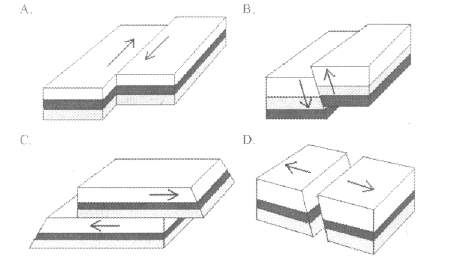
3.This passage implies that ______.
A.horizontal faults are more dangerous than vertical faults
B.vertical faults are more dangerous than horizontal faults
C.more people would die if the 1811 New Madrid earthquakes happened today
D.the volcanoes that caused the New Madrid fault are still alive.
4.The underlined word "vertical" most probably means ______.
A.moving straight up B.terribly changing
C.breaking suddenly D.extending largely
湖北省互联网违法和不良信息举报平台 | 网上有害信息举报专区 | 电信诈骗举报专区 | 涉历史虚无主义有害信息举报专区 | 涉企侵权举报专区
违法和不良信息举报电话:027-86699610 举报邮箱:58377363@163.com