|
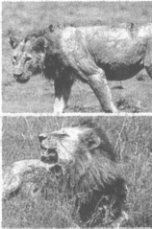
The male lion’s splendid mane(鬃毛)sets him apart from other cats-and it’s great attraction for the ladies-so why would he do without it? That question has puzzled scientists since 1833, when the first reports of“maneless”lions streamed in from around the world.Now.a research team reports that lions from the Tsavo region of Kenya deliberately delay mane growth to fit in with the region’s harsh temperatures.
John Patterson.a hunter and a British Colone1.Was one of the first to document manelessness in Tsavo’s famous man-eaters.Ever since.naturalists have developed more evolutionary descriptions.Some researchers suggested that lions lost their manes because they were caught too many times in Tsavo’s thorn bushes everywhere.Others argued that Tsavo’s aggressive lions have unusually high testosterone(雄激素)levels, known to cause male pattern baldness(秃顶)in humans Still others supposed that Tsavo’s lions were a distinct group of were related to a lion pictured in prehistoric caves,which no longer existed.
But expert Thomas Gnoske at the Field Museum in Chicago, Illinois, considered something these researchers didn’t:lion shipped to zoos in cooler climates grow longer manes.This made him wonder whether hot temperatures account for Tsavo’s thinning lions.To find out.Gnoske and his colleagues studied museum records and conducted 10 year of fieldwork in Tsavo and in the Serengeti.which is about l0 degrees cooler.In an article published online this month in the Jourmal of Zoology.the team reports that lions in the Serengeti grow a full mane in 5 years-by the time they’re ready to be parents-but that Tsavo’lions don’t have much of mane until age 8.well past their reproductive period.
Gnoske thinks smaller manes improve a young, energetic lion’s ability to keep cool.Bushy manes probably evolved to attract females in cooler climates where heat stress was not an issue, Gnoske says, and lions can’t just turn off that program, though they’re in a place like Tsavo.“They’re hard-wired to grow a mane;period, and they’ll develop as large of a mame as they possibly can.”
Scientist Roland Kays of the New York State Museum in Albany says he is surprised by the delay in mane development.However, he expresses concern about the accuracy of using field observations to judge the age of Tsavo’lions.Gnoske says his team is now focusing its research On Tsavo lions with known birth dates, but it will be a challenge to keep track of the wide-ranging animals, especially since radio collars are prohibited in Tsavo’s national parks.
| 