
题目列表(包括答案和解析)
A
Pronouncing words of a language is a skill. Every normal person is expert in the skill of pronouncing their own language; but few people are ever skilled at pronouncing foreign languages. Now there are many reasons for this, some obvious, some perhaps not so obvious. But I suggest that the reason why people in general do not speak foreign languages much better than they do their own language is that they fail to grasp the true nature of the problem of learning to pronounce, and never set about solving it in the right way. Far too many people fail to realize that pronouncing a foreign language is a skill-one that needs careful training of a special kind, and one that cannot be gained by just leaving it to take care of itself. I think even teachers of language, while recognizing the importance of a good accent, tend to neglect(忽略), in their practical teaching, the branch of study which has something to do with speaking the language. So the first point I want to make is that English pronunciation must be taught. The teacher should be prepared to devote some of the lesson time to this, and by his whole attitude(态度)to the subject should get the student to feel that here is a matter worthy of receiving close attention, thus when other aspects(方面)of English, such as grammar or spelling, are allowed for the moment, to take second place, there is something else.
Except for the question of time given to pronunciation, there are two other requirements for the teacher: the first, knowledge; the second, technique.
1. Why don't people speak a foreign language better than they speak they native language?
A. Because they can't grasp the nature of the problem of learning to pronounce.
B. Because they think pronouncing a foreign language is a impossible.
C. Because they never solve the problem in any way.
D. Because they pay more attention to pronunciation than anything else.
2. What is the passage mainly about?
A. Grammar should be paid no attention to.
B. Pronunciation is the most important aspect in learning a foreign language.
C. Spelling should not be taught in class.
D. Knowledge and technique are unnecessary in learning a foreign language.
B
How do apology languages work? Have you ever tried to apologize, only to be refused? It may be that you were offering a partial apology in a “language”, that was foreign to your listener. The five languages of apology include:
Apology Language 1: “I am sorry.”
List the hurtful effects of your action. Not “I am sorry if …”, but “I am sorry that…”. You might ask if they want to add any points that you have not recognized.
Apology Language 2:“I was wrong.”
Name your mistake and accept fault. Note that it is easier to say “You are right” than “ I am wrong”, but the latter carries more weight.
Apology Language 3: “What can I do to make it right?”
How are you now? How shall I make amends(弥补) to you? How can I restore your confidence that I love you— even though I was so hurtful to you?
Apology Language 4: “I’ll try not to do that again.”
Engage in problem-solving. Don’t make excuses for yourself such as, “Well, my day was just so…” Instead, offer what you will change to prevent yourself from putting them in the same bad situation again.
Apology Language 5: “Will you please forgive me?”
Be patient in seeking forgiveness. They may need some time or greater clarification(澄清) of your input from Apology Languages 1-4.
Finally, your apology may not be accepted, but at least you know that you have been faithful in offering a sincere olive branch(橄榄枝) of peace.
1.The passage mainly talks about___________
A.5 tips for apologies that work B.5 ways of refusing apologies
C.the function of apology languages D.the importance of apology languages
2.According to Paragraph 1, your apology may be refused mainly because________
A.your listeners can’t understand your dialect.
B.your listeners can’t hear what you said clearly.
C.your apology is not sincere.
D.your apology is not expressed well enough.
3.When offering an apology, which of the following does the author prefer?
A.“You are right” B.“I am sorry if …”
C.“I was wrong.” D.“Well, my day was just so…”
4.In the last paragraph, the author tells us even if your apology may not be accepted, at least ___________.
A.It’s your fault any more B.your mind will be at peace
C.your friend will make peace with you. D.your apology is true to your heart
C
Have you ever been afraid to talk back when you were treated unfairly? Have you ever bought something just because the salesman talked you into it? Many people are afraid to support themselves. Dr. Robert Albert, author of Stand Up, Speak Out, and Talk Back,thinks it’s because their self-respect is low. “There s always a ‘superior’ (长辈) around ˉa parent, a teacher, a boss—— who knows better.” But Albert and other scientists are doing something to help people help themselves. They offer “assertiveness(维护) training” courses——A.T. for short. In the A. T. Course people learn that they have a right to be themselves. They learn to speak out and feel good about doing so. They learn to be aggressive (进攻的) without hurting other people. In one way, learning to speak out is to get rid of fear. A group taking an A. T. Course will help the timid (懦弱的) person to lose his fear. But A. T. uses an even stronger motive (动机)——the need to share. The timid person speaks out in the group because he wants to tell how he feels. Whether or not you speak up for yourself depends on your self-respect. If someone you face is more “important” than you, you may feel less of a person. You start to doubt your answers to problems. You can get to feel good about yourself. And once you do you can learn to speak out.
1. The problem the writer talks about is that…
A. some people buy things they don t want
B. some people are afraid to speak out for their rights
C. there are too many superiors
D. some people don t think enough of themselves
2.The cause of the problem talked about in this passage is that .
A. some people have a low self-respect
B. there is always someone around who “knows better”
C. salesmen talk people into buying things they don’t want
D. people don t share enough
3. The A.T. Course often
A. make people distrust their own answers
B. make things more favorable for “superiors”
C. help people know as much as their “superiors”
D. help people become more important
4.One thing the A . T. Course don t do is to .
A. share the need of people
B. show they have a right to be themselves
C. help people overcome fear
D. help people to help themselves even if others suffer
5.A good title for this passage could be .
A. The Need to Share
B. Talk Back When Necessary
C. One Way to Build Self-Respect
D. One Way to Train Speaking Ability
Ever since I was little I loved doing things for other people. As I got older I began doing random ( 随意的 ) things for people. For example, during holidays, such as Christmas, I would make an extra 21 along with the ones for my relatives. Then I would go and find someone in the grocery store and just hand it to them and walk away. It was so much fun. I admit, 22 , the first time I did it I was so 23 . I didn’t know who to give the card to. So I said a little prayer and knew that the 24 person would just appear. About that time an elderly man ran 25 me with his shopping cart. It was an accident, and he 26 a million times. We smiled and he walked away, and I knew that he was the one. Later I found him in a different isle(过道), handed him the card, and smiled. I said Happy Holidays, and then walked away. It was so great, and the 27 I had afterwards was unexplainable.
Then one day I came across your website (the coolest website ever) and 28 some Smile Cards. When they came in, I started a new project. When I go into a store, I locate a person who I think needs a 29 . Then, I buy a flower, a carnation, to be exact, and 30 it in the most beautiful paper they have. I tie lots of ribbons on it to make it 31 , and then slip the smile card into an envelope and 32 it to the flower. After that, I pay for it and explain to the cashier 33 it is to go to (I live in a pretty small town so it’s easy to get the help of the cashiers). They then give it to that person when they come through.. Once in a while I’ll buy the flower and then just leave it for the cashier. That gets smiles.
My favorite time was when I picked out this elderly woman who was walking around the 34 somewhat confused. I had come across her numerous times and she only smiled slightly once. When she came to the check out (I was watching from outside) her face 35 and the smile was the biggest I had ever seen. Later that week the cashier whom I had had 36 me told me that the lady had been so surprised and while she was walking out with the grocery bag to her car, she was planning what she was going to do for someone else. It was awesome.
I absolutely love the random acts of kindness cards. I 37 at least two in my purse and others in my car, locker and everywhere I go. As I mentioned, my club, STARS, is doing a Random Acts of Kindness Project with the smile cards so they also are using them. I look forward to hearing about their success. It’s really great. I 38 used them in school. I bought my entire math class cans of pop after lunch one day. They came in from lunch and a can of pop and a smile card were setting 39 that day. It totally lightened the mood in the class that day 40 we were studying for a test. Thank you for all of the help that you provide. The smile cards are a great program that brings smiles into the lives of many!
|
1. |
|
|
2. |
|
|
3. |
|
|
4. |
|
|
5. |
|
|
6. |
|
|
7. |
|
|
8. |
|
|
9. |
|
|
10. |
|
|
11. |
|
|
12. |
|
|
13. |
|
|
14. |
|
|
15. |
|
|
16. |
|
|
17. |
|
|
18. |
|
|
19. |
|
|
20. |
|
A Good Custodian
I know a woman who tries hard to be a good custodian.
I pass her every day after school as she pushes her cart down my
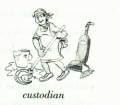 hallway.Of course, she is my building's cleaner,
One Tuesday morning I came into school and saw a 36 on my
desk from my custodian,
It seemed that some unbearable first year students had damaged the bathroom in a particularly disgusting way and she had been 37 to clean it.This took 38 than she had expected. She had left the typewritten note on my desk to 39 for not being able to clean my room as she was 40 to do.
At the beginning of the period, I shared her note with my first period 41 When I mentioned that our custodian had apologized to us, their first 42 was to volunteer to seek out and beat up those first year students for making our custodian have to clean up their 43 . It turned out that just about all of my students also knew our custodian by name -all of them responded with smiles and 44 for a long time about this time or that time when she'd 45 each of them in the hallway.That she felt she needed to apologize 46 a strong reaction from many of the kids.
As the class period was about to end, I asked them to 47 the floor like I do every period and thanked them for picking up any garbage 48 it wasn't theirs.My entire class disappeared; they each disappeared instantly 49 their desks to pick up those annoying tiny pieces of paper that 50 so easily from notebooks.One girl made a (an) 51 that I later used with my other classes:" Her job might be to clean the room, but she shouldn't have to clean up 52 us.There's a difference.”
I believe that people know the difference between right and wrong.I believe that people appreciate it when others 53 take care of them.And I believe that people, even adolescents who are not quite yet mature, appreciate it when they see someone who takes 54 in her work. Sometimes we need a 55 of the things we take for granted ...things like a good custodian to take care of us.
36.A.paper B.handbook C.note D.letter
37.A.advised B.persuaded C.allowed D.charged
38.A.shorter B.longer C.mare D.less
39.A.apologize B.regret C.appeal D.complain
40.A.recommended B.believed C.approved D.scheduled
41.A.class B.colleagues C.staff D.members
42.A.answer B.reaction, C.decision D.behavior
43.A.room B.desks C.mess D.chaos
44.A.talked B.asked C.quarreled D.discussed
45.A.visited B.called C.praised D.greeted
46.A.made B.showed C.earned D.accepted
47.A.sweep B.examine C.check D.mop
48.A.even if B.only if C.if only D.if ever
49.A.above B.under C.beyond D.across
50.A.leave B.fall C.fly D.miss
51.A.promise B.agreement C.announcement D.comment
52.A.after B.before C.with D.for
53.A.freely B.gently C.hopefully D.sincerely
54.A.advantage B.pride C.action D.chance
55.A.keeper B.caretaker C.reminder D.observer
湖北省互联网违法和不良信息举报平台 | 网上有害信息举报专区 | 电信诈骗举报专区 | 涉历史虚无主义有害信息举报专区 | 涉企侵权举报专区
违法和不良信息举报电话:027-86699610 举报邮箱:58377363@163.com