
题目列表(包括答案和解析)
阅读理解
All over the world mothers and fathers teach their children manners. There are all kinds of manners. Other children may have manners that are not like yours.
Sometimes good manners in one place are bad manners in other places.
If you visit some friends in Mongolia and they ask you to eat with them. What kind of manners do they want you to have? They want you to give a loud “belch” after you finish eating. Belching world show that you like your food. But in some other countries, if you give a loud “belch”, you are told to say “Excuse me, please.”
In many places people like to eat together. But in some parts of Polynesia it is bad manners to be seen eating at all. People show their good manners by turning their backs on others while they eat.
What are manners like in an East African town? The people try not to see you. When you are visiting a friend, he may not see you at all. If you are polite, you will sit down beside him. You will wait until he finishes what he is doing. Then he will talk to you.
If you visit a friend in Arabia you should walk behind other tents until you come to his tent. If you pass in front of other tents, you will be asked into each one. The people will ask yon to eat with them. And it is bad manners if you say no.
Manners are different all over the world. But it is good to know that all manners began in the same way. People need ways to show that they want to be friends.
(1)What's the main idea of this passage?
[ ]
A. Manners are different throughout the world.
B. Mothers are different throughout the world.
C. Children's manners are different.
D. When you are in Rome, do as the Romans do.
(2)In some other countries in the world, if you belch after a meal,________.
[ ]
A. you show that you like the food very much
B. it is good manners for you to say “Excuse me, please”
C. you ask the host to say “Excuse”instead of you
D. you are telling the host you dislike the food
(3)What's the polite way of eating if you are living in Polynesia?
[ ]
A. Eating outside together with your family.
B. Eating while sitting face to face.
C. Eating at the back of your house.
D. Trying not to make yourself seen eating.
(4)What will an Arabian do if he sees a person walking in front of his tent?
[ ]
A. He will feel very angry and drive the person off.
B. He will politely ask where the person is going and act as a guide.
C. He will ask the person to eat with him.
D. He will give the person some food to show his pity.
(5)Which of the following statements is true according to the passage?
[ ]
A. People show they are friendly in different manners.
B. Good manners are the same in different countries.
C. In the East African town the people who try not to see you are not polite at all.
D. Different manners in different countries show people's different ideas.
Reading Comprehension
Section B
Directions:Read the following passages. Each passage is followed by several questions or unfinished statements. For each of them there are four choices marked A, B, C and D. Choose the one that fits best according to the information given in the passage you have just read.
Are organically grown foods the best food choices?The advantages claimed for such foods over conventionally (传统地) grown and marketed food products are now being debated. Supporters of organic foods—a term whose meaning varies greatly—frequently announce that such products are safer and more nutritious than others.
The growing interest of consumers in the safety and nutritional quality of the typical North American diet is a welcome development. However, much of this interest has been sparked by sweeping claims that the food supply is unsafe or inadequate in meeting nutritional needs. Although most of these claims are not supported by scientific evidence, the flood of written material advancing such claims makes it difficult for the general public to separate fact from fiction. As a result, claims that eating a diet consisting entirely of organically grown foods prevents or cures disease or provides other benefits to health have become widely publicized.
Almost daily the public is besieged by claims for “no-aging” diets, new vitamins and other wonder foods. There are numerous unproved reports that natural vitamins are superior to synthetic ones, that fertilized eggs are nutritionally superior to unfertilized eggs, that untreated grains are better than fumigated grains and the like.
One thing that most organically grown food products seem to have in common is that they cost more than conventionally grown foods. But in many cases consumers are misled if they believe organic foods can maintain health and provide better nutritional quality than conventionally grown foods. So there is real cause for concern if consumers,particularly those with limited incomes, distrust the regular food supply and buy only expensive organic foods instead.
1.The “welcome development” mentioned in paragraph 2 is an increase in ______.
A. attention to food safety and nutrition among north Americans
B. the nutritional quality of the typical North American diet
C. the amount of healthy food grown in North America
D. the number of consumers in North America
2. The author implies that there is cause for concern if consumers buy organic foods instead of conventionally grown foods because ______.
A. organic foods can be more expensive but are often not better than conventionally grown foods
B. many organic foods are actually less nutritious than similar conventionally grown foods
C. conventionally grown foods are more readily available than organic foods
D. too many farmers will stop using conventional methods to grow food crops
3.What is the author’s attitude toward the claims made by advocates of health foods?
A. Enthusiastic. B. Favorable. C. Neutral. D. Distrustful.
In general, people talk about two groups of colors: warm colors and cool colors. Researchers in psychology think that there are also two groups of people: people who prefer warm colors and people who prefer cool colors.
The warm colors are red, orange and yellow. Where there are warm colors and a lot of light, people usually want to be active. People think that red, for example, is exciting. Sociable people, those who like to be with others, like red. The cool colors are green, blue and violet. These colors, unlike warm colors, are relaxing. Where there are cool colors, people are usually quiet. People who like to spend time alone often prefer blue.
Red may be exciting, but one researcher says that time seems to pass more slowly in a room with warm colors than in a room with cool colors. He suggests that a warm color, such as red or orange is a good color for a living room or restaurant. People who are relaxing or eating do not want time to pass quickly. Cool colors are better for offices or factories if the people who are working there want time to pass quickly.
Researchers do not know why people think some colors are warm and other colors are cool. How ever, almost everyone agrees that red, orange, and yellow are warm and that green, blue, and violet are cool. Perhaps warm colors remind people of warm days and the cool colors remind them of cool days. Because in the north the sun is higher during summer, the hot summer sunlight appears yellow.
Which of the following colors belong to cool colors?
A.Yellow, green. B.Blue, violet.
C.Black, blue. D.Brown, white.
Which of the following statements is not true?
A.Sociable people like warm colors.
B.Warm colors can make people excited.
C.People who like to be with others don't like red.
D.Where there are warm colors, people want to be active.
Which is the right color for different rooms?
A.Red or orange for offices. B.Orange for dining-rooms.
C.Blue for bedrooms. D.Red for studies.
What is the main idea of the last paragraph?
A.It shows the reason why people think some colors are warm and others are cool.
B. Warm colors remind people of warm days.
C.Cool colors remind people of cool days.
D.People have an agreeable opinion of warm colors and cool colors.
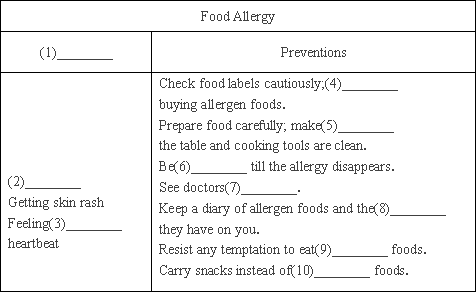
请认真阅读下列短文,并根据所读内容填入最恰当的单词。注意:每空只填一个单词。
Have you ever started sneezing when eating peanuts, getting rash on your skin or feeling your heat starting to beat faster? Statistics show that around 12 million Americans suffer from food allergy, with 6.9 million allergic to seafood and 3.3 million allergic to peanuts or tree nuts.
Food allergic symptoms occur immediately after having an allergen food.The food is treated as harmful to the body, by the immune system, which defends our organism from harmful external attacks.Here are a few guidelines about things you should know and how to put them into practice to prevent food allergies and eat healthily.
When buying food, read attentively the labels on the food products.All manufacturers according to the new Food Allergen and Consumer Act must clearly list all the elements of the product including the 8 food allergens even if they are present in very small amounts.Don’t buy these products, even if they might be cheaper.
Parents should be very careful when preparing food.The table and cooking tools used need to be clean.It is recommended to cook the food of the allergic person in the first place.
Food allergic persons should have a little patience.In certain people, the allergy disappears gradually.Visit your doctor at regular times to find about the progress of your allergies instead of having strict diets every day.
Keep a diary to note the foods that worsen your food allergies, new experiences and changes that you notice.Being tempted to have a piece of cake can be very dangerous.Your health is much more worth than it.Always think about the efforts people around you are putting to create an allergic-free environment for you.
Allergic persons should avoid consuming cakes that are not homemade and should always carry some snacks on them.Buying food in restaurants is risky.
There is a poster below. Read it carefully.
VISIT SWANSEA ZOO!
Come and see the African elephants and the new tigers from India. The Arctic bears are waiting to meet you, and the monkeys from Zaire are waiting to throw things at you. The hyenas (a flesh-eating animal, like a wolf, with a howl that sounds like wild laughter) from Tanzania are waiting to laugh at you, and the giraffes from Zambia are waiting to look down on you.
Tickets
Adult: $1.20
Children: Over 12: 80 cent
Under 12 : Free
Opening Time: 9: 00a. m. ~4: 00p. m.
Except Fridays: 10: 00a. m. ~3: 00p. m.
KEEP THE ZOO CLEAN!
DO NOT FEED,TOUCH OR GO NEAR THE ANIMALS!
【小题1】If you want to visit the Swansea Zoo, what is the best time to go there?
| A.4:00 p. m on Sunday. | B.4:00 p. m on Friday. |
| C.9:00 a. m on Friday. | D.9:30 a. m on Sunday. |
| A.$3.60 | B.$2.00 | C.$2.60 | D.$2.40 |
| A.To give an orange to a monkey. | |
| B.To pat a tiger on the head. | C.To go near a hyena. |
| D.To sing a song if you like. |
| A.fat | B.small | C.strong | D.tall |
| A.grass-eating | B.fruit-eating | C.meat-eating | D.earth-eating |
湖北省互联网违法和不良信息举报平台 | 网上有害信息举报专区 | 电信诈骗举报专区 | 涉历史虚无主义有害信息举报专区 | 涉企侵权举报专区
违法和不良信息举报电话:027-86699610 举报邮箱:58377363@163.com