
题目列表(包括答案和解析)
阅读下列短文, 从所给的四个选项中, 选出最佳答案。
When a group of people work together to reach the same goal, they make up a team. Teamwork is very important as men try to learn more about the world in which we live.
In 1957, a team of eighteen men from the United States spent the winter at the South Pole. They were there to study the secrets of the earth and the sky.
The South Pole is at the bottom of the world. During its winter, the sun never rises. The men had to face the darkness of a six-month night, as well as the world's worst weather.
The men lived in a group of buildings joined together by tunnels. They were cut off from the rest of the world. During the long winter, they could not be reached even by plane.
The men depended on one another for company. They also shared certain tasks. Everyone took turns working in the "snow mine". This was a giant cave dug into the ice beneath their camp. There, they dug out clean snow needed as a water supply.
Each man also had his own important job to do. There was a cook and a doctor. There were scientists and men who were trained in other jobs. Working together they proved that men can live and work at the South Pole.
1. This story is about _________ .
[ ]
A. training cooks at the South Pole
B. living and working together at the South Pole
C. finding work for people who live at the South Pole
D. digging into the ice beneath the camp
2. The men lived in a group of buildings ______ .
[ ]
A. surrounded by caves
B. buried under snow
C. in their snow mine
D. joined by tunnels
3. The reason why the men went to the South Pole was _______ .
[ ]
A. to study the secrets of the earth and the sky
B. to live in a cold place
C. to see the world's worst weather
D. to work there
4. The story does not say so, but it makes you think that _______ .
[ ]
A. most men like living at the South Pole
B. people living at the South Pole cannot work together
C. people living at the South Pole can work together
D. the best weather in the world is found at the South Pole
5. The statement the story leads you to believe is _________ .
[ ]
A. what the men learned at the South Pole is important to us
B. the South Pole is the wrong place to go to learn anything
C. nobody is interested in what happens at the South Pole
D. what men learn at the South Pole is not important
完形填空
阅读下面短文,从短文后所给各题的四个选项中选出能填入相应空白处的最佳选项。
New Zealand is an English-speaking country. But the government recognizes 1 language, too. This is the Maori language. The English 2 began to visit New Zealand after 1770. They found a 3 people living there. These were the Maoris, 4 had come from hot island in the Pacific Ocean 400 years before.
For a long time the 5 government was not interested in these faraway islands. It was 6 a British colony. As a 7 , more and more British settlers came.
The Maoris were 8 to the first settlers. But soon the new settlers wanted 9 land. So in 1844 there was fighting 10 them. This was the first of several wars between the two 11 . The next fifty years were very bad for the Maoris. Many were 12 in the wars. Many more died from new diseases 13 by the British. In 1840 there were perhaps 200,000 Maoris. By 1859 this number had 14 to 42,000.
However, this century the two peoples have lived in 15 . For many years the“British”New Zealanders looked 16 upon the Maoris. 17 in recent years, they have had equal 18 , and the Maori language is one of the languages of the country with 19 . Today there are about a quarter of a million Maoris, that is, about 9% of the 20 .
1.
[ ]
A.others B.this
C.another D.other
2.
[ ]
A.searchers B.pilots
C.drivers D.sailors
3.
[ ]
A.dark-skinned B.yellow-skinned
C.short-lagged D.white-haired
4.
[ ]
A.which B.they
C.who D.whom
5.
[ ]
A.Maori B.British
C.European D.New Zealand
6.
[ ]
A.rewarded B.awarded
C.called D.made
7.
[ ]
A.rule B.result
C.whole D.ruler
8.
[ ]
A.cruel B.friendly
C.dangerous D.unknown
9.
[ ]
A.their B.its
C.the D.a
10.
[ ]
A.among B.of
C.in D.between
11.
[ ]
A.settlers B.persons
C.peoples D.sailors
12.
[ ]
A.killed B.died
C.defended D.wounded
13.
[ ]
A.brought B.given
C.taken D.made
14.
[ ]
A.increased B.fallen
C.improved D.developed
15.
[ ]
A.danger B.trouble
C.peace D.distance
16.
[ ]
A.after B.down
C.for D.forward
17.
[ ]
A.But B.Until
C.So D.Therefore
18.
[ ]
A.income B.rights
C.education D.experience
19.
[ ]
A.English B.Maoris
C.German D.French
20.
[ ]
A.areas B.land
C.population D.settlers
阅读下列短文, 从所给的四个选项中, 选出最佳答案。
Kuwait is a country which is quite small, but which is very rich. It has a population of a little more than a million and it is situated at the north end of the Persian Gulf, between Iraq on the north and Saudi Arabia on the south. This small desert country is one of the world's leading oil producers and it has about 15 percent of the world's known petroleum reserves. Since the discovery of oil in 1938, Kuwait rulers have turned the country into a prosperous welfare state. It has free primary and secondary education, free health care and social services, and the Kuwaitis do not have to pay any personal income tax for those services. The rate of literacy is high and constantly growing. The University of Kuwait was opened in 1966. but many of the Kuwaiti students still study in colleges and universities abroad, at state expense. Kuwait is an Arab country, and about 99 percent of the people who live there are Moslems. But fewer than half of these Moslems are actually citizen of Kuwait. This is because there are many Moslem immigrants (移民) living and working there. The other 1 percent of the population, in other words the non-Moslems, are recent immigrants who were attracted (吸引) by the opportunities to work for the oil companies. There are several thousand Europeans and Americans in Kuwait. Many of them are employed by the oil companies.
(1) Why is Kuwait so rich?
[ ]
A. Because it has fewer people than any other country in the world.
B. Because its education is highly developed.
C. Because there are many immigrants who have brought it science and technology.
D. Because it is rich in oil.
(2) How many years after oil was discovered in Kuwait was the University of Kuwait opened?
[ ]
A. 28 years. B. 29 years. C. 30 years. D. None of the above.
(3) What fraction (分数) of the world's known petroleum reserves does Kuwait have?
[ ]
A. 1/3 B. 1/4 C. 1/10 D. 3/20
(4) How many people are there in Kuwait who are non-Moslems?
[ ]
A. 10,000 or so. 100,000. C. More than 20,000. D. Less than 100,000.
(5) Which of the following maps gives the right position of Kuwait?
[ ]
(Saudi Arabia=S Kuwait=K the Persian Gulf=P)
A.  B.
B. 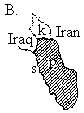
C. 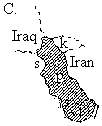 D.
D. 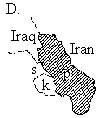
完形填空
Being an English graduate. I know how difficult it is to be as good at English as a native speaker.
It has been more than three years (1) I graduated from university, but dare not stop (2) my English for there is so much I need to learn. I discover new words and idioms every day.
There is a Chinese saying that means (3) there is a will there is a way, and after many years of studying English, I have (4) the best way to improve my English-translation.
When you translate an article you will come (5) words or expressions you don' t know. You can (6) these words up in a dictionary or ask other people. Either of these two methods will (7) an impression and make it easy to memorize the word.
(8) I translate, or act as an interpreter(译员), I always learn some new words and expressions (9) from a dictionary or from foreigners, and I make note of them.
I find I can remember (10) the words I learned during my translation work than (11) I recited from vocabulary books.
I translate anything I am interested in and (12) words that are new to me, such as articles on economics, words and expressions I hear (13) on TV, and even advertisements in magazines.
During last year's football World Cup (14) watching every match, I learned new words and expressions such as“ (15) a goal,”“top-seeded player”and“referee(裁判).”
(16) also improves one's idiomatic English. When you are an interpreter. You sometimes find it difficult to translate English (17) into Chinese but you can learn the English way of expressing the same idea.
There is no short-cut to (18) English. It requires a lot of (19) in reading, listening, speaking and writing. But I have found transitions a (20) tool for improving my English.
(1)
[ ]
A.before B.after
C.since D.when
(2)
[ ]
A.increasing B.improving
C.to improve D.increase
(3)
[ ]
A.why B.how
C.when D.where
(4)
[ ]
A.worked out B.picked out
C.chosen D.worked at
(5)
[ ]
A.up B.across
C.down D.over
(6)
[ ]
A.watch B.see
C.look D.search
(7)
[ ]
A.live B.remain
C.stay D.leave
(8)
[ ]
A.Whenever B.However
C.Wherever D.Whoever
(9)
[ ]
A.neither B.either
C.not only D.both
(10)
[ ]
A.good B.fast
C.firm D.better
(11)
[ ]
A.them B.this
C.that D.those
(12)
[ ]
A.get B.type
C.check D.compare
(13)
[ ]
A.used B.appeared
C.published D.printed
(14)
[ ]
A.but B.except
C.beside D.besides
(15)
[ ]
A.double B.score
C.dozen D.play
(16)
[ ]
A.Translation B.Rewriting
C.Speaking D.Typing
(17)
[ ]
A.particularly B.soon
C.generally D.completely
(18)
[ ]
A.learn B.learning
C.learned D.study
(19)
[ ]
A.effort B.ways
C.skills D.strength
(20)
[ ]
A.hopeful B.pleasant
C.careful D.valuable
完形填空
Being an English graduate. I know how difficult it is to be as good at English as a native speaker.
It has been more than three years (1) I graduated from university, but dare not stop (2) my English for there is so much I need to learn. I discover new words and idioms every day.
There is a Chinese saying that means (3) there is a will there is a way, and after many years of studying English, I have (4) the best way to improve my English-translation.
When you translate an article you will come (5) words or expressions you don' t know. You can (6) these words up in a dictionary or ask other people. Either of these two methods will (7) an impression and make it easy to memorize the word.
(8) I translate, or act as an interpreter(译员), I always learn some new words and expressions (9) from a dictionary or from foreigners, and I make note of them.
I find I can remember (10) the words I learned during my translation work than (11) I recited from vocabulary books.
I translate anything I am interested in and (12) words that are new to me, such as articles on economics, words and expressions I hear (13) on TV, and even advertisements in magazines.
During last year's football World Cup (14) watching every match, I learned new words and expressions such as“ (15) a goal,”“top-seeded player”and“referee(裁判).”
(16) also improves one's idiomatic English. When you are an interpreter. You sometimes find it difficult to translate English (17) into Chinese but you can learn the English way of expressing the same idea.
There is no short-cut to (18) English. It requires a lot of (19) in reading, listening, speaking and writing. But I have found transitions a (20) tool for improving my English.
(1)
[ ]
A.before B.after
C.since D.when
(2)
[ ]
A.increasing B.improving
C.to improve D.increase
(3)
[ ]
A.why B.how
C.when D.where
(4)
[ ]
A.worked out B.picked out
C.chosen D.worked at
(5)
[ ]
A.up B.across
C.down D.over
(6)
[ ]
A.watch B.see
C.look D.search
(7)
[ ]
A.live B.remain
C.stay D.leave
(8)
[ ]
A.Whenever B.However
C.Wherever D.Whoever
(9)
[ ]
A.neither B.either
C.not only D.both
(10)
[ ]
A.good B.fast
C.firm D.better
(11)
[ ]
A.them B.this
C.that D.those
(12)
[ ]
A.get B.type
C.check D.compare
(13)
[ ]
A.used B.appeared
C.published D.printed
(14)
[ ]
A.but B.except
C.beside D.besides
(15)
[ ]
A.double B.score
C.dozen D.play
(16)
[ ]
A.Translation B.Rewriting
C.Speaking D.Typing
(17)
[ ]
A.particularly B.soon
C.generally D.completely
(18)
[ ]
A.learn B.learning
C.learned D.study
(19)
[ ]
A.effort B.ways
C.skills D.strength
(20)
[ ]
A.hopeful B.pleasant
C.careful D.valuable
湖北省互联网违法和不良信息举报平台 | 网上有害信息举报专区 | 电信诈骗举报专区 | 涉历史虚无主义有害信息举报专区 | 涉企侵权举报专区
违法和不良信息举报电话:027-86699610 举报邮箱:58377363@163.com