
题目列表(包括答案和解析)
根据下列各句句意和空白之后的汉语提示词,在答题卡上指定区域上写出对应单词的正确形式,每空只写一词。
66. He was curious (好奇) to know what was happening in the office.
67. There is much work to do, so we’ll have to divide (分) it between us.
68. His nose ran , he coughed, and his temperature (体温) was a little up.
69. The twelfth (第十二) man in a football team will play if one of the other players is ill.
70. It’s no use regretting (后悔) what you have done.
71. The acceptance of new members is strictly (严格) controlled.
72. When building materials (材料) cost more. the price of houses increases.
73. Leave your key with a neighbor(u)r (邻居) in case you lock yourself out one day.
74. The idea started in Standlake and has spread (传开) throughout the country.
75. It’s cold today, Please put another blanket (毯子) on the bed.
阅读下面短文,从每小题所给的四个选项中,选出一个最佳答案。
History Of Chinese Tea
World-wide, tea is consumed more than any other liquid except for water. People of all ages have historically enjoyed the infusion from the Camellia Sinensis tree as a beverage as well as for its medicinal properties. Modern research has shown that tea does indeed have many health affecting qualities; and numerous publications extolling (称赞) the benefits of tea have contributed to the tremendous growth in its consumption in the U. S.
Historically, tea's origins date back to around 2700 BC.It is thought to have first been discovered in the mountainous areas of China’s far western Sichuan and Yunnan provinces. It was originally taken as a detoxifying medicine though it grew to great social prominence (显著) during the Tang (620-907 AD) and Song (960-1279 AD) Dynasties. In addition to tea’s attributed health benefits, the high level of “tea culture” was appealing to people outside of China as well. Since the fifth century AD, tea had been exported (if', A) by land and sea throughout Asia before it reached Europe in 1610.It was Dutch traders that first brought tea to Europe but the British who greatly developed it, transplanting it to India in the early 1800's.
There are three basic categories of tea which differ according to the manner in which they are produced. Green, Oolong and Black teas each have their respective subcategories such as white, yellow, light or heavily fermented, or compressed. The diverse environmental conditions in which the plants are grown, the age and number of leaves used, and the final appearance of the leaves also contribute to creating the enormous variety of products on the market.
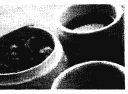
1.What are the reasons why tea is becoming more popular?
[ ]
A.It is easy to make.
B.It is easy to carry.
C.It is good to health.
D.it is cheap.
2.How is tea classified into different categories? It is classified according to ________.
[ ]
A.the way it is produced
B.the colour
C.the taste
D.the quality
3.Please put the following events of the spreading of tea in order.
a.Dutch traders brought tea to Europe.
b.Tea was discovered in China.
c.The Chinese began to export tea.
d.Tea was popular during Tang and Song dynasties.
e.The British transplanted tea to India.
[ ]
4.What are the three basic categories of tea according to the passage?
[ ]
A.Green, Oolong and Black teas.
B.Green , White and yellow teas.
C.White , yellow, light compressed teas.
D.Green, white, yellow and black teas.
第一节 听力
听下面5段对话。每段对话后有1小题,从题中所给的A、B、C三个选项中选出最佳选项。每段对话仅读一遍。
1.How does the man come here?
A.By bus.
B.By taxi.
C.By car.
2.Why isn't Helen present?
A.She forgot to come.
B.She changed her decision.
C.She wasn't invited.
3.What's the probable relationship between the two speakers?
A.Husband and wife.
B.Mother and son.
C.Doctor and patient.
4.What's the man's job?
A.A shop assistant.
B.A tailor.
C.A salesman.
5.What does the man mean?
A.He can't go to the cinema.
B.He can go to the cinema on Saturday morning.
C.He can go to the cinema on Saturday evening.
第二节(共15小题;每小题1分,满分15分)
听下面几段对话或独白。每段对话或独白后有几个小题。从题中所给的A、B、C三选项中选出最佳选项。听完每段对话或独白前,你将有时间来阅读各小题,每小题5秒钟;听完后,各小题将给出5秒钟时间作答。每段对话或独白读两遍。
听下面一段材料,回答第6、7题。
6.What is the job?
A.To work for a newspaper.
B.To serve in a phone company.
C.To look after 5 children in California.
7.On what condition would the woman accept the job?
A.If working there was great fun.
B.If she could be free to go on business.
C.If the return ticket was paid and the salary was good.
听下面一段材料回答第8至10题。
8.Where was Meryl Streep born?
A.In Africa.
B.In the U.S
C.In English.
9.How old was she when acted in her first film?
A.49
B.37
C.28
10.How was she when acted in her first film?
A.She did well in sports.
B.She was an excellent piano player.
C.She was good at acting.
听下面一段材料回答第11至13题。
11.Who is the man probably speaking to?
A.Children.
B.Students.
C.Teachers.
12.Where is the speaker?
A.In the classroom.
B.In the library.
C.In the office
13.How does the man treat his job?
A.He doesn't care about it.
B.He is serious about it.
C.He is tired of it.
听下面一段材料回答第14至16题。
14.How high is the mountain?
A.7 170 meters.
B.7 117 meters.
C.7 171 meters.
15.How many mountaineers of the association reached the top of the mountain?
A.4
B.15
C.19
16.What can we learn from the passage?
A.Some mountaineers had ever reached the peak in 1999.
B.The eldest mountaineers of the association is 30 years old.
C.Some mountaineers of the association reached the top of the mountain in a week.
听下面一段材料回答第17至20题。
17.The man drinks tea because ________.
A.he doesn't eat anything in the evening.
B.he can't eat without it.
C.he cannot work without it.
18.What does the man do when he has a break?
A.He leaves the studio.
B.He puts some music on and plays the drums.
C.He does something different.
19.A.He enjoys working long hours.
B.He enjoys looking for new ideas and problems to solve.
C.He enjoys playing the drums and listening to music.
20.A.A singer.
B.A worker.
C.An inventor.
第三节 听一段对话,根据你所听到的内容判断以下句子是否正确。正确的请用“T”;错误的请用“F”。本段对话读两遍。(共5小题每小题3分,满分15分)
21.Stella has just had a quarrel with Mr.Smith.( )
22.Stella has made another three bad mistakes so far.( )
23.Stella has been woken up at 5:30.( )
24.The milkman likes doing housework with a radio on.( )
25.Stella will have a talk with the milkman.( )
第四节 听下面对话或独白,根据所听内容,在相应题目的空白处填上适当的词或短语.每段对话读两遍。(10×3)
Good afternoon, and welcome to English.We hope that your 26 here will be a pleasant one.Today I would like to draw your attention to a few of our 27 .
The first one is about 28 .Now, you may not buy alcohol in this country if you are under 18 years of age, nor may your friends buy it for you.
Secondly, noise.Enjoy yourselves 29 , but please don't make unnecessary noise, particularly at night.We ask you to 30 other people who may wish to be quiet.
Thirdly crossing the road.Be careful.The traffic moves on the left side of the road in this country.Use the crossings for walking and do not 31 when crossing the road.
My next point is about litter.It is 32 the law to throw away waste material in a public place.When you have something to 33 please put it in your pocket and take it home, or put it in a litter bin.
Finally, 34 smoking, it is against the law to buy cigarettes or tobacco if you are under 16 years of age.
I'd like to finish by saying that if you 35 any sort of help or assistance, you should get in touch with your local police station, who will be pleased to help you.Now, are there any questions?
Good afternoon, and welcome to England. We hope that your visit here will be a pleasant one. Today, I would like to draw your attention to a few of our laws.
The first one is about drinking. Now, you may not buy wine in this country if you are under 18 years of age, nor may your friends buy it for you.
Secondly, noise. Enjoy yourselves by all means, but please don't make unnecessary noise, especially at night. We ask you to respect other people who may wish to be quiet.
Thirdly, crossing the road. Be careful. The traffic moves on the left side of the road in this country. Use pedestrian crossings(人行道)and do not take any chances when crossing the road.
My next point is about rubbish. It isn't lawful to drop rubbish in the street. When you have something to throw away, please put it in your pocket and take it home, or put it in a dustbin.
Finally, as regards(至于)smoking, it is against the law to buy cigarettes or tobacco if you are under 16 years of age.
I'd like to finish by saying that if you require any sort of help or assistance(帮助), you should contact the police, who will be pleased to help you. You can call, write or directly go to ask any policeman.
1.Who do you think is most likely to make the speech?
A. A guide(向导) B. A person who makes laws
C. A teacher D. An English officer
2.How many laws are there discussed in the speech?
A. Four B. Three C. Six D. Five
3. The main purpose of this speech is to __________.
A. tell people that those above 18 can drink and smoke there
B. declare the different laws of England
C. give advice to travelers to the country
D. warn people against going to the country
4. The underlined word "contact" in the last paragraph means to __________.
A. keep in touch with(联系) B. turn to C. make a call to D. write to
Once upon a time there was a painter who had just finished his course from a great painter. He wanted to assess his skills, so he decided to display one of his best works on a busy street.
He put his painting at a busy street-crossing. And below it a board read — "Gentlemen, I have painted this piece. Since I'm new, I might have made some mistakes in my work. 65 "
When he came back in the evening to collect his painting, he was completely shocked to see that the whole painting was filled with crosses.
66 He burst into tears and said sadly, "I'm useless and if this is what I have learned to
paint, I'm not worth teaching."
The master smiled and suggested, "My son, I will prove that you are a great artist." The master told him, "Just paint the same painting once again and give it to me."
Then they went to the same street the next morning and displayed the same painting. The master took out another board which read — "Gentleman, I have painted this piece. Since I'm new, I might have made some mistakes. I have put a box with colors and brushes just below. Please do
me a favor. 67 "The master and the young painter went back home.
They visited the place in the evening. The young painter was surprised to see that actually there was not a single correction done! 68 If you want to help people improve their behaviors, it is worth investing your effort in learning how to help people change their behaviors, attitudes and skills. Also, always remember not to get carried away or judge yourself by someone else's criticism and feel depressed as you are the best judge to judge yourself!
A. It is easy to criticize, but difficult to improve.
B. Please put a cross wherever you see a mistake.
C. Discouraged and broken, he ran to his master's place.
D. If you see a mistake, kindly pick up the brush and correct it.
E. Criticizing has the function of helping people improve themselves.
湖北省互联网违法和不良信息举报平台 | 网上有害信息举报专区 | 电信诈骗举报专区 | 涉历史虚无主义有害信息举报专区 | 涉企侵权举报专区
违法和不良信息举报电话:027-86699610 举报邮箱:58377363@163.com