
题目列表(包括答案和解析)
I was tired and hungry after a long day of work.When I walked into the living-room, my 12-year-old son looked (1) at me and said , “I love you.” I didn't know what to say. (2 ) several seconds all I could do was to stand there and (3) down at him.My first thought was that he must need (4) with his homework or he was trying to (5) me for some news.
Finally I asked, “What was that all about ? ”
“Nothing, ”he said.“My teacher said we should (6 ) our parents that we love them and see what they say.It's (7).
The next day I called his teacher to find out more about this “experiment” and how the other parents had (8) .
“Most of the fathers had the (9) reacting as you did , ”the teacher said.“When I first (10) we try this , I asked the children what they thought their parents would say.Some of them thought their parents would have heart trouble.The (11) is , ”the teacher explained , “feeling loved is an important part of (12) .It is something all people (13) .What I'm trying to tell the children is that it's too (14) we don't all express those feeling.A boy should be (15) to tell his dad he loves him.
The teacher , a middle - aged man , understands how (16) it is for some of us to say the things that would be good for us to say.
When my son came to me that evening, I held on to him for (17) second.And just (18) he pulled away , I said in my deepest , most manly voice , “Hey , I love you , too.”
I don't know if saying that made either of us healthier, but it did feel pretty good.Maybe next time one of my children said “I love you ”, it would not take me a whole (19) to think of the right (20) .
1.A.down B.away C.out D.up
2.A.After B.For C.At D.On
3.A.sit B.get C.look D.knock
4.A.rest B.time C.help D.paper
5.A.report B.prepare C.answer D.excuse
6.A.help B.tell C.ask D.make
7.A.a matter B.an experiment C.a word D.a sentence
8.A.said B.reacted C.done D.explained
9.A.same B.different C.usual D.common
10.A.suggested B.agreed C.allowed D.planned
11.A.point B.idea C.way D.cause
12.A.body B.know C.take D.need
13.A.agree B.understand C.know D.require
14.A.bad B.good C.late D.early
15.A.fit B.ready C.worth D.able
16.A.easy B.much C.often D.difficult
17.A.a more B.after C.an exact D.an extra
18.A.before B.after C.because D.if
19.A.day B.week C.afternoon D.night
20.A.answer B.result C.reason D.experiment
Li Lu’ou thought he did the right thing by calling 110 when he saw his two classmates in trouble on the corner of a dark street.
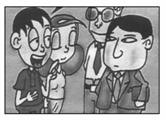
Li and his classmates from NO.2 Middle School Affiliated to Beijing Normal University spent this year’s Valentine’s Day selling roses on the street.As night approached,they cycled back with over 200 yuan in their pockets.
Suddenly,a gang of robbers jumped out at them.The five robbers were tall and strong,so Li ran away to call the police.He thought it would be the most practical thing to do and he was right.His classmates returned safe and sound.
So,what would you have done in Li’s situation?Would you have got off your bike and fought the robbers to rescue your friends?
A new Beijing student code does not encourage you to risk your life to help them.
The new code was introduced to more than 1.7 million primary and middle school students in the city at the start of the new term.
It has cut words which might encourage youngsters to risk their lives for others dangerous situations.Gone are the old calls,which had been in place since 1987,for students to“fight criminals courageously”and “sacrifice themselves to save others”.
Children’s heroic acts usually left them injured or even dead because they failed to fully foresee the dangers of their actions.
A wellknown example was Lai Ning,who was listed among the “top 10 model young pioneers” in 1989 after he lost his life trying to put out a fire at the age of 14.
The deaths connected to teenagers’“heroic acts” started a nationwide debate about the protection of youngsters.
Wei Lusheng,a parent in Beijing,said schools must first teach children how to protect themselves,before learning from heroes.
But educators thought the spirit of courage should not be thrown away in the new student code.
“Getting rid of the words‘fight criminals courageously’do not mean we deny the spirit of‘fearlessness’and ‘readiness’to help others.”said Li Jing,an official in Beijing.“But,we should be more rational about the spirit of sacrifice.”
Li Lu’ou agreed.“Cherishing life is no reason to be a coward,” he said.“but you need make sure you are able to offer help.For example,it would cause more trouble if I jumped into water to rescue someone drowning,but didn’t know how to swim.In that situation it’s better to call the police or an adult.”
41.Which is true about Li and his classmates?
A.They bought roses for each other on Valentine’s Day.
B.They called 110 immediately when they were held up by a gang of robbers.
C.Li risked his life for his classmates in the dangerous situation.
D.Instead of fighting the robbers Li thought it right for him to call the police.
42.The new student code was introduced in Beijing because______.
A.students are facing more danger than they used to
B.the old student code didn’t include the spirit of courage
C.the old one didn’t tell students how to protect themselves while helping others in trouble
D.the old student code encouraged students to sacrifice themselves to save others.
43.Which can be inferred about Lai Ning?
A.He was one of the top 10 model young pioneers in 1987.
B.If it weren’t him,the forest fire would not have been put out.
C.According to the new code,he shouldn’t have risked his life to put out the fire.
D.His deeds did not agree with what the old student code encouraged.
44.The underlined word“deny ”in the second last paragraph means“________”.
A.agree with B.disagree with
C.connect with D.object to
45.According to the new student code which of the following statements is right?
A.There will be more criminals after the new student code was introduced.
B.The police in Beijing will have a more difficult time in keeping order.
C.The spirit of“fearlessness”and “readiness”help others will be thrown away.
D.Teenagers are advised to make sure they are able to offer help when they want to.
| |||||||||||||||||||||||||||||||||||||||||||||||||||||||||||||||||||||||||
Li Lu’ou thought he did the right thing by calling 110 when he saw his two classmates in trouble on the corner of a dark street.
Li and his classmates from No.2 Middle School affiliated to Beijing Normal University spent this year’s Valentine’s Day(情人节) selling roses on the street. As night approached, they cycled back with over 200 yuan in their pockets.
Suddenly, a gang of robbers jumped out at them. The five robbers were tall and strong, so Li ran away to call the police. He thought it would be the most practical thing to do and he was right. His classmates returned safe and sound.
So, what would you have done in Li’s situation? Would you have got off your bike and fought the robbers to rescue your friends?
A new Beijing student code(守则) does not encourage you to risk(冒险) your life to help them.
The new code was introduced to more than 1.7 million primary and middle school students in the city at the start of the new term.
It has cut words which might encourage youngsters to risk their lives for others in dangerous situations. Gone are the old calls, which had been in place since 1987, for students to “fight criminals(犯罪分子) courageously” and “sacrifice themselves to save other”. Children’s heroic acts usually left them injured or even dead because they failed to fully foresee the dangers of their actions.
A well-known example was Lai Ning, who was listed among the “top 10 model young pioneers” in 1989 after he lost his life trying to put out a fire at the age of 14.
The deaths connected to teenagers “heroic acts” started a national wide debate(争论) about the protection of youngsters.
Wei Lusheng, a parent in Beijing, said schools must first teach children how to protect themselves, before learning from heroes.
But educators thought the spirit of courage should not be thrown away in the new student code.
“Getting rid of the ‘fight criminals courageously’ words do not mean we deny the spirit of ‘fearlessness’ and ‘readiness’ to help others”, said Li Jing, an official in Beijing. “But, we should be more rational(理智的) about the spirit of sacrifice.”
Li Lu’ou agreed. “Cherishing life is no reason to be a coward,” he said. “But you need to おmake sure you are able to offer help. For example, it would cause more trouble if I jumped into water to rescue someone drowning, but didn’t know how to swim. In that situation it’s better to call the police or an adult.”
1.Which is true about Li and his classmates?
A. They bought roses for each other on Valentine’s Day.
B. They called 110 immediately they were held up by a gang of robbers.
C. Li risked his life for his classmates in the dangerous situation.
D. Instead of fighting the robbers Li thought it right for him to call the police.
2.The new student code was introduced in Beijing because_____________.
A. students are facing more danger than they used to
B.the old student code didn’t include the spirit of courage
C.the old one didn’t tell students how to protect themselves while helping others in trouble
D.the old student code encouraged students to sacrifice themselves to save others
3.Which can be inferred about Lai Ning?
A. He was one of the top 10 model young pioneers in 1987.
B. If it weren’t him, the forest fire would not have been put out.
C. According to the new code, he shouldn’t have risked his life to put out the fire.
D. His deeds did not agree with what the old student code encouraged.
4.The underlined word “deny” in the second last paragraph means “_____________”.
A. agree with B.disagree with
C.connect with D.object to
5.According to the new student code which of the following statements is right?
A. There will be more criminals after the new student code was introduced.
B. The police in Beijing will have a more difficult time in keeping order.
C. The spirit of “fearlessness” and “readiness” to help others will be thrown away.
D. Teenagers are advised to make sure they are able to offer help when they want to.
湖北省互联网违法和不良信息举报平台 | 网上有害信息举报专区 | 电信诈骗举报专区 | 涉历史虚无主义有害信息举报专区 | 涉企侵权举报专区
违法和不良信息举报电话:027-86699610 举报邮箱:58377363@163.com