
题目列表(包括答案和解析)
| |||||||||||||||||||||||||||||||||||||||||||||||||||||||||||||||||||||||||
Your smartphone can do a lot of things. It can call people. It connects to the Internet. It enables you to play fun games. But there is a dark side to this smart little equipment of yours----- it might also spread disease.
“People are just likely to get sick from their phones as from handles of the bathroom, ” Jeffrey Cain, the president of the American Academy of Family Physicians , told The Wall Street Journal.
This may be hard to believe, but scientists reached this conclusion after they tested eight cell phones from an office in Chicago. All the tested phones showed high numbers of coliforms (大肠菌), a kind of bacteria found in human waste , with about 2700 to 4200 units of the bacteria on each phone. The bacteria can cause flu, pinkeye and other diseases . That is right --- your phone is covered in our human waste.
Although computers, keys and pens carry germs (细菌) , our phones get far dirtier. They touch a lot of things, including our hands and the inside of our pocket or purse. We take them almost everywhere: the bus, the subway and who hasn’t played Angry Birds or Fruit Ninja while sitting on the toilet?
“Some things that we think are personal are actually more public than we imagine,” Cain said. What is even worse is that after the phone returns from its dirty trip, it then spends most of its time cozying up to our faces. You don’t think about how often you touch your phone to your face, do you? Our noses, mouths and ears are all warm and rich in grease (油脂) , an environment that germs really like.
So how do you keep your phone clean? Alcohol is effective when used to kill germs from the back and side of your phone. But it might harm the screen. There is one simple and reliable way you can reduce the germs on your phone’s surface: wash your hands regularly.
【小题1】The underlined word “dark” in the first paragraph means _______
| A.black | B.hopeless | C.unpleasant | D.unclear |
| A.Terrified | B.concerned | C.Satisfying | D.Threatening |
| A.people love to share their phones more than they realize |
| B.our personal items could be as risky to our health as public items |
| C.phones are used in public places more than people realize |
| D.Most people don’t know how dirty their cell phones are |
| A.Tips on the use of phones |
| B.Health problems caused by the use of phones |
| C.The danger of coliforms infection |
| D.The influence that phone have on our life |
[1] Look at the center circles of Diagram A and Diagram B. Which of the centre circles looks larger? 
[2] Take a first look and you probably think that the centre circle in Diagram A is smaller than that in Diagram B. In fact, they are exactly the same size.
[3]Then look at the picture on the right. What do you see? A vase? Or two faces? Does the picture change quickly from one to the other again and again? Maybe or maybe not, but you can see them at the same time. 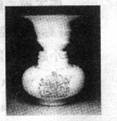
[4]“What’s happening? Is something wrong with my eyes?” You may wonder at what you see. Don’t worry. Here is how it goes:
[5]When we look at things, our eyes send messages to our brains and then our brains interpret the information. However, sometimes our brains interpret the received information in a wrong way. It seems that our eyes are playing a joke on us. This often happens and we call it “Visual illusion(幻觉)”. 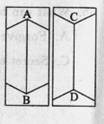
[6] Movie makers often make use of illusions. They make the objects around actors much smaller or bigger than usual. This makes us believe that the actors are much larger or smaller than they usually are. The movies Jurassic Park and Honey J shrunk the kids just make use of illusions.
【小题1】In which column of a magazine can you read the above text?
| A.Culture. | B.Science. | C.Humour. | D.Education. |
| A.something is wrong with our eyes |
| B.the two circles are not of the same size |
| C.our brains interpret the information wrongly |
| D.pictures change quickly from one to the other |
Natural ways of keeping time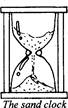
In ancient times, people had to use the sun and the moon to tell time. They got up when the sun came up and worked in the fields until the sun went down.
Man-made things
The sand clock is made of two glass balls joined by a narrow neck. The top ball was filled with sand. The sand slowly moved through the neck into the bottom ball. People knew how much time had passed when all the sand had fallen to the bottom ball.
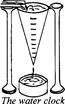
People also made the water clock. They made a small hole near the bottom of a pot. Then they filled the pot with water. Markings inside the pot showed how much time passed as the water dripped (滴) out of the hole.
Nature’s Clocks in Living Things
◆Animals’ Body Clock
Animals do not need clocks to know time. They have a way of telling time by their bodies. Birds know when to fly to warmer places before winter. Some animals know when to keep more food for the cold winter months. Some fish know when it is time to move up the river and lay eggs.
◆Plants have their own clocks
Plants also have their own clocks to keep time. Plants know when to open flowers or when to drop their leaves.
◆The Body Clock in Human Beings
People also have their own body clocks. When we get used to our lives, our body clocks can be very accurate (准确的). It can tell us when it is time to wake up. It can also tell us when to eat or to go to sleep.
【小题1】How could an ancient farmer know when to go back home in the daytime?
| A.By looking at the moon. | B.By looking at the stars. |
| C.By looking at the sun. | D.By feeling whether tired or not. |
| A.2. | B.3. | C.5 | D.6. |
| A.both of them have a hole. | B.both of them are designed with glass balls. |
| C.both of them can be used only once. | D.both of them tell time in the same way |
湖北省互联网违法和不良信息举报平台 | 网上有害信息举报专区 | 电信诈骗举报专区 | 涉历史虚无主义有害信息举报专区 | 涉企侵权举报专区
违法和不良信息举报电话:027-86699610 举报邮箱:58377363@163.com