
题目列表(包括答案和解析)
Rail passengers are being forced to pay thousands of pounds more in fares as a result of poor advice from the national telephone help line and individual stations, a consumer organization reveals today. Research by Which? found that in some cases passengers are being charged almost double the cheapest price because of errors made by staff.
Which? asked 25 questions of both station staff and the National Rail Enquiries (NRES) helpline. Only half of the 50 questions were answered correctly. If customers had followed all the advice given, they would have been £1,263. 60 worse off.
Bad advice was given for the cheapest fare for a single journey between
Some of the most costly misinformation was given for journeys where season tickets should have been recommended. Passengers making a return journey between Swindon and Penzance twice in a week could buy a ticket from one company for £70 which would cover all the travel. But both NRES and station staff quoted £67 for each journey, making £134. However, the NRES website proved to be a much more reliable source of information.
Which? also checked “the earlier you book, the cheaper the ticket” claims by five companies and found this was not always the case. On some services, prices went up and down at random.
Ithiel Mogridge, 52, gave one example of poor advice: “Last Christmas I found my brother a ticket on the train line. Come to travel from Blackburn to Yate. While the direct route was £51, this one involved a change in Newport and cost just £21. I emailed the details to him and his partner. They went to Blackburn station, where the clerk insisted the fare was £51.”
Malcolm Coles, editor of which.co.uk said: “Staff training needs to be improved. In the meantime, we’ve designed a checklist, available at which.co.uk / railadvice.”
72. According to the passage “which?” is a ________.
A. national telephone helpline
B. department under the British Rail
C. consumer organization
D. website under the National Rail Enquiries
73. When the author said that customers “would have been £1,263. 60 worse off”, he was telling us that customers would have _________.
A. saved £1,263. 60 if they had followed the advice
B. spend £1,263. 60 more than the lowest price
C. used £1,263. 60 for the survey of 25 questions
D. been cheated of £1,263. 60 from the poor advice
74. The phrase at random in paragraph 5 is closest in meaning to “_________”.
A. casually B. purposefully C. exactly D. inevitably
75. The passage is mainly concerned with the phenomenon that __________.
A. rail passengers can get cheaper tickets if they book earlier
B. rail passengers are ill-treated by station staff
C. booking clerks and the telephone helpline offer reliable information
D. train passengers get bad advice on fares
Part I Listening Comprehension(30 marks)
Section A(22.5 marks)
Directions:In this section, you'll hear six conversations between two speakers.For each conversation, there are several questions, and each question is followed by three choices marked A, B and C.Listen carefully and then choose the best answer for each question.You will hear each conversation TWICE.
Conversation 1
1.How long does the woman need to work every day?
A.Three hours.
B.Four hours.
C.Five hours.
2.How much can the woman earn each day?
A.5 dollars.
B.10 dollars.
C.20 dollars.
Conversation 1
M:Do you have any work experience?
W:No, I’ve never worked in a restaurant before.
M:Do you think you can get along will with customers?
W:Yes, I think so.
M:Can you make sure to be here from four to eight in the afternoon?
W:Yes, I'm always on time.
M:Then you can start tomorrow.Monday through Friday.Five dollars an hour.
W:That's fine.
Conversation 2
3.What's the possible relationship between the speakers?
A.Boss and employee.
B.Mother and son.
C.Teacher and student.
4.When will the man come back?
A.This Monday.
B.This Wednesday.
C.This Friday.
Conversation 2
M:Mrs.Sharon, I say…, I have to …
W:What's the matter, Richard?
M:Er, I'd like to take two days off.My mother's ill.I need to stay with her.
W:I'm sorry to hear that.You mean you will be back here this Wednesday?
M:Yes, I hope I can come back earlier.
W:That's all right.By the way, don't worry about your lessons.I'll certainly help you with them.
Conversation 3
5.What can we know about Nancy and Steve?
A.They will divorce soon.
B.They have two daughters.
C.They divorced last year.
6.Who will help Nancy out in the woman's opinion?
A.Her daughter.
B.Her parents.
C.Her friends.
Conversation 3
M:Kate, Nancy and Steve are breaking up.
W:It's really a shame.I’ve heard that they quarrel, but they’ve always made up afterward.
M:Things are not working out this time.They are getting a separation soon.
W:What will happen to their daughter, Bonnie?
M:Nancy is going to take her.
W:The cost of living is so high.It will be difficult for her to take te responsibility.
M:She seems to have made up her mind.She said she would rather be a single parent than cope with an unhappy marriage.
W:Well, I hope her parents will be able to help her out.
Conversation 4
7.How often does the woman pay the tax?
A.Once a month.
B.Twice a year.
C.Once a year.
8.Why does the woman have to pay more taxes?
A.The government has raised the tax rate.
B.She didn't pay taxes last year.
C.She has got extra money.
9.What can we know about the woman?
A.She is an accountant.
B.She taught in a night school.
C.She lives upon a small income.
Conversation 4
W:Henry, our income tax is due soon.Did you call our accountant?
M:He's figuring out our taxes right now.I gave him all the records on our income and expenses last week.
W:The government has taken away taxes from our paychecks all year.I hope we get some of that money back or at least that we won't have to pay more.
M:Remember the money your aunt left us when she died, and the money you made when you taught in a night school?
W:Yes.
M:Well, that's all taxable income.That money has put us in a higher tax bracket.
W:What does that mean?
M:It means we have to pay more taxes.
W:Well, it looks like we'll have to make more money this year just to pay last year's taxes.
Conversation 5
10.What can we know about the kid from Haiti?
A.He doesn't get on well at school.
B.He is often late for school.
C.He doesn't speak much English.
11.How many countries are mentioned in the conversation?
A.Six.
B.Five.
C.Four.
12.How does the woman help the immigrant kids?
A.She has spent much time with them after class.
B.She gives them more lessons than other kids.
C.She pays more attention to them at class.
Conversation 5
M:Kate, how's the new student in your class doing?
W:The kid from Haiti? He's having a rough time communicating since he doesn't speak much English.However, the other kids seem to involve him pretty well.
M:Our students are used to new kids who don't speak much English since we have had so many new immigrant families moving into our school district.
W:Don't I know it! This year I have had a Vietnamese, an Ethiopian, a Cuban and the kid from Haiti in my class.I spend a lot of time with them after class so that they can catch up.
M:It must have been hard for you since you have to give them special attention in order to help them.
W:It has been.Nevertheless, it's really rewarding to see them progress and make friends.
Conversation 6
13.When will the speakers have the exams?
A.In one week.
B.In two weeks.
C.In three weeks.
14.What will the woman do this summer?
A.Teach English.
B.Find a job.
C.Study Chinese.
15.How did the man learn Chinese?
A.By speaking.
B.By reading.
C.By listening.
Conversation 6
M:Well, Jenny.The school year is almost over.We just have two weeks before exams.What are you going to do this summer?
W:I'm going to teach English to some immigrants in the university's community service program.
M:That sounds interesting.Don't you need to speak a foreign language for the job?
W:No.You just have to present the language simply and give the students a chance to practice speaking.
M:But that's the way I was taught to speak Chinese.But speaking Chinese didn't help me learn to read and write Chinese.
W:My students don't want to read and write English.They are more interested in speaking.
M:You sound very knowledgeable about all this.How do you know so much?
W:I took teaching English as a second language course last year when you were in China.I’ve also talked with the program administrators quite a lot.I think I would like to be an ESL teacher when I graduate.
SECTION B
Directions:In this section, you'll hear a mini-talk.Listen carefully and then fill in numbered blanks with the information you’ve got.Fill each blank with NO MORE THAN 3 WORDS.
You'll hear the mini-talk TWICE.
About friendship
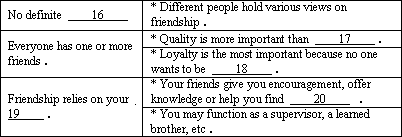
Section B
We often say, “A friend in need is a friend indeed.” But what is the exact meaning of friendship? No one can really offer a definite concept, because different people hold various views on friendship.
Everyone has his own friendship and some have a lot of friends.But in fact, quantity is not so important as quality.Loyalty is the most important for friendship.No one wants to make friends with those who will betray them.
No matter whether you are married or not, no matter where you live and work, your friends are your friends.It is not based on bloodline.It relies on your intention.To you, some friends are fun-loving, some give encouragement, some offer knowledge, and others help you to find your own identity.Before your friends, you may act as a supervisor, a learned brother, a lovely child, a gentleman or a playmate.In a word, friendship helps you to be a full person.So friendship can benefit.
Keys:
听力(共两节,满分30分)
第一节(共5小题;每小题1.5分,满分7.5分)
听下面5段对话。每段对话后有一个小题,从题后所给的A、B、C三个选项中选出最佳选项。听完每段对话后,你都有10秒钟的时间来回答有关小题和阅读下一小题。每段对话仅读一遍。
W:Did you all enjoy the film yesterday?
M:John was the only one who didn’t.
1.Who enjoyed the film yesterday?
A.John.
B.All except John.
C.Everyone, including John.
M:Aren’t you going to apologize for breaking that window?
W:Why should I?I didn’t throw the ball.
2.Who broke the window?
A.The boy.
B.The girl.
C.Someone else.
W:Have you moved into your new house yet?
M:Yes, already.
W:How do you like it?
M:It’s small but quiet.
3.What are they talking about?
A.A new house.
B.A new friend.
C.A new garden.
W:I’m returning the book you lent me.
M:That isn’t my book.
W:It’s not?That’s funny.It must belong to your brother then.
M:Should I give it to him?
W:Thanks.Here you are.
4.Who is the owner of the book?
A.The man himself.
B.The man’s brother.
C.The woman’s brother.
M:The study with all those bookshelves would be very useful.
W:And here is the kitchen with a large table and a fridge as well.
5.Where does the conversation most probably take place?
A.In a house.
B.In a park.
C.In a library.
第二节(共15小题;每小题1.5分,满分22.5分)
听下面5段对话或独白。每段对话或独白后有几个小题,从题后所给的A、B、C三个选项中选出最佳选项。听每段对话或独白前,你有时间阅读各个小题,每小题5秒钟;听完后,各小题给出5秒的作答时间。每段对话或独白读两遍。
听第6段材料,回答第6~8题。
W:Sir!Please take me to the airport as quickly as possible.
M:OK!I will drive as fast as I can.When is your flight?
W:9∶30.
M:Don’t worry.We will be there on time.
W:You see, it takes quite a long time to pass the customs.
M:I know.Is this the first time you are travelling by air?
W:Yes, and this is the first time for me to go abroad.
M:No wonder you look a little nervous.Are you going alone?
W:No, five other teachers will go together with me.
6.What’s the relationship between the two speakers?
A.Passenger and taxi driver.
B.Husband and wife.
C.Newly-made friends.
7.What time does the plane take off?
A.At 9∶13.
B.At 9∶30.
C.At 9∶20.
8.Why is the woman in such a hurry?
A.She is going to see five teachers off at the airport.
B.It’s almost time for her plane to take off.
C.It’s her first time to take a plane and she is a little nervous.
听第7段材料,回答第9~10题。
W:Do you have a plan for your holidays?
M:Yes, I’ll go back to my hometown.
W:To see your grandparents?
M:Yes, and also to do some farming.
W:You mean you know how to farm?
M:Yes.I did that every summer during holidays.
W:I didn’t know that a city boy can do farm work.Can I go there with you?I’d like to learn to do some farming.
M:Sure, my grandparents would be very happy to see you.
W:Are you sure?
9.What are the speakers mainly talking about?
A.Farming.
B.Holiday plans.
C.Grandparents.
10.Where did the man grow up?
A.In the country.
B.At the seaside.
C.In the city.
听第8段材料,回答第11~13题。
W:Why did you sell the car?
M:It was giving me too much trouble.I was spending so much money on it that I was…er…spending more money than it was worth.Unfortunately, of course, when you actually sell the car, you’ve already, spent the money on it, so you lose both ways.
W:What was wrong with your old car?
M:The engine needed a lot of repairs and the wheels were giving trouble now and then.When I set off on a journey, it gave me a sort of feeling that I might not get to the other end.So I decided to change it.
W:Is the new car good?
M:Yes.It’s newer, more comfortable, and it hasn’t given me any trouble at all.When I set off, I’m quite sure that I’ll be able to get to the other end safely.
11.What did the man do about his old car?
A.He sold it.
B.He repaired the engine.
C.He gave it to his friend as a present.
12.How did the man feel about his old car?
A.It would go far safely.
B.It was in pretty good condition.
C.He shouldn’t have spent money having it repaired.
13.How does the man feel about his new car?
A.We are not sure.
B.It’s even worse than the old one.
C.It’s much better than the old one.
听第9段材料,回答14~16题。
M:Excuse me, Miss Smith, I cannot come to class tomorrow.
W:You missed two classes last week.You’ve missed a lot of lessons already.I think you should work a little harder to make up for them.
M:Yes, I will, Miss Smith.
W:Well, now, why can’t you attend my class tomorrow?
M:My grandfather is seriously ill and my family is going to visit him in the hospital tomorrow.
W:It seems to be an excuse.All right, you are excused.By the way, which hospital has your grandfather been in?
M:Which hospital? Er-er…he is in St.George’s Hospital.
W:St.George’s Hospital? That’s interesting.It has been closed for repair for the past two months.Tony Banks, you’re trying to cut my class again.You’re coming to my class tomorrow and staying after class for extra work.
14.What can we learn about the boy?
A.His grandfather is seriously ill.
B.He is tired of learning.
C.He is a good student.
15.What makes that woman know the boy is lying?
A.The fact that the hospital has been closed for 2 months.
B.The fact that the boy has cut classes before.
C.She met the boy’s grandfather only minutes ago.
16.What does the teacher decide to do?
A.Give the boy permission to see his grandfather.
B.Punish the boy by having him stay for extra work after class.
C.Go to the hospital to see the boy’s grandfather
17.How might the boy feel in the end?
A.Happy.
B.Moved.
C.Disappointed.
听第10段材料,回答第18~20题。
It was about two o’clock in the morning, and…and suddenly I woke up, I heard a noise.I got out of bed and went slowly downstairs.There was a light in the living room.I listened very carefully.I could hear two men speaking quietly.
“Burglars!” I thought.“Two of them!”Well, I was really frightened, so I went back upstairs, and immediately phoned they police from my bedroom.The police arrived quickly.They opened the front door with a special key and went into the living room.Then they came upstairs.“It’s all right now, sir, ”they explained.“We turned the television off for you!”
18.What did the speaker think had happened when he woke up?
A.The house was on fire.
B.Some guests had arrived.
C.The house was broken into.
19.Why didn’t the speaker get into the living room?
A.Because it was too dark there.
B.Because he was afraid.
C.Because the police were there.
20.What did the police find out?
A.The speaker had forgotten to turn off the TV before going to bed.
B.Two burglars (夜贼)were trying to steal valuable things.
C.Someone had opened the door with a special key.
听力(共两节,满分30分)
第一节(共5小题;每小题1.5分,满分7.5分)
听下面5段对话。每段对话后有一个小题,从题中所给的A、B、C三个选项中选出最佳选项。听完每段对话后,你都有10秒钟的时间回答有关小题和阅读下一小题。每段对话仅读一遍。
1.What does the woman mean?
A.His brother should let them use the car.
B.The subway is fine with her.
C.A car wouldn’t be any faster.
2.What does the man have to do now?
A.Complete the research.
B.Write the research paper.
C.Finish typing the paper.
3.What do you know about the woman?
A.Perhaps she is a doctor.
B.She was seriously ill.
C.She didn’t want to see the film.
4.What does the woman mean?
A.The light isn’t bright enough.
B.The dining hall isn’t large enough.
C.She agrees with the man.
5.What does the man mean?
A.His daughter is too old for the club.
B.His daughter is too young to join the club.
C.His daughter is the eldest.
听力原文:(Text 1)
M:I’d like to drive to the concert but my brother has the car tonight.
W:Who needs a car?We can take the subway if we go a little earlier.
(Text 2)
W:How are you getting on with research paper?
M:I’ve finished all my research, but I haven’t been able to organize it, therefore I haven’t begun the paper yet.
(Text 3)
M:What a pity you missed the film last night.It was wonderful.
W:I would have gone to see it.But there was a patient seriously ill.
M:No wonder you didn’t come.
(Text 4)
M:The light in this dining hall is a little too bright, don’t you think so?
W:I’d say it’s perfect for a football stadium.
M:Quite right.
(Text 5)
W:Can I join your club, Dad?You know I’m interested in it, too.
M:You can when you get a bit older.
第二节(共15小题;每小题1.5分,满分22.5分)
听下面5段对话或独白。每段对话或独白后有几个小题,从题中所给的A、B、C三个选项中选出最佳选项。听每段对话或独白前,你将有时间阅读各个小题,每小题5秒钟;听完后,各小题将给出5秒钟的作答时间。每段对话或独白读两遍。
听第6段材料,回答第6~8题。
6.What time is it now?
A.It’s 10∶10 p.m.
B.It’s 10∶30 p.m.
C.It’s 9∶50 p.m.
7.How long will it take the woman to get to the railway station?
A.Fifteen minutes or less.
B.More than fifteen minutes.
C.Less than fifty minutes.
8.Why did the man invite the woman to his house?
A.They had a tea party.
B.They had a dinner party.
C.They had a dancing party.
听力原文:(Text 6)
W:What’s the time by your watch, David?
M:Just a minute.It’s ten to ten by my watch.
W:Is it?I had no idea it was so late.I must be going now.
M:Can’t you stay a bit longer?
W:I’m afraid not.I must catch the ten-thirty train back.
M:You’ve got plenty of time yet.The railway station’s very near.It won’t take you more than fifteen minutes to get there.
W:Well, I hate to rush at the last minute.
M:OK, drop in whenever you like.
W:Yes, I’ll do that.Thank you for asking me to dinner.It was a nice dinner party and I’ve enjoyed your cooking.
M:I’m glad you enjoyed yourself.Good night.
W:Good night.
听第7段材料,回答第9~11题。
9.Why does the man want to have a word with the waitress?
A.Because he has been kept waiting for a long time.
B.Because he wants to complain about the food.
C.Because he wants to pay the bill.
10.What do we learn about the restaurant?
A.It must be a new one.
B.They don’t know how to serve the people.
C.They need more waiters.
11.If the head waitress had known about his situation, what would
have happened?
A.She would have served him much earlier.
B.She would have brought another drink.
C.She would have turned to her boss for help.
听力原文:(Text 7)
M:Head waitress! I want to have a word with you.
W:Yes, sir.I’ll be with you in a minute.Is there anything else you’d like to have, sir?
M:Anything else?We have been kept waiting here for almost an hour for the meal!
W:I’m terribly sorry about that, sir.There might be something wrong.You see, we’re short of help today.I’ll see to it at once.Would you like to have a drink while waiting?
M:Well, another martini.
W:Yes, sir.One moment.Here you are.I’ll be back in a minute.Here are the dishes you ordered, sir.
M:Thank you.
W:I’m very sorry to have kept you waiting.I wish I could have known earlier.
M:That’s all right.
W:Thank you for your understanding.I assure you it won’t happen again.
听第8段材料,回答第12~14题。
12.Who is Mary?
A.A student.
B.A worker.
C.A teacher.
13.What can we infer about Washington’s birthday from the conversation?
A.Maybe there was a national holiday near that day.
B.It was fine that day and nobody wanted to stay in.
C.It is perhaps a national holiday.
14.How did Mary go to the mountain on Washington’s birthday?
A.By bus.
B.By car.
C.By train.
听力原文:(Text 8)
M:Hey, Mary!You have really been gone a long time.Why is that?
W:Hi!Well, I talked with my teachers before I left about the work I would miss.Besides, my aunt in Denver made me study a lot there.
M:I thought she was your rich aunt.
W:Not very.But she didn’t have any children to raise, so she does have some money, even though she was a teacher.
M:How was the holiday?
W:Cold...at least three of the days while I was there.And I saw so many people on the mountain on Washington’s birthday.
M:The beaches were full on Washington’s birthday, too.It really was warm here, so lots of people went swimming.
W:Well, we should have stayed home that day.There were so many people.We took the train over to the mountain, so that at least we didn’t have to drive.It was a good thing we did-there were so many cars and buses, and no place to park anywhere.
M:Just like the beaches here.
听第9段材料,回答第15~17题。
15.When will the man come back from the trip?
A.December 22.
B.January 3.
C.January 13.
16.Which flights is the man going to take for his round trip?
A.Flight 220 and Flight 476.
B.Flight 476 and Flight 220.
C.Flight 220 and Flight 414.
17.How much will the man probably pay for the tickets?
A.About $952.
B.About $414.
C.About $476.
听力原文:(Text 9)
W:United Airlines.May I help you?
M:Yes.I’d like to book some tickets on your Flight 220, departing for Honolulu on December 22 at 7:30 in the evening.
W:Your name, please.
M:Mr.Wang Lin and Mrs.Li Fang.
W:Do you want to fly first or economy class?
M:Economy, please.
W:Yes, we still have room on that flight.Will this be a one-way trip?
M:No, round trip back to Chicago-on January 3.By the way, do you have any direct flights coming back?
W:Yes, we do.Flight 414, leaving Honolulu at 3∶00 p.m.flies non-stop back to Chicago.
M:That’s perfect.What’s the exact air fare?
W:Economy fare round trip from Chicago to Honolulu is $476 during busy season.
M:I see,…then our tickets are confirmed.
W:Yes, your seats are confirmed on those two flights.Please be at the airport at least one hour before departure.
听第10段材料,回答第18~20题。
18.How long does Mr.Hill have to work every day?
A.6 hours.
B.7 hours.
C.8 hours.
19.What’s the worst thing that can happen to a postman?
A.Having too many items to deal with a day.
B.Going to work late in the morning.
C.Delivering letters to people from abroad.
20.How does Mr.Hill feel about his work?
A.Boring.
B.Dangerous.
C.Satisfactory.
听力原文:(Text 10)
I’m Harley Hill.I was chosen as a postman of the year 1975.I have been a postman for 23 years.I love my work very much and it’s a fine life for me.Every week I work forty hours.I work from six o’clock in the morning to about two o’clock in the afternoon.The worst thing is being late in the morning.We handle 50 000 to 60 000 items a day.I deliver to probably 278 addresses.Some of them are from abroad.
I’m happy to see the smile on their faces when I give them a letter from home.I think if there is anything I don’t like about the job, it’s the snow and ice and especially dogs.I’ve been bitten about half a dozen times.I have got 3 years before I retire.I’m going to miss the job when I retire.
听力(共两节,满分30分)
第一节(共5小题,每小题1.5分,满分7.5分)
听下面5段对话。每段对话后有一个小题,从题中所给的A、B、C三个选项中选出最佳选项。听完每段对话后,你都有10秒钟的时间来回答有关小题和阅读下一小题。每段对话仅读一遍。
1.Where is the bank?
A.Next to the bookstore.
B.Behind the bookstore.
C.Far from the bookstore.
2.What does the man mean?
A.There are too many shopping centers already.
B.They aren’t going to build one.
C.He hasn’t been to the other centers.
3.What does the man mean?
A.Bob said nothing at the meeting.
B.Something is wrong with Bob’s ears.
C.Bob doesn’t listen to him.
4.What is the woman going to do?
A.See the man smile.
B.Take the man’s photo.
C.Take out the film.
5.What’s the relationship between the man and the woman?
A.They’re friends.
B.They’re mother and son.
C.They’re husband and wife.
听力原文:(Text 1)
M:Excuse me.Could you tell me where the bank is?
W:Turn left here, and it’s right besides the bookstore.
(Text 2)
W:They’re building a new shopping center near my house.
M:Not another one!
(Text 3)
W:Didn’t you tell Bob about the meeting?
M:Whatever I say to him goes in one ear and out of the other.
(Text 4)
W:What are you doing with that camera?
M:Smile.I want a picture of you.
(Text 5)
W:Come in and make yourself at home.Our house is your house while you’re here.
M:Thank you.You’re very kind.
W:Invite your friends, Jim, if you like.
M:You really make me feel at home.
第二节(共15小题;每小题1.5分,满分22.5分)
听下面5段对话或独白。每段对话或独白后有几个小题,从题中所给的A、B、C三个选项中选出最佳选项。听每段对话或独白前,你将有时间阅读各个小题,每小题5秒钟;听完后,各小题将给出5秒钟的作答时间。每段对话或独白读两遍。
听第6段材料,回答第6~7题。
6.How long did Mary have to stay in bed?
A.One day.
B.Two days.
C.The whole of last week.
7.Why does everybody seem to have a cold?
A.Because of the changing weather.
B.Because one day is cold and the next day is colder.
C.Because everybody doesn’t wear his thick coat.
听力原文:(Text 6)
M:Hello, Mary.How are you today? I hear you weren’t well last week.
W:I’m much better now.Thank you.
M:What was the matter? Nothing serious, I hope.
W:Oh, no.I had a cold and had to stay in bed for two days.
M:I’m glad you’re better, anyway.And what about your friend Ann? I hear that she’s ill, too.
W:She was ill, but she’s all right now.I think she caught a cold.
M:Everybody seems to have one now.I think it’s the sudden change of weather.One day hot and the next day cold.
听第7段材料,回答第8~10题。
8.How many times has Linda been to China?
A.Never.
B.Once.
C.Many times.
9.What is Linda doing?
A.She’s visiting the Great Wall.
B.She’s doing sightseeing around the city.
C.She’s enjoying Chinese food.
10.How is the weather?
A.Warm and rainy.
B.Warm and fine.
C.Cool and sunny.
听力原文:(Text 7)
M:Linda, I don’t think you have been here before, have you?
W:No, I’ve traveled a great deal in the country.But this is my first time to come to Beijing.
M:I hope that you like it here.
W:I’m sure that I enjoy it.I’ve heard a lot about the Great Wall and I’ve been eager to visit it for ages.So I’m glad my dream has finally come true.
M:We’d love to take you to go sightseeing.
W:That’s great.Thank you.By the way, what is the weather usually like this time of the year?
M:It’s usually warm and sunny.It seldom rains.
W:So I’ve come here at the right time.
M:I guess you have.
听第8段材料,回答第11~13题。
11.What’s Jim’s phone number?
A.88362507.
B.83365207.
C.83362507.
12.What’s Jim?
A.Jack’s brother.
B.Jack’s classmate.
C.A basketball player.
13.What time is Jack expected to call Jim at?
A.4∶30.
B.4∶40.
C.5∶30.
听力原文:(Text 8)
M:Hello.Is Jack in?
W:No, he’s out at the moment.Who is that speaking, please?
M:Jim, his basketball teammate.May I leave a message?
W:Certainly.Just a moment, please.I need to get a pen…Yes? What’s the message?
M:Please ask him to call me back at five thirty this afternoon.My number is 83362507.
W:83362507?
M:That’s right.Thank you.
听第9段材料,回答第14~16题。
14.How far is the man’s hometown from the sea?
A.It isn’t very far.
B.About one hundred miles.
C.About one hundred kilometres.
15.What do the tourists do in his hometown?
A.They go through the town by bus and look at the old buildings.
B.They go through the town on foot and have a look at the old buildings.
C.They pass through the town by bike and look a the old buildings.
16.What’s the favourite sport there in winter?
A.Skiing.
B.Picnics.
C.Walk.
听力原文:(Text 9)
W:And tell me something about your hometown in, Vemont.It’s quite near the sea, isn’t it?
M:Oh, no.It’s about a hundred miles from the sea.
W:Oh, I see.And is it a very big town?
M:Not really.It’s got a population of about twenty thousand.
W:And is it a very old town?
M:Yes, it is.Many of the buildings go back to the eighteenth century.
W:Really? It must be quite an interesting place then.
M:Yes, it is.We get a lot of tourists.In fact, tourism is our main industry.There isn’t much else in the town at all.
W:Well, what do the tourists do there?
M:Oh, they can walk through the town and look at the old buildings.There are some great restaurants in the town.
W:Are there? And what about museums?
M:No, there aren’t any museum.They are planning to build one, though.
W:And is the scenery nice in the area?
M:Yes, there are lovely mountains near the town, for walks and picnics, and the mountains are very good for skiing in the winter.
W:I see.So it gets quite cold in the winter?
M:Yes, very cold.
听第10段材料,回答第17~20题。
17.Who need more sleep?
A.Adults.
B.Growing children.
C.New-born babies.
18.Why do children need more sleep than adults?
A.Because children need more energy.
B.Because children need dreams.
C.Because children are growing.
19.What probably come into our dreams?
A.The feelings.
B.What we have thought of.
C.What we have never heard of.
20.How will we feel if we sleep well at night?
A.Happier.
B.More worried.
C.Sleepy.
听力原文:(Text 10)
Everyone needs sleep so that their bodies can make up the energy used in the day.Growth takes place mainly when we are asleep.Children need more sleep than grown-ups because they are still growing.New-born babies sleep nearly all the time except when they are being fed.Although we are not conscious of anything when we are asleep, sometimes we dream.When we dream we imagine that we are awake.Often strange things seem to be happening to us.Dreams are a mixture of our fears and hopes and what we have done and thought.Sleep and dreams affect our moods and the moods affect our performance throughout the day.Generally, we will feel happier in the day if we sleep well at night.
湖北省互联网违法和不良信息举报平台 | 网上有害信息举报专区 | 电信诈骗举报专区 | 涉历史虚无主义有害信息举报专区 | 涉企侵权举报专区
违法和不良信息举报电话:027-86699610 举报邮箱:58377363@163.com