
题目列表(包括答案和解析)
A lesson in caring
It was a cold evening. My daughter and I were walking up Broadway. I didn’t notice a guy sitting inside a cardboard box. But Nora 36 . She wasn’t even four, but she 37 at my coat and said, “That man’s cold. Daddy, can we take him home?”
I don’t remember my 38 . But I do remember a sudden 39 feeling inside me. I had always been delighted at how much my daughter noticed in her 40 , whether it was 41 flying or children playing. But now she was noticing 42 and beggary.
A few days later, I saw an article in the newspaper about volunteers who picked up a food package from a nearby school on a Sunday morning and 43 it to an elderly person. It was quick and easy. I signed us up. Nora was 44 about it. She could understand the importance of food, so she could easily see how 45 our job was. When Sunday came, she was ready, but I had to 46 myself to leave the house to fetch the food package. On my way to the school, I fought an urge (强烈愿望) to turn 47 . The Sunday paper and coffee were waiting for me at home. Why do this? 48 , we phoned the elderly person we’d been appointed. She 49 us right over.
The building was in a bad state. Facing us was a silver-haired woman in an old dress. She took the package and asked us to come in. Nora ran inside. I unwillingly followed. 50 inside, I saw that the department belonged to someone poor. Our hostess showed us some photos. Nora played and when it came time to say goodbye, we three hugged. I walked home 51 .
Professionals call such a(n) 52 “a volunteer opportunity”. They are opportunities and I’ve come to see. Where else but as volunteers do you have the opportunity to do something 53 that’s good for others as well as for yourself? Nora and I regularly serve meals to needy people and 54 clothes for the homeless. Yet, as I’ve 55 her grow over these past four years, I still wonder—which of us has benefited more?
| 【小题1】 |
|
| 【小题2】 |
|
| 【小题3】 |
|
| 【小题4】 |
|
| 【小题5】 |
|
| 【小题6】 |
|
| 【小题7】 |
|
| 【小题8】 |
|
| 【小题9】 |
|
| 【小题10】 |
|
| 【小题11】 |
|
| 【小题12】 |
|
| 【小题13】 |
|
| 【小题14】 |
|
| 【小题15】 |
|
| 【小题16】 |
|
| 【小题17】 |
|
| 【小题18】 |
|
| 【小题19】 |
|
| 【小题20】 |
|
D
My father’s family name being Pirrip, and my Christian name Philip, my infant tongue could
make of both names nothing longer or more explicit than Pip. So, I called myself Pip, and came to
be called Pip.
As I never saw my father or my mother, and never saw any likeness of either of them (for their days were long before the days of photographs), my first imagination regarding what they were like, were unreasonably from their tombstones. The shape of the letters on my father’s gave me a strange idea that he was a square, dark man , with curly black hair. From the character and turn of the words, “Also Georgiana Wife of the Above,” I drew a childish conclusion that my mother was freckled(长雀斑的)and sickly.
Ours was wet country, down by the river, within, as the river wound, twenty miles of the sea. My first most vivid and broad impression of the identity of things, seems to me to have been gained on an unforgettable cold afternoon towards evening. At such a time I found out for certain, that this place overgrown with nettles(荨麻)was the churchyard(墓地);and that Philip Pirip, and also Georgiana wife of the above, were dead and buried; and that Alexander, Bartholomew, Abraham, Tobias, and Roger, infant children to the aforesaid, were also dead and buried. Suddenly I began to feel lonely and sad and afraid. I began to cry.
"Hold your noise!" cried a terrible voice, as a man started up from among the graves at the side of the church porch. "Keep still, you little devil, or I'll cut your throat!"
A fearful man, all in grey, with a great iron on his leg. A man with no hat, and with broken shoes, and with an old rag tied round his head. A man who had been shivered; and whose teeth chattered in his head as he seized me by the chin.
"Oh! Don't cut my throat, sir," I pleaded in terror. "Pray don't do it, sir."
"Tell us your name!" said the man. "Quick!"
"Pip, sir."
"Once more," said the man, staring at me. "Give it mouth!"
"Pip. Pip, sir."
“Show us where you live ,” said the man. “Point out the place!”
I pointed to where our village lay, among the alder-tree, a mile or more from the church. The man, after looking at me for a moment, turned mw upside down, and emptied my pockets. There was nothing in them but a piece of bread. When the church came to itself—for he was so sudden and strong that he made to go head over heels before me, and I saw the steeple(尖塔)under my feet—when the church came to itself, I say, I was seated on a high tombstone, trembling, while he ate the bread hungrily.
“You young dog,” said the man, licking his lips, “what fat cheeks you have got.”
I believe they were fat, though I was at that time undersized for my years, and not strong.
“Darn me If I couldn’t eat them,” said the man, with a threatening shake of his head.
I carefully expressed my hope that he wouldn’t, and held tighter to the tombstone on which he had put me; partly, to keep myself upon it; partly, to keep myself from crying.
“Now look here!” said the man. “Where’s your father?”
“There sir!” said I .
He started, made a short run, and stopped and liked over his shoulder.
“There sir!” I explained. “That’s his grave.”
“Oh!” said he, coming back.
“And mother’s there too, sir. And my five little brothers.”
67.Who do you think Alexander is?
A.Pip’s friend. B.Pip’s father.
C.One of Pip’s little brothers. D.The fearful man.
68.It can be learned from the passage that .
A.Pip’s mother was freckled and ill.
B.Pip imagined what his parents liked through their photographs.
C.Pip’s parents and little brothers were killed by the man.
D.Pip was probably shorter or thinner than most children of his age.
69.What is the fearful man most likely to be?
A.An escaped prisoner. B.A minister of the church.
C.A tower watcher. D.Pip’s parents’ enemy.
70.Which of the following is right according to the passage?
A.It was the words on the tombstones that made mw know of my parents’ appearance.
B.The man was so hungry that he wanted to cut his throat and eat his fat cheeks.
C.Pip’s parents were buried together in the churchyard 20 miles from the village.
D.He called himself Pip just because he was too young to pronounce his long name clearly.
A newly-wed couple on a four-month honeymoon were hit by six natural disasters, including the Australian floods, Christchurch earthquake and Japanese tsunami.
Stefan and Erika Svanstrom left Stockholm, Sweden, on December 6 and were immediately stranded in Munich, Germany, due to one of Europe's worst snowstorms. Travelling with their baby daughter, they flew on to Cairns in Australia which was then struck by one of the most tremendous tonadoes in the nation's history. From there, the couple, in their 20s, were forced to shelter for 24 hours on the cement floor of a shopping centre with 2,500 others. "Trees were being knocked over and big branches were scattered across the streets," Mr Svanstrom told Sweden's Express newspaper. "We escaped by the skin of our teeth," said Svanstrom.
They then headed south to Brisbane but the city was experiencing massive flooding, so they crossed the country to Perth where they narrowly escaped raging bush fires. The couple then flew to Christchurch, New Zealand, arriving just after a massive magnitude 6.3 earthquake destroyed the city on February 22. Mrs. Svanstrom said, "When we got there the whole town was a war zone." "We could not visit the city since it was completely blocked off, so instead we travelled around before going to Japan." But days after the Svanstroms arrived, Tokyo was rocked by Japan's largest earthquake since records began. "The trembling was horrible and we saw roof tiles fly off the buildings," Mr. Svantrom said. "It was like the buildings were swaying back and forth."
The family returned to Stockholm on March 29,2011 after a much calmer visit to their last destination China. But Mr. Svanstrom, who also survived the destructive Boxing Day tsunami that hit southeast Asia in 2004, said the marriage was still going strong. He added, "I know marriages have to endure some trials, but I think we have been through most of them." "We've certainly experienced more than our fair share of catastrophes, but the most important thing is that we're together and happy." Mrs. Svantrom added: “ To say we were unlucky with the weather doesn’t really cover it! It’s so absurd that now we can only laugh.”
【小题1】How many countries did the couple visit during their honeymoon?
| A.6. | B.5. | C.4. | D.3. |
| A.a-b-c-d |
| B.a-c-b-d |
| C.d-b-c-a |
| D.d-b-a-c |
| A.The tornadoes was tremendous |
| B.They escaped from the tornadoes easily. |
| C.They had a narrow escape from the tornadoes |
| D.There was something wrong with their teeth |
| A.ambitious. |
| B.enthusiastic |
| C.considerate |
| D.optimistic |
D
My father’s family name being Pirrip, and my Christian name Philip, my infant tongue could
make of both names nothing longer or more explicit than Pip. So, I called myself Pip, and came to
be called Pip.
As I never saw my father or my mother, and never saw any likeness of either of them (for their days were long before the days of photographs), my first imagination regarding what they were like, were unreasonably from their tombstones. The shape of the letters on my father’s gave me a strange idea that he was a square, dark man , with curly black hair. From the character and turn of the words, “Also Georgiana Wife of the Above,” I drew a childish conclusion that my mother was freckled(长雀斑的)and sickly.
Ours was wet country, down by the river, within, as the river wound, twenty miles of the sea. My first most vivid and broad impression of the identity of things, seems to me to have been gained on an unforgettable cold afternoon towards evening. At such a time I found out for certain, that this place overgrown with nettles(荨麻)was the churchyard(墓地);and that Philip Pirip, and also Georgiana wife of the above, were dead and buried; and that Alexander, Bartholomew, Abraham, Tobias, and Roger, infant children to the aforesaid, were also dead and buried. Suddenly I began to feel lonely and sad and afraid. I began to cry.
"Hold your noise!" cried a terrible voice, as a man started up from among the graves at the side of the church porch. "Keep still, you little devil, or I'll cut your throat!"
A fearful man, all in grey, with a great iron on his leg. A man with no hat, and with broken shoes, and with an old rag tied round his head. A man who had been shivered; and whose teeth chattered in his head as he seized me by the chin.
"Oh! Don't cut my throat, sir," I pleaded in terror. "Pray don't do it, sir."
"Tell us your name!" said the man. "Quick!"
"Pip, sir."
"Once more," said the man, staring at me. "Give it mouth!"
"Pip. Pip, sir."
“Show us where you live ,” said the man. “Point out the place!”
I pointed to where our village lay, among the alder-tree, a mile or more from the church. The man, after looking at me for a moment, turned mw upside down, and emptied my pockets. There was nothing in them but a piece of bread. When the church came to itself—for he was so sudden and strong that he made to go head over heels before me, and I saw the steeple(尖塔)under my feet—when the church came to itself, I say, I was seated on a high tombstone, trembling, while he ate the bread hungrily.
“You young dog,” said the man, licking his lips, “what fat cheeks you have got.”
I believe they were fat, though I was at that time undersized for my years, and not strong.
“Darn me If I couldn’t eat them,” said the man, with a threatening shake of his head.
I carefully expressed my hope that he wouldn’t, and held tighter to the tombstone on which he had put me; partly, to keep myself upon it; partly, to keep myself from crying.
“Now look here!” said the man. “Where’s your father?”
“There sir!” said I .
He started, made a short run, and stopped and liked over his shoulder.
“There sir!” I explained. “That’s his grave.”
“Oh!” said he, coming back.
“And mother’s there too, sir. And my five little brothers.”
67.Who do you think Alexander is?
A.Pip’s friend. B.Pip’s father.
C.One of Pip’s little brothers. D.The fearful man.
68.It can be learned from the passage that .
A.Pip’s mother was freckled and ill.
B.Pip imagined what his parents liked through their photographs.
C.Pip’s parents and little brothers were killed by the man.
D.Pip was probably shorter or thinner than most children of his age.
69.What is the fearful man most likely to be?
A.An escaped prisoner. B.A minister of the church.
C.A tower watcher. D.Pip’s parents’ enemy.
70.Which of the following is right according to the passage?
A.It was the words on the tombstones that made mw know of my parents’ appearance.
B.The man was so hungry that he wanted to cut his throat and eat his fat cheeks.
C.Pip’s parents were buried together in the churchyard 20 miles from the village.
D.He called himself Pip just because he was too young to pronounce his long name clearly.
A typical Chinese Internet user is a young male who prefers instant messaging to e-mail, favors news, music and games sites and seldom makes online purchases(购物).According to a study, about two-thirds of survey participants use the Internet for news — often entertainment-related — or for online games.About half download music and movies.
They also tend to prefer instant messaging to e-mail, and they are depending on the Internet more frequently than before to communicate with others who have the same professions, hobbies and political interests.Online purchases still remain unpopular in China.Three-quarters of users surveyed have never bought anything over the Internet, and only 10 percent make purchases even once a month.Among those who do buy online, most pay for entertainment while others buy phone cards, or computer hardware or software.
“Many people don’t trust the quality of goods bought online,” Guo said Wednesday.“If they buy it in a store and don’t like it, they can easily bring it back.”
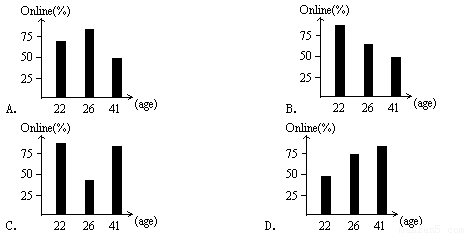
The survey was done in five major cities: Beijing, Shanghai, Guangzhou, Chengdu and Changsha.Results do not necessarily project countrywide because Internet use in rural areas is lower than in cities.Guo describes the typical netizen in the five cities surveyed as young, male, richer and more highly educated.Males make up two-thirds of the Internet community, and more than 80 percent of users are under 24.Among people ages 25 to 29, 60 percent to 80 percent go online.
China has more than 100 million people online, second in the world to the United States.
1.A typical Chinese Internet user may be the one who _________.
A.likes to send e-mails B.likes to buy goods online
C.likes to pay for entertainment D.likes the games sites
2.Online purchases still remain unpopular in China mainly because _________.
A.it is more difficult for sales returns
B.people haven’t computers
C.it is not convenient to purchase on line
D.all goods bought online are of low quality
3.Which of the following words fails to describe the typical netizens in the five cities?
A.well educated B.richer C.female D.young
4.According to the text, which of the following shows the right relation between online people and their ages?
湖北省互联网违法和不良信息举报平台 | 网上有害信息举报专区 | 电信诈骗举报专区 | 涉历史虚无主义有害信息举报专区 | 涉企侵权举报专区
违法和不良信息举报电话:027-86699610 举报邮箱:58377363@163.com