
题目列表(包括答案和解析)
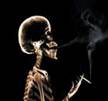 A new weapon is on the way in the fight against smoking in Europe.
Soon when smokers buy cigarettes, they might see a shocking photo of
a blackened lung or a cancer patient staring back at them from the packet.
Some boys may think of smoking as cool and sexy. Their friends won’t
agree when they see their packets of cigarettes lying on the table.
The European Union announced on October 22, that it had chosen 42 photos that showed the damage cigarettes could do to the body. It called on member nations to put these pictures on packets to discourage young smokers.
To catch the attention of teenagers, the special packets warn of long-term medical dangers, like cancer. Short-term effects, like bad skin, are also on the list.
“The true fact of smoking is disease, death and horror. That is the message we should send to the young,” said David Byrne, an EU health official. “Hopefully these pictures will shock students out of their love for cigarettes.”
The EU head office hoped the pictures would work better than current written warnings on packs of cigarettes. The warning included “smoking kills” and “smoking can lead to a slow and painful death.”
So far, Ireland and Belgium have shown interest in the photos. Canada has used similar pictures and warnings on cigarette packs since 2000.The country has recently seen a fall in the number of smokers.
According to studies, smoking is the single biggest cause of avoidable death in EU. Every year more than 650,000 smokers die, more than one person a minute.
68.What would be the best title for the text?
A.New Ways to Stop Smoking. B.Pictures to Shock Smokers.
C.New Packers of Cigarettes. D.Dangers of Smoking.
69.We can learn from the test that _______.
A.The EU countries have put the new warning method into practice
B.only a small number of the EU countries have used the new warning method
C.the new warning method has worked in some EU countries
D.countries in the EU still use the old warning method
70.Which country is most successful in stopping smoking?
A.Ireland. B.Belgium. C.Canada. D.EU
71.The underlined sentence in the last paragraph suggests that ________.
A.It’s hard to stop smoking in EU
B.deaths caused by smoking could have been avoided
C.smoking is the biggest cause of deaths in EU
D.EU has the largest number of deaths caused by smoking
A study of art history might be a good way to learn more about a culture than is possible to learn in general history classes. Most typical history courses concentrate on politics, economics and war. But art history focuses on much more than this because art reflects not only the political values of a people, but also religious beliefs, emotions and psychology. In addition, information about the daily activities of our ancestors can be provided by art. In short, art expresses the essential qualities of a time and a place, and a study of it clearly offers us a deeper understanding than can be found in most history books.
In history books, objective (客观的) information about the political life of a country is presented; that is, facts about politics are given, but opinions are not expressed. Art, on the other hand, is subjective: it reflects emotions and opinions. The great Spanish painter Francisco Goya was perhaps the first truly “political” artist. In his well-known painting The Third of May, 1808, he criticized the Spanish government for its abuse of power over people.
In the same way, art can reflect a culture’s religious beliefs. For hundreds of years in Europe, religious art had been almost the only type of art that existed. Churches and other religious buildings were filled with paintings that described people and stories from the Bible. Although most people couldn’t read, they could still understand the Bible stories in the pictures on church walls. By contrast (对比), one of the main characteristics of art in the Middle East was (and still is) its absence of human and animal images. This reflects the Islamic belief that statues are not holy.
Which of the following statements has the closest meaning to the underlined sentence?
A. General history only focuses on politics.
B. Art history shows us nothing but the political values.
C. General history concerns only religious beliefs, emotions and psychology.
D. Art history gives us an insight (洞察力) into the essential qualities of a time and a place.
Art is subjective in that __________.
A. it can easily arouse people’s anger about their government
B. it only reflects people’s anger or sadness about social problems.
C. a personal and emotional view of history is presented through it.
D. artists were or are religious, who reflect only the religious aspect of the society.
Which of the following statements is TRUE according to the passage?
A. Francisco Goya expressed his religious belief in his painting.
B. In history books political views of people are entirely presented.
C. For centuries in Europe, painters had only painted on walls of churches.
D. In the Middle East, you can hardly find animal or human figures on church walls.
What’s the main topic of the passage?
A. The development of art history.
B. What we can learn from art.
C. The influence of artists on art history.
D. The difference between general history and art history.
What time is it? Most people are pretty accurate in their answer. And if you don’t know for sure, it’s very likely that you can find out. There may be a watch on your wrist; there may be a clock on the wall, desk, or computer screen; or maybe you’re riding in a car that has a clock in the dashboard(仪表板).
Even if you don’t have a timepiece of some sort nearby, your body keeps its own beat. Humans have an internal clock that regulates(调节) the beating of our heart, the pace of our breathing, the discharge(排出) of chemicals within our bloodstream, and many other bodily functions.
Time is something from which we can’t escape. Even if we ignore it, it’s still going by, ticking away, second by second, minute by minute, hour by hour. So the main issue in using your time well is, “Who’s in charge?” We can allow time to slip by and let it be our enemy. Or we can take control of it and make it our ally.
By taking control of how you spend your time, you’ll increase your chances of becoming a more successful student. Perhaps more importantly, the better you are at managing the time you devote to your studies, the more time you will have to spend on your outside interests.
The aim of time management is not to schedule every moment so we become slaves of a timetable that governs every waking moment of the day. Instead, the aim is to permit us to make informed choices as to how we use our time. Rather than letting the day go by, largely without our awareness, what we are going to discuss next can make us better able to control time for our own purposes.
The underlined word “ally” in Para.3 most likely means somebody or something that is ___.
A. your supporter and helps you B. under your control and obeys you
C. under your influence and follows you D. your slave and serves you
The author intends to tell you that time __________.
A. could be managed by the internal clock of human bodies
B. should be well managed for our own interest
C. should be saved for outside interests
D. could be regulated by a timepiece such as a clock or a watch
In the next part, the author would most probably discuss with you _________.
A. how to make up for lost time B. how to have a good time
C. how to make good use of time D. how to keep up with the times
湖北省互联网违法和不良信息举报平台 | 网上有害信息举报专区 | 电信诈骗举报专区 | 涉历史虚无主义有害信息举报专区 | 涉企侵权举报专区
违法和不良信息举报电话:027-86699610 举报邮箱:58377363@163.com