warn sb. of sth. against/about doing (not) to do that clause The doctor warned him of the danger of smoking. against smoking. not to smoke. smoking is harmful to health. 查看更多


题目列表(包括答案和解析)

We’ve just heard a _____ on the radio that a hurricane is _____ to come.

  A. warn; like   B. warning; likely C. warned; able   D. warning; like

查看答案和解析>>

阅读理解

Working Wives

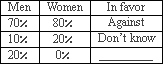
  Last week, we published an article about modern marriage.A recent survey showed that in England 51 percent of married women go out to work.People were asked what they thought of “working wives”.The results were as follows:

  We asked readers to write and tell us their opinions.Here are some of the hundreds of letters we received.?

  I’m a(woman)photographer.I make plenty of money, travel a lot, and meet a lot of people.I enjoy my work, and would hate to stay at home.I would never marry a man who wanted me to give up my work.

  O’Leary

  At present there are over 1,000,000 unemployed men in Britain.If a woman gets a job, she puts one more man out of work.Perhaps that man has a wife and twelve children to support.Let women stay at home where they belong to.

  Ted Stubbs

  I am a mother of twelve children.When I go to work, my husband looks after the children.He is very good with the children and enjoys staying at home with them.And I enjoy my job as a bus driver.

  Boot Battersea

  We are twin sisters, who both got married recently.One of us(Doreen)kept her job.The other(Doris)gave up her jobs.But Doris gets bored staying at home, and Doreen gets bored going out to work.So now Doreen works for a week, while Doris stays at home.Then Doris does Doreen’s job for a week, while Doreen stays at home.At work, they never know if it’s Doreen who’s working today!

  Doris & Doreen Bean Hendon

(1)

Last week we published an article about _________.

[  ]

A.

marriage nowadays

B.

working women

C.

working wives

D.

a strange marriage

(2)

The woman photographer would not marry a man who _________.

[  ]

A.

has less money than her

B.

likes staying at home

C.

is not very gentle

D.

wants her to stay at home

(3)

Ted Stubbs thought that women going out to work _________.

[  ]

A.

would make men lose chances for work

B.

would be better than men

C.

would weaken the right of the husband at home

D.

would be meaningless

(4)

When the bus driver goes to work, _________.

[  ]

A.

her children take care of themselves

B.

a nurse looks after her children instead of her

C.

her husband looks after the children

D.

she has to have everything ready for the children

查看答案和解析>>

We’ve just heard a _____ on the radio that a hurricane is _____ to come.

A. warn; like    B. warning; likely

C. warned; able   D. warning; like


查看答案和解析>>

完形填空

  One morning I wasted nearly an hour watching a tiny ant carry a huge feather.Several times, it   1   several obstacles in its path.And after a momentary pause it would make the necessary detour.  2   one point, the ant had to cross a crack about 10mm wide.After some   3   thoughts, the ant laid the feather over the crack, walked   4   it and picked the feather up on the other side, then continued on its way.I was   5   by the cleverness of this ant.It was only a small insect, lacking in   6   yet equipped with a brain to reason, explore, discover and overcome.  7   this ant, like the other two-legged creatures   8   on the earth, also shares human failings.

  After some time the ant   9   reached its destination-a flower bed and a small hole that was the entrance to its   10   home.It was there that the ant met its   11  .How could that large feather possibly   12   such a small hole?Of course, it couldn't.So the ant, after all the   13   and using great brightness, overcoming problems all along the way, just gave up the   14   and went home.The ant had not thought the problem through   15   it began its journey and in the end the feather was   16   more than a burden.Isn't our   17   like that?

  We worry about our families; we worry about the   18   of money; and we worry about all kinds of things.These are all burdens-the things we pick up along life's path, and drag them around the obstacles and over the cracks that life will bring, only to   19   that at the destination they are   20   and we can't take them with us.

(1)

[  ]

A.

dealt with

B.

got over

C.

came across

D.

brought about

(2)

[  ]

A.

At

B.

For

C.

To

D.

With

(3)

[  ]

A.

brave

B.

tiring

C.

magic

D.

short

(4)

[  ]

A.

across

B.

through

C.

beside

D.

behind

(5)

[  ]

A.

frightened

B.

attracted

C.

annoyed

D.

satisfied

(6)

[  ]

A.

size

B.

height

C.

depth

D.

length

(7)

[  ]

A.

Therefore

B.

But

C.

Moreover

D.

Otherwise

(8)

[  ]

A.

working

B.

sleeping

C.

living

D.

walking

(9)

[  ]

A.

probably

B.

suddenly

C.

easily

D.

finally

(10)

[  ]

A.

underground

B.

lonely

C.

comefortable

D.

big

(11)

[  ]

A.

partner

B.

match

C.

parent

D.

friend

(12)

[  ]

A.

fit

B.

fix

C.

suit

D.

fill

(13)

[  ]

A.

decision

B.

pleasure

C.

trouble

D.

matter

(14)

[  ]

A.

insect

B.

problem

C.

hole

D.

feather

(15)

[  ]

A.

after

B.

until

C.

before

D.

once

(16)

[  ]

A.

nothing

B.

anything

C.

something

D.

everything

(17)

[  ]

A.

study

B.

aim

C.

dream

D.

life

(18)

[  ]

A.

waste

B.

lack

C.

worth

D.

danger

(19)

[  ]

A.

think

B.

find

C.

wonder

D.

warn

(20)

[  ]

A.

bad

B.

practical

C.

useless

D.

meaningful

查看答案和解析>>

【2011·贵州遵义七校联考】A

 O. Henry was a pen name used by an American writer of short stories. His real name was William Sydney Porter. He was born in North Carolina in 1862. As a young boy he lived an exciting life. He did not go to school for very long, but he managed to teach himself everything he needed to know. When he was about 20 years old, O. Henry went to Texas, where he tried different jobs. He first worked on a newspaper, and then had a job in a bank. When some money went missing from the bank, O. Henry was believed to have stolen it. Because of that, he was sent to prison. During the three years in prison, he learned to write short stories. After he got out of prison, he went to New York and continued writing. He wrote mostly about New York and the life of the poor there. People liked his stories, because simple as the tales were, they would finish with a sudden change at the end, to the readers’ surprise.

41.   In which order did O. Henry do the following things?

a. Lived in New York.

b. Worked in a bank.

c. Traveled to Texas.

d. Was put in prison.

e. Had a newspaper job.

f. Learned to write stories.

A. e, c, f, b, d, a                                              B. c, b, e, d, a, f

C. e, b, d, c, a, f                                              D. c, e, b, d, f, a

42.   People enjoyed reading O. Henry’s stories because _____.

A. they had surprise endings                       B. they were easy to understand

C. they showed his love for the poor                  D. they were about New York City

43.   What do we know about O. Henry before he began writing?

A.      He was well-educated.

B.      He was very good at learning.

C.      He was devoted to the poor.

D.     He was not serious about his work.

44.   Where did O. Henry get most material for his short stories?

A. His life inside the prison.                        B. The newspaper articles he wrote.

C. The city and people of New York.           D. His exciting early life as a boy.

查看答案和解析>>


同步练习册答案