
题目列表(包括答案和解析)
Good afternoon, and welcome to England. We hope that your visit here will be a pleasant one. Today, I would like to draw your attention to a few of our laws.
The first one is about drinking. Now, you may not buy wine in this country if you are under 18 years of age, nor may your friends buy it for you.
Secondly, noise. Enjoy yourselves by all means, but please don't make unnecessary noise, especially at night. We ask you to respect other people who may wish to be quiet.
Thirdly, crossing the road. Be careful. The traffic moves on the left side of the road in this country. Use pedestrian crossings(人行道)and do not take any chances when crossing the road.
My next point is about rubbish. It isn't lawful to drop rubbish in the street. When you have something to throw away, please put it in your pocket and take it home, or put it in a dustbin.
Finally, as regards(至于)smoking, it is against the law to buy cigarettes or tobacco if you are under 16 years of age.
I'd like to finish by saying that if you require any sort of help or assistance(帮助), you should contact the police, who will be pleased to help you. You can call, write or directly go to ask any policeman.
1.Who do you think is most likely to make the speech?
A. A guide(向导) B. A person who makes laws
C. A teacher D. An English officer
2.How many laws are there discussed in the speech?
A. Four B. Three C. Six D. Five
3. The main purpose of this speech is to __________.
A. tell people that those above 18 can drink and smoke there
B. declare the different laws of England
C. give advice to travelers to the country
D. warn people against going to the country
4. The underlined word "contact" in the last paragraph means to __________.
A. keep in touch with(联系) B. turn to C. make a call to D. write to
| |||||||||||||||||||||||||||||||||||||||||||||
( C )
In Denmark, parents are allowed to set up a new school if they are dissatisfied with the school in the area where they are living. Although these schools have to follow the national courses, they are allowed a lot of choice in deciding what to teach. Some of these new schools are called “small schools” because usually the number of pupils in them is only sixty, but a school has to have at least twenty-seven pupils.
Cooleenbridge School in Ireland, is a small school similar to the ones in Denmark, it was set up by parents who came from Holland, Germany, Czechoslovakia, England and other parts of Ireland. They came because they wanted to live in the countryside and to grow their own food. In June 1986, they decided to start a school. They managed to get an old, disused primary-school (小学) building and started with twenty-four children aged from four to twelve.
The teachers say, “The important thing in school is doing, not sitting.” And so the courses includes yoga(瑜伽), cooking, knitting, kite-making, music, fishing, drama (戏剧) and environmental(环境的) river studies, as well as reading, writing, maths and science.
【小题1】What are the rules for setting up a new school in Denmark?
| A.Parents are allowed to set up their own school. |
| B.The school has to follow the national courses. |
| C.The school has to have at least 27 pupils. |
| D.All of the above. |
| A.it was set up by parents who are not people of Denmark |
| B.it was taken as an example of this kind of “small school” |
| C.there were only twenty-four children |
| D.the pupils there were aged from 4 to 12 |
| A.It is set up by parents not by government. |
| B.It is free to decide what to teach. |
| C.The number of pupils in it is only sixty. |
| D.It has to have at least 27 pupils. |
| A.What we should do is teaching in the classroom, not sitting in the office. |
| B.Children should do more homework at home, not just sit in class to listen to the teachers. |
| C.Children should learn by themselves not rely on teachers. |
| D.Children should learn through practice not just from books. |
| A.yoga, cooking, knitting, kite-making, music, fishing, drama and environmental river studies, except reading, writing, maths and science |
| B.either yoga, cooking, knitting, kite-making, music, fishing, drama and environmental river studies, or reading, writing, maths and science |
| C.not only reading, writing, maths and science, but also yoga, cooking knitting, kitemaking, music, fishing, drama and environmental river studies |
| D.mainly yoga, cooking, knitting, kite-making, music, fishing, drama and environmental river studies, and supplemental (补充的) reading writing, maths and science |
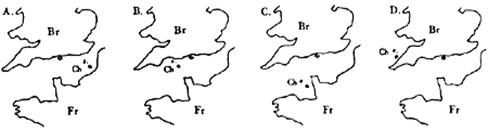
The Channel Islands are a group of British-owned islands lying in the English Channel, 10 to 30 miles off the French coast, and 70 to 90 miles from the English coast. There are ten islands with a total land area of 75 square miles and a total population of 123,000. The three largest islands, Jersey, Guernsey, and Alderney, have long been known for the fine breeds (品种) of cattle that are raised on them and named after them.
In earliest known history the islands were considered part of Normandy, which was part of France, but the ruler of Normandy became king of England in 1066, and from then on the islands were looked upon as British land. English control was unbroken until World War II, when the Germans held the islands for five years.
Although people on the islands speak both languages and they are considered English, their customs are more French than English.
1.Which of the following maps gives the right position of the Channel Islands?
Br = Britain Fr = France Ch = Channel Islands
2.Jersey, Guernsey, and Alderney breeds of cattle are __________.
A. considered best in England
B. named after their birthplaces
C. brought to the islands by the Germans
D. raised on well-known farms by the French
3. The Channel Islands have been continuously under British rule since__________.
A. earliest known history B. 1066
C. 1930s D. the end of World War II
4.Why do people on the Channel Islands follow French way of living?
A. Their islands used to be part of France.
B. Their islands are often visited by the French.
C. They came from France.
D. They speak French.
完型填空
Have you ever imagined that you could be cloned like Dolly the sheep in the not too distant future?
The news that a human embryo (胚胎) has been 1 cloned for the first time has caused mixed reactions (反映).
The 2 was carried out by scientists from the Advanced Cell Technology Inc (ACT), in Massachusetts, US. The group 3 the news on November 25.
“This is 4 human being. A clone is alive, it walks, it breathes,” said Jamie Grifo, 5 on the study of cloning at New York University School of Medicine.
“This is a set of cells in a lab that will be used to 6 someone's life. ”
Such research could lead to treatment for 7 such as heart diseases, AIDS and even cancer, 8 scientists.
Despite high hopes from other scientists, the news raised concerns immediately from religious and political leaders. Several 9 in the US do not allow human cloning. President George W. Bush also made it clear that he is 10 any type of human cloning. However, the scientists at ACT said they have no interest at present in 11 an early embryo into __12__.
Animals have been cloned repeatedly since Dolly the sheep 13 in 1997. And there were no real technical 14 to stand in the way of scientists making a cloned human embryo.
This time the research group used traditional cloning technology with a human 15
16 it was given DNA from an adult cell, the egg began to __17__.__18__ it was stopped from becoming a baby--at a stage in which it was 19 a ball of cells. The 20 technology has been used to clone sheep, cattle and monkeys.
(1)
[ ]
(2)
[ ]
(3)
[ ]
(4)
[ ]
(5)
[ ]
(6)
[ ]
(7)
[ ]
(8)
[ ]
A. according to
B. including
C. besides
D. argued
(9)
[ ]
(10)
[ ]
(11)
[ ]
A. developing
B. building
C. inventing
D. discovering
(12)
[ ]
(13)
[ ]
(14)
[ ]
(15)
[ ]
(16)
[ ]
(17)
[ ]
(18)
[ ]
(19)
[ ]
(20)
[ ]
湖北省互联网违法和不良信息举报平台 | 网上有害信息举报专区 | 电信诈骗举报专区 | 涉历史虚无主义有害信息举报专区 | 涉企侵权举报专区
违法和不良信息举报电话:027-86699610 举报邮箱:58377363@163.com