
题目列表(包括答案和解析)
Most of us spend our lives seeking the natural world. To this end, we walk the dog, play golf, go fishing, sit in the garden, drink outside rather than inside the pub, have a picnic, live in the suburbs, go to the seaside, buy a weekend place in the country. The most popular free time activity in Britain is going for a walk. And when joggers (慢跑者) jog, they don’t run the streets. Every one of them automatically heads to the park or the river. It is my firm belief that not only do we all need nature, but we all seek nature, whether we know we are doing so or not.
But despite this, our children are growing up nature-deprived (丧失). I spent my boyhood climbing trees. These days, children are robbed of these ancient freedoms, due to problems like crime, traffic, the loss of the open spaces and strange new ideas about what is best for children, that is to say, things that can be bought, rather than things that can be found.
The truth is to be found elsewhere. A study in the US: families had moved to better housing and the children were assessed for ADHD (多动症). Those whose housing had more natural views showed an improvement of 19%; those who had the same improvement in material surroundings but no nice view improved just 4%.
A study in Sweden indicated that kindergarten children who could play in a natural environment had less illness and greater physical ability than children used only to a normal playground. A US study suggested that when a school gave children access to a natural environment, the entire school would do better in studies.
Another study found that children play differently in a natural environment. In playgrounds, children create a hierarchy (等级) based on physical abilities, with the tough ones taking the lead. But when a grassy area was planted with bushes, the children got much more into fantasy play, and the social hierarchy was now based on imagination and creativity.
Most bullying (恃强凌弱) is found in schools where there is a tarmac (柏油碎石) playground; the least bullying is in a natural area that the children are encouraged to explore. This reminds me unpleasantly of Sunnyhill School, with its hard tarmac, where I used to hang about in corners dreaming about wildlife.
But children are frequently discouraged from involvement with natural spaces, for health and safety reasons, for fear that they might get dirty or that they might cause damage. So, instead, the damage is done to the children themselves: not to their bodies but to their souls.
One of the great problems of modern childhood is ADHD, now increasingly and expensively treated with drugs. Yet one study after another indicates that contact with nature gives huge benefits to ADHD children. However, we spend money on drugs rather than on green places.
The life of old people is much better when they have access to nature. The most important for the growing population of old people is in quality rather than quantity of years. And study after study finds that a garden is the single most important thing in finding that quality.
In wider and more difficult areas of life, there is evidence to indicate that natural surroundings improve all kinds of things. Even problems with crime and aggressive behaviour are reduced when there is contact with the natural world.
Dr William Bird, researcher from the Royal Society for the Protection of Birds, states in his study, “A natural environment can reduce violent behaviour because its process helps reduce anger and behavior that people might regret later.” Wild places need encouraging for this reason, no matter how small their contribution.
We tend to think human beings are doing nature some kind of favor when we are protecting nature. The error here is far too deep: not only do humans need nature for themselves, but the very idea that humanity and the natural world are separable things is damaging.
Human beings are a species of animals. For seven million years we lived on the planet as part of nature. So we miss the natural world and long for contact with non-human life. Anyone who has patted a dog, stroked a cat, sat under a tree with a glass of beer, given or received a bunch of flowers or chosen to walk through the park on a nice day, understands that.
We need the wild world. It is necessary to our well-being, our health, our happiness. Without other living things around us we are less than human.
1.What is the author’s firm belief?
A. People seek nature in different ways.
B. People should spend most of their lives in the wild.
C. People have quite different ideas of nature.
D. People must make more efforts to study nature.
2.What does the author say people prefer for their children nowadays?
A. Personal freedom. B. Things that are natural.
C. Urban surroundings. D. Things that are purchased.
3.What does a study in Sweden show?
A. The natural environment can help children learn better.
B. More access to nature makes children less likely to fall ill.
C. A good playground helps kids develop their physical abilities.
D. Natural views can prevent children from developing ADHD.
4.Children who have chances to explore natural areas ________.
A. tend to develop a strong love for science
B. are more likely to dream about wildlife
C. tend to be physically tougher in adulthood
D. are less likely to be involved in bullying
5.What does the author suggest we do to help children with ADHD?
A. Find more effective drugs for them.
B. Provide more green spaces for them.
C. Place them under more personal care.
D. Engage them in more meaningful activities
6. In what way do elderly people benefit from their contact with nature?
A. They look on life optimistically. B. They enjoy a life of better quality.
C. They are able to live longer. D. They become good-humored
阅读理解
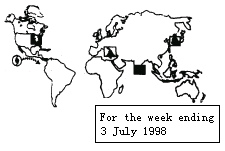
EARTH WEEK-A DIARY OF THE PLANETEnduring Storms
Several more rounds of severe storms, tornadoes and flash flooding struck many parts of the American Midwest and Northeast as bad weather continued across the US for a second month.
Monsoon Storms
A south-west monsoon has caused havoc in parts of SriLanka. Government meteorologists said that unexpected monsoonal winds blew directly across the country from the Southern Hemisphere at about 100 km/h, producing several rounds of stormy weather. Nearly 250 houses in the capital Colombo were damaged.
For the week ending 3 July 1998
Mt. Etna Erupts
Sicily’s Mount Etna volcano erupted shortly after midnight on July 1, shooting“bombs”of lava nearly 1.5 metres in diameter on the eastern side of the mountain. The 30-minute eruption could be seen for several miles, but did not threaten any nearby villages.
Hurricane
Hurricane Blas lost strength as it moved over cooler waters in the Pacific Ocean to the west of Mexico. Blasformed off southwest Mexico during the previous week, but squalls on the outer fringes of the storm lashed western Michoacan State, killing four people when their wood and cardboard home collapsed.
Monkey Repellent
After years of unsuccessful attempts to keep crop-eating monkeys out of Japanese fields, a Tokyo research team believes that it may have finally found a way to prevent the damage caused by the monkeys. Animal raids on crops were successfully prevented by shooting chilli powder into the air, irritating the eyes and noses of monkeys that passed in front of carefully-placed warning sensors.“We’ve tried…all kinds of preventive measures, but the monkeys are smart enough to outwit the tricks,”said Toshiaki Wada, Director of the Tokyo Forestry Experiment Station in western Tokyo.
1.The monsoon is Sri Lanka ________.
[ ]
A.was of average strength
B.destroyed more property than previous monsoons
C.was not typical for that time of the year
D.affected only the outer areas of the nation
2.What aspect of Hurricane Blas does the map show?
[ ]
3.According to the information, which of the following statements is TRUE?
[ ]
A.The eruption of Mt. Etna lasted thirty days.
B.Hurricane Blas was formed off the coast of Italy.
C.The American Midwest had fine weather throughout July 1998.
D.The eruption of Mt. Etna did not destroy local villages.
4.According to the information, the monkeys in the Japanese fields ________.
[ ]
A.destroy crops
B.kill unsuspecting humans
C.spread eye diseases to humans
D.stop farmers from working
5.Toshiaki Wada, Director of the Tokyo Forestry Experiment Station, would describe the monkeys as ________.
[ ]
Maria would not go to the party, as she had no fine dress, no jewelry _____.
A. to show B. shown
C. showing off D. to show off
EAT YOUR VEGETABLES.Wash your hands. Always say “please” and “thank you”. We are full of advice for our children, but when it comes to money, we often have little to say. As a result, our children may grow up with clean hands and good manners, but without any idea how tomanage their money.
Here are some basics that will help guide them their entire lives:
Show them the future. If your 13-year-old girl were to save $1.000,invest(投资)it at 8% and add $100 every month, by the time she’s 65,she would have $980,983!
Be careful of credit(信用).Credit cards can help you buy necessary things and build a credit history, but they must be used responsibly, which means paying off your debt in time. Explain to your children that when you buy something using a credit card, you can easily end up paying two or three times what you would have paid if you used cash.
Teach patience. Suppose your child wants a new bicycle that costs $150.Rather than paying the cash, give him some regular pocket money and explain that by putting aside,say,$15 each week, he will be able to buy it for himself in only ten weeks.
Provide incentive. Tell your children the importance of saving. “For every dollar he or she agrees to save and invest rather than spend, you agree to add another dollar to the pot,” says Cathy Pareto, expert in money planning.
Explain your values. Values and money are deeply intertwined, says Eilleen Gallo,co-author of The Financially Intelligent Parent. When your child demands that you buy something, explain why you really don’t want to buy it.“You might say, ‘I’d rather save that money for your education,’” advises Gallo. Every time you spend or don’t spend money, you have a chance to share your values.
【小题1】The writer gives some basics to help________ in a proper way.
| A.parents teach their children how to deal with money |
| B.children follow their parents’ instructions |
| C.children manage their money |
| D.parents save their money |
| A.give him some regular pocket money |
| B.encourage him to put money away for it |
| C.explain to him the importance of investment |
| D.tell him to save some money by using a credit card |
| A.honor | B.praise | C.excitement | D.encouragement |
| A.Parents want to know how to educate their children. |
| B.He wants to share his good ideas about money matters. |
| C.He thinks money management the most important for children. |
| D.Parents care Little about their children’s management of money. |
根据短文内容,从短文后的七个选项中选出能填入空白处的最佳选项。选项中有两项为多余选项。
Early Childhood EducationEarly childhood education is the formal(正规的)teaching and care of young children.It primarily focuses on learning through playing to encourage the child's different kinds of development. 1
Studies with Head Start programs throughout the United States have shown some evidence that there are quite a few advantages to early childhood education, which can produce significant gains in children's learning and development.Compared to a child who does not attend pre-school, children completing their early education programs are found to be better at math and reading skills.They are excited to learn and have the tools to do so. 2 These children are more competent in their pre-school, kindergarten and school-age years, and they are usually reported as “friendlier” by parents and the children's peers(同伴).
3 In studies with matched control groups, more students who had early schooling experiences were employed at the age of 19, fewer were on welfare, and fewer were involved with the criminal activity.What's more, some studies show that children attending pre-school are more likely to graduate and have higher education, and be well integrated(综合)as an adult.
Early childhood education gives most children a jump-start on education for their kindergarten and primary school years.It is clear that early childhood education can have some great benefits for children. 4 If early childhood education is less effective, perhaps the best model is finding strategies for allowing a parent to stay home with his or her child for at least the first two to three years.Also important is considering a child's own personality. 5
A.The long-term influence of early education is significant as well.
B.They can benefit greatly from encouragement in their early childhood.
C.Yet its quality must be assessed to see what kind of benefits it actually provides.
D.They are also able to relate to others in a superior way and that improves their social skills.
E.Many experts of education have concerned about what early childhood education means today.
F.Individual differences in children mean that not all children will get equal benefits from early childhood education.
G.It consists of activities that serve children in the pre-school years and is designed to improve later school performance.
湖北省互联网违法和不良信息举报平台 | 网上有害信息举报专区 | 电信诈骗举报专区 | 涉历史虚无主义有害信息举报专区 | 涉企侵权举报专区
违法和不良信息举报电话:027-86699610 举报邮箱:58377363@163.com