
题目列表(包括答案和解析)
Even plant can run a fever, especially when they’re under attack by insects or disease. But unlike human, plants can have their temperature taken from 3, 000 feet away straight up. A decade ago, adopting the infrared (红外线)scanning technology developed for military purposes and other satellites, physicist Stephen Paley came up with a quick way to take the temperature of crops to determine which ones are under stress. The goal was to let farmers precisely target pesticide (杀虫剂)spraying rather than rain poison on a whole field, which invariably includes plants that don’t have pest (害虫)problems.
Even better, Paley’s Remote Scanning Services Company could detect crop problems before they became visible to the eye. Mounted on a plane flown at 3, 000 feet at night, an infrared scanner measured the heat emitted by crops. The data were transformed into a color-coded map showing where plants were running“fevers”. Farmers could then spot-spray, using 50 to 70 percent less pesticide than they otherwise would.
The bad news is that Paley’s company closed down in 1984, after only three years. Farmers resisted the new technology and long - term backers were hard to find. But with the renewed concern about pesticides on produce, and refinements in infrared scanning, Paley hopes to get back into operation. Agriculture experts have no doubt the technology works. “This technique can be used on 75 percent of agricultural land in the United States, ” says George Oerther of Texas A & M. Ray Jackson , who recently retired from the Department of Agriculture, thinks remote infrared crop scanning could be adopted by the end of the decade. But only ff Paley finds the financial backing which he failed to obtain 10 years ago.
Plants will emit an increased amount of heat when they are______________.
A. sprayed with pesticides
B. facing an infrared scanner
C. in poor physical condition
D. exposed to excessive sun rays
In order to apply pesticide spraying precisely, we can use infrared scanning to____________.
A. estimate the damage to the crops
B. measure the size of the affected area
C. draw a color-coded map
D. locate the problem area
Farmers can save a considerable amount of pesticide by______________.
A. resorting to spot-spraying
B. consulting infrared scanning experts
C. transforming poisoned rain
D. detecting crop problems at an early stage
The application of infrared scanning technology to agriculture met with some difficulties
_______________.
A. the lack of official support
B. its high cost
C. the lack of financial support
D. its failure to help increase production
Infrared scanning technology may be brought back into operation because of_____________.
A. the desire of farmers to improve the quality of their produce
B. growing concern about the excessive use of pesticides on crops
C. the forceful promotion by the Department of Agriculture
D. full support from agricultural experts
Even plant can run a fever, especially when they’re under attack by insects or disease. But unlike human, plants can have their temperature taken from 3, 000 feet away - straight up. A decade ago, adopting the infrared (红外线)scanning technology developed for military purposes and other satellites, physicist Stephen Paley came up with a quick way to take the temperature of crops to determine which ones are under stress. The goal was to let farmers precisely target pesticide (杀虫剂)spraying rather than rain poison on a whole field, which invariably includes plants that don’t have pest (害虫)problems.
Even better, Paley’s Remote Scanning Services Company could detect crop problems before they became visible to the eye. Mounted on a plane flown at 3, 000 feet at night, an infrared scanner measured the heat emitted by crops. The data were transformed into a color - coded map showing where plants were running“ fevers”. Farmers could then spot - spray, using 50 to 70 percent less pesticide than they otherwise would.
The bad news is that Paley’s company closed down in 1984, after only three years. Farmers resisted the new technology and long - term backers were hard to find. But with the renewed concern about pesticides on produce, and refinements in infrared scanning, Paley hopes to get back into operation. Agriculture experts have no doubt the technology works. “This technique can be used on 75 percent of agricultural land in the United States, ” says George Oerther of Texas A & M. Ray Jackson , who recently retired from the Department of Agriculture, thinks remote infrared crop scanning could be adopted by the end of the decade. But only ff Paley finds the financial backing which he failed to obtain 10 years ago.
56.Plants will emit an increased amount of heat when they are________.
A. sprayed with pesticides B. facing an infrared scanner
C. in poor physical condition D. exposed to excessive sun rays
57.In order to apply pesticide spraying precisely, we can use infrared scanning to________.
A. estimate the damage to the crops B. measure the size of the affected area
C. draw a color -coded map D. locate the problem area
58.Farmers can save a considerable amount of pesticide by________.
A. resorting to spot – spraying B. consulting infrared scanning experts
C. transforming poisoned rain D. detecting crop problems at an early stage
59.The application of infrared scanning technology to agriculture met with some difficulties________.,
A. the lack of official support B. its high cost
C. the lack of financial support D. its failure to help increase production
60.Infrared scanning technology may be brought back into operation because of________.
A. the desire of farmers to improve the quality of their produce
B. growing concern about the excessive use of pesticides on crops
C. the forceful promotion by the Department of Agriculture
D. full support from agricultural experts
完形填空
A couple from Minneapolis, in the north, decided to go to Florida, in the south, for a long weekend during one particularly icy cold winter. They both had jobs, and had 1 managing their travel schedules(日程安排)It was decided the husband would fly to Florida on a Thursday, and his wife would 2 him the next day. Upon arriving as 3 , the husband checked into the 4 There he decided to 5 his laptop(computer)and send his wife an email back in Minneapolis. However, he 6 left off one letter in her 7 and sent the e-mail without 8 his error.
In the 9 in Houston, a widow(寡妇)had just returned from her husband’s burial service He was a minister of many years who had been“called home to glory”following a heart 10 (died and gone to report in heaven). The widow checked her e-mail, 1l messages from family and friends. Upon 12 the first message, she was so shocked as to fall to the floor, The widow’s son 13 into the room, found his mother on the floor and saw the computer 14 which read:
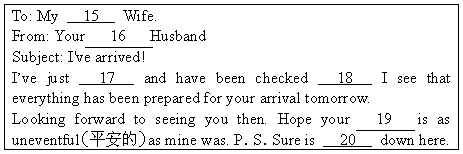
|
(1)A.confidence |
B.argument |
C.doubt |
D.difficulty |
|
(2)A.visit |
B.detect |
C.follow |
D.track |
|
(3)A.aimed |
B.planned |
C.meant |
D.programmed |
|
(4)A.hotel |
B.office |
C.airport |
D.station |
|
(5)A.open |
B.set |
C.show |
D.begin |
|
(6)A.willingly |
B.accidentally |
C.purposely |
D.aimlessly |
|
(7)A.article |
B.sentence |
C.address |
D.letter |
|
(8)A.looking |
B.watching out |
C.noticing |
D.observing |
|
(9)A.absence |
B.course |
C.meantime |
D.case |
|
(10)A.blow |
B.knock |
C.strike |
D.attack |
|
(11)A.hearing |
B.typing |
C.hoping |
D.expecting |
|
(12)A.taking |
B.reading |
C.staring |
D.bringing |
|
(13)A.rushed |
B.charged |
C.hurried |
D.walked |
|
(14)A.screen |
B.keyboard |
C.window |
D.mouse |
|
(15)A.Living |
B.Loving |
C.Brave |
D.Poor |
|
(16)A.Disappeared |
B.Deserted |
C.Departed |
D.Dead |
|
(17)A.gone |
B.died |
C.left |
D.arrived |
|
(18)A.over |
B.back |
C.out |
D.in |
|
(19)A.arrangement |
B.journey |
C.voyage |
D.adventure |
|
(20)A.hot |
B.sad |
C.new |
D.quiet |
Even plant can run a fever, especially when they’re under attack by insects or disease. But unlike human, plants can have their temperature taken from 3, 000 feet away - straight up. A decade ago, adopting the infrared (红外线)scanning technology developed for military purposes and other satellites, physicist Stephen Paley came up with a quick way to take the temperature of crops to determine which ones are under stress. The goal was to let farmers precisely target pesticide (杀虫剂)spraying rather than rain poison on a whole field, which invariably includes plants that don’t have pest (害虫)problems.
Even better, Paley’s Remote Scanning Services Company could detect crop problems before they became visible to the eye. Mounted on a plane flown at 3, 000 feet at night, an infrared scanner measured the heat emitted by crops. The data were transformed into a color - coded map showing where plants were running“ fevers”. Farmers could then spot - spray, using 50 to 70 percent less pesticide than they otherwise would.
The bad news is that Paley’s company closed down in 1984, after only three years. Farmers resisted the new technology and long - term backers were hard to find. But with the renewed concern about pesticides on produce, and refinements in infrared scanning, Paley hopes to get back into operation. Agriculture experts have no doubt the technology works. “This technique can be used on 75 percent of agricultural land in the United States, ” says George Oerther of Texas A & M. Ray Jackson , who recently retired from the Department of Agriculture, thinks remote infrared crop scanning could be adopted by the end of the decade. But only ff Paley finds the financial backing which he failed to obtain 10 years ago.
56.Plants will emit an increased amount of heat when they are________.
A. sprayed with pesticides B. facing an infrared scanner
C. in poor physical condition D. exposed to excessive sun rays
57.In order to apply pesticide spraying precisely, we can use infrared scanning to________.
A. estimate the damage to the crops B. measure the size of the affected area
C. draw a color -coded map D. locate the problem area
58.Farmers can save a considerable amount of pesticide by________.
A. resorting to spot – spraying B. consulting infrared scanning experts
C. transforming poisoned rain D. detecting crop problems at an early stage
59.The application of infrared scanning technology to agriculture met with some difficulties________.,
A. the lack of official support B. its high cost
C. the lack of financial support D. its failure to help increase production
60.Infrared scanning technology may be brought back into operation because of________.
A. the desire of farmers to improve the quality of their produce
B. growing concern about the excessive use of pesticides on crops
C. the forceful promotion by the Department of Agriculture
D. full support from agricultural experts
| |||||||||||||||||||||||||||||||||||||||||||||||||||||||||||
湖北省互联网违法和不良信息举报平台 | 网上有害信息举报专区 | 电信诈骗举报专区 | 涉历史虚无主义有害信息举报专区 | 涉企侵权举报专区
违法和不良信息举报电话:027-86699610 举报邮箱:58377363@163.com