
题目列表(包括答案和解析)
I had my first job at the age of thirteen, when a friend of my mother’s who owned a book shop 36 me for six hours a week to help her in the shop. I was very 37 to earn my own pocket money and my parents 38 interfered with how I spent it, even when I was spending it 39 . They believed that by earning money, spending it, and learning from the 40 , I would become more mature and 41 about how to handle work, relationships with others, and money.
Like many 42 parents, my parents also let me and my brothers do things over which they 43 a great deal. When I was sixteen, for example, after I finished high school and before I entered university, I wanted to spend the summer months traveling around 44 . My mother was against the idea of my traveling alone at such a young age, but my father felt that it would be a great 45 for me. In the end, my father won the 46 on the condition that I limited my traveling to France, my mother’s home, where I had many uncles, aunts and cousins 47 through the country who could 48 shelter and help if I needed them.
Three years later, my younger brother decided to 49 a year off after his first year in university and travel through the United States and the Caribbean. Again my mother was very worried and not 50 to see my brother leave school, but my father encouraged him and my brother had a(n) 51 year working his way on trains and ships to 52 passage to different ports and cities, and discovering many fascinating places and people.
These kinds of experiences are probably rare for children in many countries but in the US they are fairly 53 . Most parents start 54 their children at a young age to do small things by themselves. By the time they have finished high school, many American kids have already had part-time jobs, traveled around the US or other countries on their own, have 55 the university they plan to attend and maybe even decided on their future career, and so on.
36. A. taught B. allowed C. treated D. hired
37. A. anxious B. content C. proud D. hopeful
38. A. never B. ever C. always D. even
39. A. quickly B. foolishly C. seriously D. honestly
40. A. work B. mistakes C. others D. books
41. A. strict B. reasonable C. polite D. responsible
42. A. American B. Japanese C. Chinese D. British
43. A. helped B. supported C. shared D. worried
44. A. Asia B. Africa C. Europe D. Oceania
45. A. journey B. experience C. chance D. possibility
46. A. argument B. game C. discussion D. plan
47. A. send out B. give out C. carry out D. spread out
48. A. promise B. afford C. provide D. serve
49. A. leave B. make C. take D. prepare
50. A. angry B. eager C. sorry D. sad
51. A. unusual B. hard C. strange D. busy
52. A. accept B. earn C. find D. search
53. A. welcome B. fit C. necessary D. common
54. A. bringing B. forcing C. pushing D. protecting
55. A. selected B. admired C. afforded D. left
第二节:完形填空(共20小题;每小题1.5分,满分30分)
Learning values and character at home is as important as any schoolwork. We all hope that the very values 36 are important to each of us are 37 along to our children. Often, 38 , that hope is challenged by a great many of pop culture messages, peer pressure (同伴压力), and overscheduled lives.
In the real world of jobs and career, people are 39 by two standards: Their professional skills and their 40 abilities. 41 grade school, high school, and college can teach skills and proficiency, it’s 42 parents to teach children the characters that make for 43 in the real world—a cooperative attitude, 44 , optimism and honesty. So take the work 45 . Send your kids into the world ready to 46 not only the tasks of life but its difficulties with character.
You really can’t start soon enough. 47 , children need personal integrity (个人操守) and morals as much as any adult. 48 the 5 to 10 most important messages you want your children to truly understand. Then think through 49 to teach these lessons. Talking to your kids should be only 50 of the plan. Letting them 51 honesty in action—through your own behaviour, by 52 films about great people together, or even by visiting a courtroom—is the 53 way to pass the message.
By identifying the specific 54 you would like to see in your children, you’re more likely to 55 those characters. So make a point of it.
36. A. which B. that C. who D. /
37. A. handed B. given C. belonged D. passed
38. A. therefore B. however C. thus D. besides
39. A. chosen B. divided C. selected D. judged
40. A. personal B. outstanding C. collective D. genetic
41. A. While B. When C. Until D. Unless
42. A. for B. to C. on to D. up to
43. A. work B. success C. grow D. maturity
44. A. depression B. encouragement C. creativity D. desertion
45. A. quickly B. eventually C. seriously D. obviously
46. A. face B. achieve C. make D. handle
47. A. First of all B. After all C. In all D. All in all
48. A. Work out B. Go over C. Write down D. Get through
49. A. how B. what C. where D. why
50. A. root B. base C. all D. part
51. A. witness B. stare C. gaze D. scan
52. A. reading B. scanning C. watching D. examining
53. A. easiest B. strongest C. cruelest D. simplest
54. A. problems B. manners C. wonders D. characters
55. A. strengthen B. forget C. remind D. tear
C
This summer vacation,Xiaokai,a high school student in Guangzhou,planned to spend his time surfing the Internet,playing basketball and watching TV.
But Xiaokai's parents tried to make him read some classics at home.In their yees,reading the classics would do his son much more good than other activities.
Though his room was full of the classic books,he had just finished reading one of them,The Old Man and the Sea.
"I picked up the book just because it was not very thick,"he said."Nothing impressed me at all after reading."
Xiaokai is not alone in today's China.Now most of the teenagers are fond of reading martial arts stories,cartoons and popular magazines.Theose classics cannot get them interested at all.
Parents areworrying about this phenomenon(现象).They always tell their chilren to read the classsics,which is supposed to help their children improve their academic studies.
Ms Li made a classics reading plan for her daughter,but her daughter refused to carry it away.She just finished less than 10 pages of the Dream of Red Chamber(阁楼) during the whole summer vacation. Ms Li sighed,"What's wrong with the children today?"
It is the same with teachers.One middle school Chinese teacher once prepared a chart(图表) of Interpersonal relationship in the best-known novel Dream of Red Chamber for his students. They were asked to remember how the characters are related to each other while preparing for the final exam.
To improve the situation in which the fastfood culture (快餐文化) seems to be winning over teenagers,parents are expected to understand their children's interests, and guide them to read the books instead of forcing them,according to some experts.It is not necessary for the kids to read the classics in their childhood.They can read classics after having their own life experience.
64.Xiaokai read only one classic book because _______.
A.he didn't have more
B.he wasn't interested in the classics
C.it took him a lot of time
D.he just acted on his parents' advice
65.When the writer says"Xiaokai is not alone",she means that ________.
A.many others don't like classics either
B.some parents and teachers support Xiaokai
C.Xiaokai is not the family's only child
D.Xiaokai often reads together with others
66.Which belong,or belongs,to the fastfood culture according to the article?
A.The old Man and the Sea.
B.The Dream of Red Chamber.
C.Martial arts stories.
D.The books filling up Xiaokai's room.
67.Who would be more likely to stand on the side of that Chinese teacher?
A.The students. B.The parents. C.The experts. D.The writer.
| |||||||||||||||||||||||||||||||||||||||||||||||||||||||||||
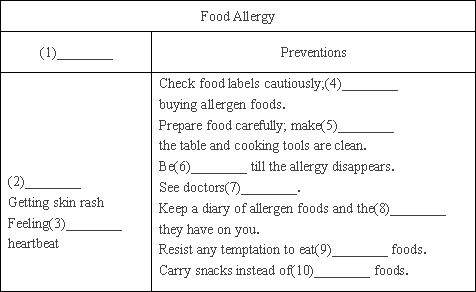
请认真阅读下列短文,并根据所读内容填入最恰当的单词。注意:每空只填一个单词。
Have you ever started sneezing when eating peanuts, getting rash on your skin or feeling your heat starting to beat faster? Statistics show that around 12 million Americans suffer from food allergy, with 6.9 million allergic to seafood and 3.3 million allergic to peanuts or tree nuts.
Food allergic symptoms occur immediately after having an allergen food.The food is treated as harmful to the body, by the immune system, which defends our organism from harmful external attacks.Here are a few guidelines about things you should know and how to put them into practice to prevent food allergies and eat healthily.
When buying food, read attentively the labels on the food products.All manufacturers according to the new Food Allergen and Consumer Act must clearly list all the elements of the product including the 8 food allergens even if they are present in very small amounts.Don’t buy these products, even if they might be cheaper.
Parents should be very careful when preparing food.The table and cooking tools used need to be clean.It is recommended to cook the food of the allergic person in the first place.
Food allergic persons should have a little patience.In certain people, the allergy disappears gradually.Visit your doctor at regular times to find about the progress of your allergies instead of having strict diets every day.
Keep a diary to note the foods that worsen your food allergies, new experiences and changes that you notice.Being tempted to have a piece of cake can be very dangerous.Your health is much more worth than it.Always think about the efforts people around you are putting to create an allergic-free environment for you.
Allergic persons should avoid consuming cakes that are not homemade and should always carry some snacks on them.Buying food in restaurants is risky.
湖北省互联网违法和不良信息举报平台 | 网上有害信息举报专区 | 电信诈骗举报专区 | 涉历史虚无主义有害信息举报专区 | 涉企侵权举报专区
违法和不良信息举报电话:027-86699610 举报邮箱:58377363@163.com