
题目列表(包括答案和解析)
Drinking Water: Bottled or From the Tap?
In America, people will include a case or two of bottled water when buying the week's groceries. When they are going to a soccer game or activity, it's common for them to grab a cold bottle of water out of the fridge with them.In fact, Americans buy more bottled water than any other nation in the world, about 29 billion bottles a year.
But all these plastic bottles use a lot of fossil fuels and pollute the environment.In order to make all the 29 billion bottles, producers use 17 million barrels of crude oil, which is enough to keep a million cars going for 12 months.
So why don't people drink water straight from the tap? Some people have a strong belief that bottled water is better than water out of the tap, but that's not necessarily true.In the US, the local governments make sure water from the tap is safe.There is also growing concern that chemicals in the bottles themselves may go into the water.
People love the convenience of bottled water.But maybe if they realized the problems it causes, they would try drinking from a glass at home or carrying water in a reusable steel container instead of plastic.
Some argue that plastic bottle recycling can help.Recycled bottles can be turned into items like carpeting or clothing.Unfortunately, only one in six bottles is recycled.The rest make it to landfills(垃圾填埋场)or end as trash in other places.Plastic bottles take hundreds of years for them to disintegrate.
Water is important for you, so keep drinking it.But think about how often you use water bottles, and see if you can make a change.
And yes, you can make a difference.Remember this: Recycling one plastic bottle can save enough energy to power a 60-watt light bulb for six hours.
【小题1】Why do Americans prefer bottled water?
| A.Bottled water is better than water from the tap. |
| B.Bottled water is cheaper than water from the tap. |
| C.Bottled water contains beneficial chemicals in it. |
| D.Bottled water is more convenient than water from the tap. |
| A.Be well recycled. | B.Become less poisonous. |
| C.Break into small pieces. | D.Go down below a surface. |
| A.drink more water from the tap |
| B.send plastic bottles to landfills |
| C.use water bottles to power light bulls |
| D.buy bottles filled with water from the tap |
When you want to go shopping, decide how much money you can spend on new clothes. Think about the kind of clothes you really need. Then look for those clothes you really need. Then look for those clothes on sale.
There are labels(标签)inside all new clothes. The labels tell you how to take care of your clothes. The label for a shirt may tell you to wash it in warm water. A sweater label may tell you to wash in cold water. The label on a coat may say “dry clean only ”, for washing may uin this coat. If you do as the directions (说明) on the label, you can keep your clothes looking their best for a long time.
Many clothes today must be dry cleaned. Dry cleaning is expensive. When buying new clothes, check to see if they will need to be dry cleaned. You will save money if you buy clothes that can be washed.
You can save money if you buy clothes that are well made. Well-made clothes last longer. They look good even after they have been washed many times. Clothes that cost more money are not necessarily better made. They do not always fit better. Sometimes less expensive clothes look and fit better than more expensive clothes.
68. If you want to save money , you had better buy clothes that_____.
A. don’t fit you B. don’t last long C. need to be dry cleaned D. can be washed
69. The label inside the clothes tell you________.
A. how to keep the clothes looking their best B. how to save money
C. whether the clothes fit you or not D. where to get the clothes dry cleaned
70. The first thing for you to do before you buy clothes is ______
A. to look for well-made clothes B. to see how much money you can spend on it
C. to know how to wash them D. to read the labels inside them
71. We learn from the passage that cheaper clothes_______.
A. are always worse made B. must be dry cleaned
C. can not be washed D. can sometimes fit you better
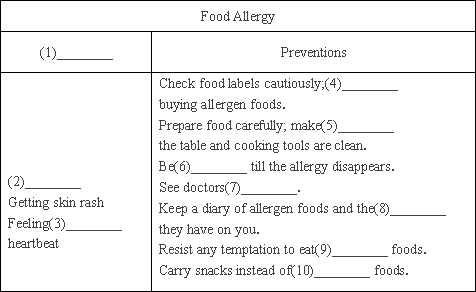
请认真阅读下列短文,并根据所读内容填入最恰当的单词。注意:每空只填一个单词。
Have you ever started sneezing when eating peanuts, getting rash on your skin or feeling your heat starting to beat faster? Statistics show that around 12 million Americans suffer from food allergy, with 6.9 million allergic to seafood and 3.3 million allergic to peanuts or tree nuts.
Food allergic symptoms occur immediately after having an allergen food.The food is treated as harmful to the body, by the immune system, which defends our organism from harmful external attacks.Here are a few guidelines about things you should know and how to put them into practice to prevent food allergies and eat healthily.
When buying food, read attentively the labels on the food products.All manufacturers according to the new Food Allergen and Consumer Act must clearly list all the elements of the product including the 8 food allergens even if they are present in very small amounts.Don’t buy these products, even if they might be cheaper.
Parents should be very careful when preparing food.The table and cooking tools used need to be clean.It is recommended to cook the food of the allergic person in the first place.
Food allergic persons should have a little patience.In certain people, the allergy disappears gradually.Visit your doctor at regular times to find about the progress of your allergies instead of having strict diets every day.
Keep a diary to note the foods that worsen your food allergies, new experiences and changes that you notice.Being tempted to have a piece of cake can be very dangerous.Your health is much more worth than it.Always think about the efforts people around you are putting to create an allergic-free environment for you.
Allergic persons should avoid consuming cakes that are not homemade and should always carry some snacks on them.Buying food in restaurants is risky.
When you want to go shopping, decide how much money you can spend on new clothes. Think about the kind of clothes you really need. Then look for those clothes you really need. Then look for those clothes on sale.
There are labels(标签) inside all new clothes. The labels tell you how to take care of your clothes. The label for a shirt may tell you to wash it in warm water. A sweater label may tell you to wash in cold water. The label on a coat may say “dry clean only”, for washing may ruin this coat. If you do as the directions (说明)on the label, you can keep your clothes looking their best for a long time.
Many clothes today must be dry cleaned. Dry cleaning is expensive. When buying new clothes, check to see if they will need to be dry cleaned. You will save money if you buy clothes that can be washed.
You can save money if you buy clothes that are well made. Well-made clothes last longer. They look good even after they have been washed many times. Clothes that cost more money are not necessarily(不一定) better made. They do not always fit better. Sometimes less expensive clothes look and fit better than more expensive clothes.
If you want to save money, you had better buy clothes that __ .
A.don’t fit you B.don’t last long
C.need to be dry cleaned D.can be washed
The labels inside the clothes tell you______.
A.how to keep them looking their best B.how to save money
C.whether they fit you or not D.where to get them dry cleaned
The first thing for you to do before you buy clothes is __ .
A.to look for well-made clothes
B.to see how much money you can spend on it
C.to know how to wash them
D.to read the labels inside them
We learn from the passage that cheaper clothes __ .
A.are always worse made B.must be dry cleaned
C.can not be washed D.can sometimes fit you better
The best title for the passage should be __ .
A.Buy Less Expensive Clothes
B.Taking Enough Money When Shopping
C.Being a Clever Clothes Shopper
D.Choosing the Labels inside New Clothes
I needed to buy a digital camera, one that was simply good at taking good snaps (快照), maybe occasionally for magazines. Being the cautious type, I fancied a reliable brand. So I went on the net, spent 15 minutes reading product reviews on good websites, wrote down the names of three top recommendations and headed for my nearest big friendly camera store. There in the cupboard was one of the cameras on my list. And it was on special offer. Oh joy. I pointed at it and asked an assistant, “Can I have one of those?” He looked perturbed (不安). “Do you want to try it first?” he said. It didn’t quite sound like a question. “Do I need to?” I replied ,“There is nothing wrong with it?” This made him look a bit insulted and I started to feel bad. “No, no. But you should try it,” he said encouragingly. “Compare it with the others.”
I looked across at the others: shelves of similar cameras placed along the wall, offering a wide range of slightly different prices and discounts, with each company selling a range of models based around the same basic box. With so many models to choose from, it seemed that I would have to spend hours weighing X against Y, always trying to take Z and possibly H into account at the same time. But when I had finished, I would still have only the same two certainties that I had entered the store with: first, soon after I carried my new camera out of the shop, it would be worth half what I paid for it; and second, my wonderful camera would very quickly be replaced by a new model.
But something in the human soul whispers that you can beat these traps by making the right choice, the clever choice, the wise choice. In the end, I agreed to try the model I had chosen. The assistant seemed a sincere man. So I let him take out of my chosen camera from cupboard, show how it took excellent pictures of my fellow shoppers… and when he started to introduce the special features, I interrupted to ask whether I needed to buy a carry-case and a memory card as well.
Why do we think that new options(选择) still offer us anything new? Perhaps it is because they offer an opportunity to avoid facing the fact that our real choices in this culture are far more limited than we would like to imagine.
1.The shop assistant insisted that the writer should
A. try the camera to see if there was anything wrong with it.
B. compare the camera he had chosen with the others.
C. get more information about different companies.
D. trust him and stop asking questions.
2.What does the writer mean by “it would be worth half what I paid for it ”(paragraph 2)
A. He should get a 50% discount.
B. The price of the camera was unreasonably high.
C. The quality of the camera was not good.
D. The camera would soon fall in value.
3.The writer decided to try the model he had chosen because he
A. knew very little about it.
B. didn’t trust the shop assistant.
C. wanted to make sure the one he chose would be the best.
D. had a special interest in taking pictures of his fellow shoppers.
4.I t can be inferred from the passage that in the writer’s opinion, .
A. people waste too much money on cameras
B. cameras have become an important part of our daily life
C. we don’t actually need so many choices when buying a product
D. famous companies care more about profit than quality
湖北省互联网违法和不良信息举报平台 | 网上有害信息举报专区 | 电信诈骗举报专区 | 涉历史虚无主义有害信息举报专区 | 涉企侵权举报专区
违法和不良信息举报电话:027-86699610 举报邮箱:58377363@163.com