
题目列表(包括答案和解析)
1.Which words tell us what the sun is like?
A. Huge. B. Hot. C. Bright. D. All above.
6.How far away are the middle group of moons from Jupiter?
A. It’s not mentioned. B. 11,100,000 kilometers away.
C. 127,600 kilometers away. D. 20,700,000 kilometers away.
Passage 11
WHY IS THE SUN IMPORTANT?
The sun is a huge, hot, bright star. It is important because without it there would be no life on Earth. The sun gives us light and heat.
All living things need light and heat from the sun to live. Plants need light and heat to grow. They use the light from the sun to make food. We cannot make our own food, but plants can. All the food we eat comes from plants in a food chain(链)which starts with the sun. For example,
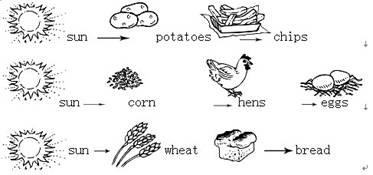
Animals need sunlight, too. Just like us, their food comes from a food chain which begins with the sun and the plants.
sun→ leaf→ caterpillar(毛虫)→bird
sun→ seaweed(海藻)→small fish→ whale(鲸)
Sunlight means we can see during the day. If there was no sun, it would be dark all the time. Even when the sky is cloudy, the sunlight is very strong and it shines through the clouds.
5.According to the passage,which of the following statements is true?
A. None of Jupiter’s moons have names. B. Most of Jupiter's moons circle clockwise.
C. Jupiter's inner moons were discovered first. D. Jupiter is the nearest planet to the earth.
4.The numbers given to Jupiter’s moons tell ______.
A. the order in which they were discovered B. the order in which they travel
C. the order of their distance from Jupiter D. the order of names
3.Jupiter’s _____group of moons travel in a clockwise direction.
A. planets B. inner C. middle D. outer
2.Things that travel in the same direction as the hands of a clock are said to be traveling in a______.
A. clockwise direction B. counter-clockwise direction
C. same direction D. different direction
1.What does “solar system” in this article mean?______
A. 银河系 B. 宇宙空间 C. 流星雨 D. 太阳系
5.Which of the following is wrong?
A.In winter the snail doesn’t eat or move. B.A snail doesn’t like living under the sun.
C.The snail’s teeth can’t be worn out. D.The snail’s nose helps to find food.
Passage 10
Jupiter’s Moons and How They Travel
The many moons of Jupiter travel around the planet in different directions (方向).
Jupiter is the largest planet in our solar system. Over the years, scientists have found that Jupiter has its own small solar system. Earth has one moon. Jupiter has at least sixteen and probably more.
Since there are so many moons, scientists began to number them. The numerals(numbers)tell the sequence, or order, in which the moons were found. They were slower to name the moons. All of Jupiter’s moons now have a name as well as a number.
The first five moons to be discovered are known as the “inner moons”. But they are not the closest to the planet. The closest is only 127,600 kilometers away from Jupiter. All the inner moons circle the planet in counter-clockwise direction, that is, opposite of the hands of a clock.
Jupiter’s middle group of moons are at least 11,100,000 kilometers from the planet. They also move in a counter-clockwise motion (moving). The four farthest moons are at least 20,700,000 kilometers away. These are called “outer moons”. They circle in a clockwise motion.
How many more moons do you think will be discovered?
4.A snail goes to sleep when _____.
A. it feels hungry B. it is put into a paper box
C. spring is coming D. it rains heavily
3.From the story, we know _________.
A. a snail’s shell is very thin B. a snail can’t see well
C. a snail’s nose is quite short D. a snail’s body changes in different seasons
湖北省互联网违法和不良信息举报平台 | 网上有害信息举报专区 | 电信诈骗举报专区 | 涉历史虚无主义有害信息举报专区 | 涉企侵权举报专区
违法和不良信息举报电话:027-86699610 举报邮箱:58377363@163.com