
题目列表(包括答案和解析)
25. My son __________ his clock when I went to get a cup I __________ in his study.
A. was winding up; had left B. would up; had forgotten
C. had wounded; left D. was winding up; forgot
24. All those _____ about the poor children should be _____.
A. concerned; thanked B. are concerned; thanked
C. who are concerned; thanked for D. are concerned; thanked for
23. After graduation, he _____ the challenge, which _____ all his spare time.
A. took up; took up B. took on; took on C. took in; took over D. took on; took in
22. We can make some adjustments __________ the reactions of the customers.
A. in answer to B. in response to C. in reply to D. A,B and C
第一节 单项填空(满分15分)
21. __________ the man’s rude behavior cost him his job, he was still in high spirits.
A. As B. Despite C. Because D. While
第二节:听下面5段对话或独白。每段对话或独白后有几个小题,从每题所给的A,B,C 三个选项钟;听完后,各小题将给出5秒钟的作答时间。每段对话或独白读两遍。
听第6段材料, 回答第6至8题。
6. What is the woman doing?
A. She is reading a novel. B. She is cleaning her room. C. She is washing clothes.
7. What is the probable relationship between the two speakers?
A. College classmates. B. Husband and wife. C. Workmates.
8. What will the woman do during the National Holiday?
A. To go to the beach. B. To climb the mountains. C. To read a novel at home.
听第7段材料, 回答第9至11题。
9.What do you think the man probably is?
A. A shop manager. B. A manager in a taxi company. C. A kind-hearted policeman.
10. What is in the woman’s handgbag?
A. Some money and an ID card. B. Some keys and a postcard. C. Some money and an IC card.
11. What do we know about the woman?
A. The woman left her handbag in a shop.
B. The woman took a taxi in the morning.
C. The woman’s name is Jenny White.
听第8段材料, 回答第12至14题。
12. When will the radio station broadcast?
A.
Only in the morning. B. Only during
the daytime. C. Twenty-four hours a
day
13.
What does the man like best?
A.
Light music. B. Pop music. C. Rock music
14.
Which of the following is NOT true according to the conversation?
A. The
school has its own newspaper.
B. The
school is going to have its own radio station.
C. The
station will offer all kinds of music.
听第9段材料,
回答第15至17题。
15.
Which month is it now?
A. April. B. June. C. September.
16.
What are they mainly talking about?
A. An
advertisement. B. A new kind of
car. C. Summer holiday.
17.
What is NOT the reason the woman gave for waiting?
A. The
car will be on sale in summer holiday.
B. It
is better to get some information about it.
C. It
is said the car is not good.
听第10段材料,回答第18至20题。
18. Where did Smith finally arrive?
A. At a country inn. B. At a country shop. C. At a country hospital.
19. What did he want to do?
A. To laugh at others. B. To give others some fish. C. To make himself warm.
20. Why did all the people run out?
A. To see a horse. B. To see the horse eat fish. C. To see the rain.
假如你叫李明,你的英国笔友David 是个教师,他和家人想要来中国定居,请你帮他在A、B 两个城市中做出选择。下面的图表对两个城市的就业机会、居住环境和娱乐三个方面进行对比。请你根据该表提供的信息用英语写一封电子邮件,提出你的建议并说明理由。图表左边的数字说明人们对这两个城市的喜爱程度。
注意: 词数100左右;短文开头和结尾已为你写好,不计入总词数。
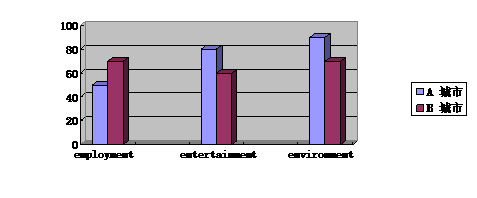
Dear David,
I’m so glad to learn that you and your family are coming to settle down in China.
_______________________________________________________________________________
Your friend,
Li Ming
命题:高一英语备课组 校对:朱舲
杭十四中二〇〇八学年第一学期期末测试
根据所学课文材料填入所缺单词或词组,以使文章通顺。
(A)
Yes, but it was a long time ago. This is 71 the story goes. A footballer was 72 taking money for deliberately not scoring goals so as to let the other team win. We went to interview him. He 73 taking money but we were sceptical. So we arranged an interview between the footballer and the man supposed to bribe him. When we saw them together we guessed from the footballer’s body language that he was not telling the truth. So we wrote an article suggesting he was 74 . It was a dilemma because the footballer could have demanded damages if we were wrong. He tried to stop us 75 it but later we were proved right.
(B)
There are various 76 why people write poetry. Some poems tell a story or describe something in a way that will give the reader a strong impression. Others try to convey certain emotions. Poets use many different forms of poetry to 77 . In this text, however, we will look at a few of the simpler forms.
Some of the first poetry a young child learns in English is nursery rhymes. These rhymes like the one on the right are 78 a common type of children’s poetry. The language is 79 but imaginative, and they delight small children because they rhyme, have strong rhythm and a lot of repetition. The poems may not 80 and even seem contradictory, but they are easy to learn and recite. By playing with the words in nursery rhymes, children learn about language.
湖北省互联网违法和不良信息举报平台 | 网上有害信息举报专区 | 电信诈骗举报专区 | 涉历史虚无主义有害信息举报专区 | 涉企侵权举报专区
违法和不良信息举报电话:027-86699610 举报邮箱:58377363@163.com