
题目列表(包括答案和解析)
25. They spent the whole night______ in the room waiting for the thief to come.
A. having locked B. locking C. locked D. to be locked
24. I can’t understand is he wants to change his mind.
A. That, what B. That, why C. What, what D. What, why
23. “Terrorists _______ war on the United States, and war is what they got.” Bush said.
A. attacked B. declared C. fought D. offered
22. Most children need encouragement in time of failure _______ they can cheer up again.
A. so that B. in case C. because D. if
第一节 单项填空(共10小题,每小题1分,满分10分)
21. -How often do you eat out?
- , but usually once a week.
A. Have no idea B. As usual C. It depends D. Generally speaking
第二节 听下面5段对话或独白。每段对话或独白后有几个小题,选出最佳选项。每段对话或独白读两遍。
听下面一段对话,回答第6至8题。
6. What are the two speakers mainly talking about?
A. When they surf the Web.
B. What they do on the Internet.
C. How they look up information online.
7. How often does the man probably surf the Internet?
A. Once a week. B. Twice a week. C. Several times a week.
8. What do we know about the man?
A. He has never sent e-mails.
B. He shows no interest in the Internet.
C. He gets some help from the Web.
听下面一段对话,回答第9至11题。
9. Who are the two speakers?
A. A conductor and a conductress.
B. A reporter and a cyclist.
C. The organizer of the race and a conductress.
10. When does the dialogue take place?
A. A day before the race. B. Right after the race. C. During the race.
11. How long has she been cycling?
A. 17 years. B. 18 years. C. 19 years.
听下面一段对话,回答第12至13题。
12. What’s the most probable relationship between the two speakers?
A. Classmates. B. Workmates. C. Boyfriend and girlfriend.
13. Why was the man feeling angry?
A. Because he thought he had lost his phone.
B. Because he wanted to call the woman but forgot the number.
C. Because he took the wrong phone.
听下面一段对话,回答第14至16题。
14. What’s wrong with Amy’s eyesight?
A. She’s near-sighted. B. She’s far-sighted.
C. She’s got her eyes hurt but reading things too close up.
15. Where can Amy get her new eyeglasses?
A. In the eyeglasses store next door.
B. At the doctor’s.
C. In any eyeglasses store she wants.
16. What does the doctor suggest to Amy?
A. Coming back when she notices a problem.
B. Having her eyes examined every month.
C. Coming back about every six months.
听下面一段对话,回答第17至20题。
17. What is the topic of the passage?
A. College life in America. B. Students in America. C. Education in America.
18. How many years do elementary and secondary schools together take in the U. S.?
A. 6. B. 12. C. 13.
19. Which course are suitable for a student who wants to work after high school?
A. Accounting and typing. B. Physics and chemistry. C. Mathematics.
20. What can you learn from what the speaker has said?
A. Children must attend school until 18.
B. It’s hard for one without a high school diploma to find a job.
|
第一节 听下面5段对话。每段对话后有一个小题,选出最佳选项。每段对话仅读一遍。
1. What news did the woman get from the man?
A. Susan will leave Beijing very soon. B. Mary will leave Shanghai very soon.
C. Susan will leave Shanghai very soon.
2. How does the man prefer to go to work?
A. By car. B. By bus. C. On foot.
3. What is “My Fair Lady” ?
A. A newspaper. B. A TV program. C. A movie.
4. What can we learn from the dialogue?
A.The man advised the woman to visit the Museum.
B. The woman followed the man’s advice.
C. The man had a photo taken in the space suit.
5. Where does the conversation most probably take place?
A. At home. B. In a restaurant. C. At the supermarket.
根据所给图表,写一篇题为”电影与电视”的短文。短文须包括以下要求:
A电影观众人数呈逐年下降趋势;
B电视观众人数越来越多(原因:方便、经济、选择范围广);
C然而还是有人喜欢看电影(原因:气氛、娱乐)。
注意:
1短文须包括主要内容,可适当增减,使内容连贯,
2词数100左右,
要求:
1 语言连贯、要点齐全、书写认真、否则扣分。
2 字数120左右。
参考词汇:
decrease v.下降 atmosphere n.氛围entertainment n.娱乐
film goer/TV watcher电影/电视观众
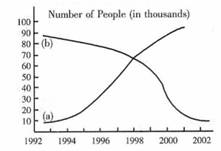
(a): Number of TV watchers (b): Number of film goers
湖北省互联网违法和不良信息举报平台 | 网上有害信息举报专区 | 电信诈骗举报专区 | 涉历史虚无主义有害信息举报专区 | 涉企侵权举报专区
违法和不良信息举报电话:027-86699610 举报邮箱:58377363@163.com