
题目列表(包括答案和解析)
---How ____ is it from here Ningbo to Xi'an?
---It's about two ____ flight.
|
A.long, hour's |
B.far, hour's |
C.long, hours' |
D.far, hours' |
--- ______ hard work you have done!
--- It’s very kind of you to say so.
| A.What | B.How | C.What a | D.How a |
Laboratory work is your chance to learn science firsthand. It can be fun but you must be careful to prevent injury. Listen closely when your teacher reads and explains the rules before your first lab lesson.
LABORATORYRULES
Throughout the lesson
·Do not enter the science lab without the teacher’s permission.·No food or drinks are to be alowed in the science lab.
Before the Experiment
·Read al instructions carefuly before every experiment.
·Prepare al apparatus(仪器)and arrange them so that you wil not knock them over while doing the experiment.
During the Experiment
·If you are unsure of how to use any apparatus or how to operate, ask your teacher for help.·Never smel or taste chemicals unless your teacher gives permission.
After the Experiment
·Wash al apparatus after use and return them to the places where they were.
·Throw waste materials in proper waste baskets. First Aid
·Report al accidents to your teacher immediately.
·If you spil( 溅 出 )any chemicals onto your body or clothing, wash with plenty of water and report to your teacher.
1. Your teacher wil probably tel you the rules above _____ the first lab lesson.
A. before B. since C. during D. after
2. Before every experiment, you should _____.
A. taste the chemicals first
B. clean al the apparatus
C. read al instructions carefuly
D. report al the accidents to the teacher
3. When you are not sure how to use al apparatus, _____.
A. try them on your own
B. read the rules carefuly
C. ask your teacher for help
d. put them back
4. It is clear that you can _____.
A. bring food into the lab
B. enter the lab anytime
C. smel chemicals as you like
D. learn science directly in the lab
5. If you get chemicals on the clothing, you can find ways to solve it in the part _____.
A. Before the Experiment
B. First Aid
C. During the Experiment
D. After the Experiment
根据句意和首字母提示,写出正确的单词
1.The panda comes f China.Its f food is bamboo.It can c trees.
2.The snake is Asian. It h no friends. It doesn't like w ,but the elephant likes ?water. It can eat 600 kilos of g in a day.
3.The camel lives in the d in Africa.
4.The wolf lives in the E forest. It likes to eat m .
5.The kangaroo comes from A .
What do you do if you're stranded(处于困境的)on a lonely island? Surely you need to find a way to get in touch with the outside world. Your best chance of doing this is to draw the attention of a passing plane.
Body signals(信号)
Pilots from different countries understand body signals if they have the correct training. When you wave your arms up and down in a straight line, it means "yes". When you point downwards and swing your arm from side to side, it means "no". If you want the pilot to know that it's safe to land, push your hands out in front of you and bend(弯曲)your knees. If you want to say that it's not safe to land, put your arms in the air and move them to one side.
Smoke signals
The smoke from a fire can be seen from far away, so it's a good way to draw attention. If the weather is dry, it isn't hard to start a fire. Remember, however, that fires can be very dangerous if they get out of control. Never light a fire unless you're sure that it can't spread. If the ground is dark, light smoke can be seen more easily. Green grass and leaves produce light smoke.
Ground-to-air signals
It's a good idea to build some signals, too. Use large pieces of wood to make the symbols(标记). If you can't find any wood, use earth. Some useful symbols are:
F "I need food and water."
II "I need medicine."
I "I am badly hurt."
X" I am unable to move from here."
Pilots' replies
If the pilot lowers the plane's wings from side to side, this means "message received and understood". (At night, the pilot flashes the plane's green lights.) If the pilots flies the plane in a clockwise circle, this means "message received but not understood".(At night, the pilot flashes the plane's red lights.)
However, there is no signal which means "message not received". Why not?
1. Which picture means "it's not safe land"?
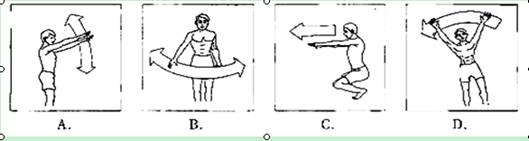
2. What can we learn from the passage?
A. Swinging your arm from side to side means "yes".
B. If the ground is dark, light smoke can't be seen.
C. If you need some medicine, make a symbol "II".
D. The pilots make replies with a blue light at night.
3. What is the passage mainly about?
A. The explanation of building signals on an island.
B. The importance of making signals on an island.
C. Ways of sending out signals on a lonely island.
D. Ways of receiving signals from a lonely island
湖北省互联网违法和不良信息举报平台 | 网上有害信息举报专区 | 电信诈骗举报专区 | 涉历史虚无主义有害信息举报专区 | 涉企侵权举报专区
违法和不良信息举报电话:027-86699610 举报邮箱:58377363@163.com