
题目列表(包括答案和解析)
Assertiveness is the ability to confidently express your opinions, feelings,attitudes, and rights, in a way that doesn't infringe(侵犯) the rights of others.
Many of us are taught that it is not nice to consider our own needs above those of others. If someone says or does something that we don't like, we should just be quiet and try to stay away from that person in the future.
Why is Assertiveness important?
If you don't know how to be assertive, you might experience:
•Depression - Anger, a sense of being helpless, hopeless, or of having no control over your life.
•Resentment - Anger at others for taking advantage of you.
•Frustration - Why did I allow that to happen?
Most people find it easier to be assertive in some situations than in others. This makes perfect sense. It's a lot easier to hold your ground with a stranger than with someone you love. But the more important the relationship is to you, the more important it is to be assertive. Assertive behavior leads to increased respect from others!
But before you decide to act assertively, you have to decide if you can live
with the results. Although assertive behavior usually will result in a positive
response (积极的回应),some people might react differently.
How to be effectively(有效地) assertive:
•Use "I" statements. Keep the focus on the problem you're having. "I'd like to be able to tell my stories without interruption." instead of "You're always interrupting my stories ! "
•Use facts, not opinions. "Did you know that shirt has a hole?" instead of "You're not going out looking like THAT, are you?"
•Express ownership of your thoughts, feelings, and opinions. "I get angry when he breaks his promises. " instead of "He makes me angry. "
• Make clear and direct requirements. Don't invite the person to say no. "Will you please?" instead of 'Would you mind...?" or "Why don't you...?"
•Keep repeating your point. Use a low level and pleasant voice. Don't try to explain yourself.
1.The writer probably agrees that____________.
A. you should consider others' response before you act assertively
B. you should be assertive if you want to get good marks
C. assertiveness is the ability to infringe others' rights.
D. assertive behavior will bring you bad feelings
2.The expression "hold yourground" probably means “_________________”
A. reach an agreement
B. insist on your point
C. keep your word
D. keep on fighting
3.Which of the following helps you to be effectively assertive?
A. Explaining yourself in a soft and sweet voice.
B. Expressing ownership of others' thoughts.
C. Making requirements directly and clearly.
D. Using your opinions instead of facts.
| 完形填空。 | |||
| If you study in America, you need to know some classroom customs.When the teacher asks a question, you 1 to give an answer. If you do not understand the question, you should put up your hand and ask the teacher to 2 the question. If you do not know the answer, it is all 3 to tell the teacher that you do not know. Then he or she may know 4 you need to learn. There is 5 for not doing your homework. If you are absent, you should call your teacher or someone 6 is in your class and ask for the homework. It is not the teacher's responsibility to remind you 7 your missed homework. You must not be absent on a test day. If you are 8 ill, call and let the teacher 9 you can't be there for the test. If your teacher allows you to make up the test, you should take the test within one or two days after returning to class. Serious illness is the only mason for 10 a test. Be on time! It is considered rude to be late. Also, it disturbs other students. 11 you come late, be sure to be quiet. Have your books and papers out of your bag 12 you enter the room. Then come in and go to your seat quietly. In the U.S. it is not necessary to knock when you enter the classroom. If you must leave during a class, do so quietly. There is no need to ask for the teacher's permission. Before entering a teacher's office or 13 office with a closed door, knock first, then wait to 14 in. 15 in class is considered impolite by many teachers. Some teachers may ignore it, but you should get permission first. | |||
| ( )1. A. expected ( )2. A. pardon ( )3. A. wrong ( )4. A. what ( )5. A. no use ( )6. A. those ( )7. A. on ( )8. A. hardly ( )9. A. knows ( )10. A. not attending ( )11. A. For ( )12. A. after ( )13. A. any ( )14. A. be noticed ( )15. A. With a hat |
B. are expecting B. repeat B. right B. how B. no time B. who B. to B. strongly B. to know B. taking B. Once B. while B. all B. be invited B. In a hat |
C. are expected C. ask C. stupid C. how many C. no chance C. which C. in C. badly C. know C. not missing C. Even if C. before C. anyone C. be stopped C. Putting on a hat |
D. expect D. raise D. helpful D. why D. no excuse D. whose D. of D. mostly D. knew D. passing D. Although D. as soon as D. a D. let D. Wearing a hat |
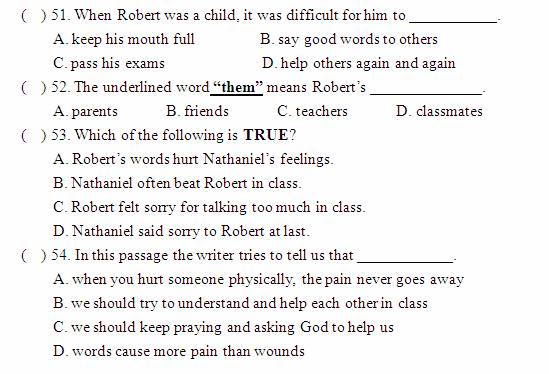
Ever since I was a child, my mouth has caused me trouble. I’m not a bad person; I have just had a hard time learning when to keep my mouth closed.
My mom has told me again and again, “Robert, your constant bad words are hurting me. If you continue to be this rude, you will get into big trouble.”
It’s been a problem at school several times, too, when teachers have told me something I didn’t want to hear. I used to feel it was my duty to stand up for myself and tell them off.
One day in English class I began working on my homework until I heard a classmate talking behind me. It was Nathaniel, talking to himself as usual.
I said ever so nicely, “Nathaniel, would you be quiet?”
Nathaniel continued talking to himself. I quickly shouted, “Nathaniel, shut up!”
For the next five minutes, we threw hurtful words back and forth at each other.
“At least I don’t have an ugly lazy eye like you!” I shouted.
I knew this would bother him deep inside. It would hurt his feelings and shut him up.
What I said filled him with anger. He tried to reach over my seat and grab (抓住) me as he shouted, “That’s it! That’s it!”
Surprised at his reaction, I sat back in seat. Never had I seen Nathaniel act like this before.
Later on, we were taken to the principal’s (校长) office.
There, the principal told us to discuss the matter. It wasn’t until then that I finally found that when I hurt someone physically, the wounds (伤口) eventually heal(痊愈). But when I hurt them with my words, sometimes the pain never goes away.
At the end of the discussion, I said sorry to Nathaniel.
When I headed back to my room, I spent some time praying (祈祷). I began to think about how often what I said hurt others. But I believe that as I keep praying and asking God to help me, He’ll tell me when to keep my mouth closed.
湖北省互联网违法和不良信息举报平台 | 网上有害信息举报专区 | 电信诈骗举报专区 | 涉历史虚无主义有害信息举报专区 | 涉企侵权举报专区
违法和不良信息举报电话:027-86699610 举报邮箱:58377363@163.com