
题目列表(包括答案和解析)
| 阅读下面短文,请从方框中选出适当的句子填入文中的适当位置,使短文内容完整正确。 | |
|
| |
|
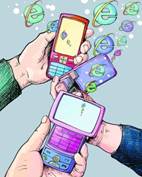
It's the end of class. When the bell rings, students of Luohu Foreign Languages School in Shenzhen quickly take out their cell phones. They want to log on* to their micro blogs to check the interesting things that have happened in the last hour.
Since last year, the trend* of micro blogging has swept the country. Recent surveys shows that most students in middle schools have a micro blog and some even update* their blogs over five times per day.
"We learn many fresh and interesting things on micro blogs and they have become popular topics in class," said Andy Liang, 14. "If you do not know about them, you are out of the loop."
It is also a great place for students to let out stress. "My parents always ask me to study all the time, and encourage me before exams, but it really adds pressure," said Simon Zhang, 15. "When I share these feelings on my micro blog, I get many replies from friends in the same situation, which makes me feel better."
But parents are worried that micro blogging could be a waste of time. Some misleading messages may even cause danger to kids, they said.
Mr. Shen, a professor at the China Education Association, suggests parents not worry too much as long as kids are not crazy about micro blogging. Maybe it can become a window for parents to understand their children. "If parents can read their children's micro blogs, they'll know their thoughts, thus leading to better communication and solutions to problems," he said. He also gives some tips for kids.
---Don't micro blog for more than one hour a day.
---Never micro blog in class.
---Try to talk face to face with people from time to time.
---Be critical*. Don't trust all the messages on a micro blog.
【小题1】The underlined part "out of the loop" in the passage probably means .
| A.not popular | B.not excited | C.unhealthy | D.unlucky |
| A.feel sad | B.let out stress | C.add pressure | D.make friends |
| A.make kids crazy while logging on to it |
| B.bring a lot of misleading messages |
| C.become a window to understand young kids |
| D.lead to worse communication |
| A.It's good for kids to micro blog for more than one hour a day. |
| B.Kids should trust all the messages on a micro blog because they are useful. |
| C.The trend of micro blogging has swept the country since five years ago. |
| D.Kids should try to talk face to face with people, not just micro blogging. |
Once there lived an old man in a town. He always forgot a lot of things. So his wife always had to say to him,“Don't forget this.”
One day he went on a long way alone. Before he left home,his wife said,“Now you have all these things. You need them on your way. Take care of your things on the way.” He went to the station. He bought a ticket and got on the train with it.
About an hour later,the conductor began to see the tickets. He came to the old man and said,“Will you please show me your ticket?” The old man looked for his ticket in all his pockets but he could not find it. He was very worried.“I can't find my ticket. I really bought a ticket before I got on the train ” said the old man.
“I think you are right. I believe you bought a ticket. All right,you don't have to buy another ticket ” said the conductor kindly. But the old man still(仍然) looked worried and said sadly,“You don't know why I'm worried. If I don't find my ticket,I can't remember my station. Where am I going? ”
1.The old man bought a ticket _______.
A. after he got on the train
B. before he got on the train
C. when the conductor told him to buy one
D. when he found he had no ticket with him
2.About an hour later,the conductor began _______.
A. to buy the tickets
B. to look for the tickets
C. to check(检查) the tickets
D. to show the tickets
3. The conductor told the old man that he didn't need to buy another ticket because _________.
A. the man was very old
B. he thought the old man had no money with him
C. the old man showed him the ticket
D. he believed the old man
4.The old man still looked worried because _________.
A. he couldn't get on the train.
B. he lost his ticket and a lot of money
C. he thought his wife would get angry with him
D. he forgot where he was going
5.Which of the following(下列) is right?
A. The old man went on the trip with his wife
B. The old man didn't find his ticket
C. The conductor was also an old man
D. The old man had to buy another ticket
Many years ago, a man (16)____Wu taught King Wang how to ride horses and how to drive a chariot (马拉战车). (17)_____ some time the king started to race against Wu. But no matter how many (18)______ the king raced against Wu, Wu always won.
The king was (19)_______ and said to Wu, “You have taught me how to ride and how to drive a chariot. But I don't think you have taught me everything about (20)______.”
“I have taught you (21)______ I know,” (22)______ Wu. “But you have not learned everything. The (23)______ thing about driving a chariot is to think of the horses. The driver of the chariot and the horse should work together. You can then go very (24)______ and drive for long distance, but your problem is this: When you are behind me, you want to (25)_____ with me. And when you are (26)_____ me, you are afraid that I will catch up with you. (27)_____ whether you are in front of me or behind me, you are thinking of me. You are not thinking of your (28)______. If you want to win, you must (29)______ thinking of me, you (30)______ think only of your horse.”
1.A. calls B. names C. called D. name
2.A. In B. After C. Since D. Before
3.A. times B. days C. weeks D. months
4.A. happy B. glad C. pleased D. unhappy
5.A. playing B. racing C. running D. working
6.A. everything B. something C. anything D. nothing
7.A. asked B. told C. answered D. spoke
8.A. dangerous B. newer C. beautiful D. most important
9.A. slowly B. soon C. fast D. slow
10.A. catch up B. do C. talk D. help
11.A. beside B. in front of C. near D. next to
12.A. So B. But C. Or D. And
13.A. cows B. dogs C. pigs D. horses
14.A. start B. stop C. keep D. begin
15.A. mustn't B. may C. must D. can
For as long as I can remember, Grandma’s plentiful tomato garden has been a sign of summer’s end. Each September, just as the decreased heat of the sun suggests cooler days, Grandma requests (ask for something) my help in her tomato garden. I’m sure that she cannot pick tomatoes without my youthful eyes and quick mind. She says we need to examine each tomato and agree on its readiness for picking. While Grandma’s request for my help in the tomato garden is always the same, her desire for my help seems to increase each year.
Grandma has eyes for finding even the tomatoes hidden by undergrowth and other tomatoes. I, however, just turn circles looking for the ones I think Grandma will like. I spot what looks like a ripe(成熟的)tomato, head in its direction, and then get sidetracked by another that appears to be equally ripe. I usually end up watching Grandma and trying to stay out of her way, which seems the only way my eyes and mind are useful.
There we are, lost in the tomato vines(藤). Grandma’s eyes are always knowing, and they are no different in the vegetable garden. From afar she spots (notice) what looks like a ripe tomato. As she walks toward the garden, she evaluates the tomato for a second time, but from a different angle. I already know it will end up in the basket with the pile of others Grandma has carefully chosen. However, Grandma acts as if she needs a final look to be sure. She calls me to her side, kneels beside the vine while enjoying the warmth of the fading sunlight on her face, and grasps the tomato in her hand. She turns each round, red ball toward the sunlight before disconnecting it from the vine with a half-hearted smile.
She then looks at me. I nod my head and smile. Grandma assumes I smile in agreement with her tomato selection. I know I smile, instead, at her.
1. Why does Grandma ask the author to go to the tomato garden with her?
A.He can help pick more tomatoes.
B.He can learn the hardship of labor.
C.She enjoys staying with him while working.
D.She tries to share tomato harvest with him.
2.The second paragraph shows that the writer _________.
A.isn’t good at picking tomatoes
B.doesn’t like to stay with Grandma
C.thinks his eyes and mind are useful
D.is trying to be out of Grandma’s sight
3. What’s the best title of the story?
A.Gardening—good for my Grandma.
B.Growing Grandma.
C.Gardening—good for my growth.
D.Picking tomatoes.
湖北省互联网违法和不良信息举报平台 | 网上有害信息举报专区 | 电信诈骗举报专区 | 涉历史虚无主义有害信息举报专区 | 涉企侵权举报专区
违法和不良信息举报电话:027-86699610 举报邮箱:58377363@163.com