
题目列表(包括答案和解析)
One day, I heard an American boy say to a Chinese girl student, “You speak very good English.” But the girl answered, “No, no. My English is very poor.” The foreigner was quite 1 at the answer. Thinking he had not made 2 understood or the girl had not 3 him clearly, he said, “Yes, indeed, you speak very well.” 4 the girl still kept saying, “No.” In the end the American boy could not understand and didn’t know 5 to say.
What’s wrong with the girl’s answer? She didn’t 6 a compliment (恭维) in the same way as the American people do. She should answer, “Thank you” instead of “No”. She 7 understood what the American boy had said, but she thought she should be modest. In the 8 , people will feel proud and 9 when they are praised . So if someone says the 10 you have cooked are very delicious, you should say, “Thank you.”
In our country we think being modest is a virtue (美德) and being proud is a bad thing , but in my opinion, being confident does not 11 being proud, so sometimes you should be confident 12 being modest.
13 you are modest and say, “No, I’m afraid I can’t do it well”, while working in a western country, the others may think that you really cannot do it. If you often say “No”, you will certainly be looked down upon by 14 . When asking for a job, if one says something like “Yes, I can certainly do it” instead of “Let me have a try”, he or she will 15 get it. So in the west, you should be brave to show your self-confidence.
| 【小题1】 |
|
| 【小题2】 |
|
| 【小题3】 |
|
| 【小题4】 |
|
| 【小题5】 |
|
| 【小题6】 |
|
| 【小题7】 |
|
| 【小题8】 |
|
| 【小题9】 |
|
| 【小题10】 |
|
| 【小题11】 |
|
| 【小题12】 |
|
| 【小题13】 |
|
| 【小题14】 |
|
| 【小题15】 |
|
根据句意,用括号内所给单词的适当形式填空。
【小题1】Tom (drop) his schoolbag on the bus. He felt worried.
【小题2】My mother is looking forward to (meet) you.
【小题3】At first, our foreign English teacher spoke so (quick) that no one could follow her.
【小题4】— What’s wrong with Maria?
— She fell off the bike and hurt (her).
【小题5】— How clean your house is!
— Thank you. It (clean) every day.
---_____?
---I don’t feel very well today. I’ve got a pain here.
A. Can I take your temperature B. What’s wrong with you
C. Do you have a cough D. How long have you been like this
Mr. Smith lived in a village. He had ___36__ farms and about twenty people working for him. He often told them _37_ hard and be honest. (诚实的).
One day he went to a farm and worked with the workers there. Soon it was time __38___ lunch. He put ___39___ nice bread on the table and ___40___. A few minutes later he came back again but he ___41____ find the bread.
‘Who ate ___42__ on the table?’ he shouted.
Some of the workers answered, ‘We ___43___.’
The others said, ‘We saw nothing.’
‘Well,’ said Mr. Smith, ‘__44___ are a lot of mice in the rooms, you know. So I ___45___ some poison in the bread. ___46___ they eat, they must die. Then I can kill them.’
As soon as he finished, four workers began to cry. ‘Oh, dear!’
‘___47___?’ asked Mr. Smith.
‘We ate the bread when you were out. We are going to die.’ One of them cried.
‘___48___,’ Mr. Smith said _49___ a smile, ‘I only ____50_____ you. Use your head.’
| 【小题1】 |
|
| 【小题2】 |
|
| 【小题3】 |
|
| 【小题4】 |
|
| 【小题5】 |
|
| 【小题6】 |
|
| 【小题7】 |
|
| 【小题8】 |
|
| 【小题9】 |
|
| 【小题10】 |
|
| 【小题11】 |
|
| 【小题12】 |
|
| 【小题13】 |
|
| 【小题14】 |
|
| 【小题15】 |
|
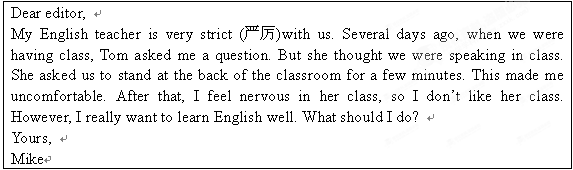
| Dear Mike, I am sorry you are having difficulty with your English class. Every teacher wants his or her students to study hard especially in class. So I think you should have a talk with your English teacher and tell her what you were doing with Tom that day. If she knows your worries, maybe she will help you with your English. And she will be pleased to hear you want to learn English well. I believe when students are not trying as hard as they can, a teacher is forced(被迫)to take actions. Yours, Editor |
| A.He meets trouble with his parents. |
| B.He doesn’t know how to get on well with his classmates. |
| C.He has a hard time with his English class. |
| D.He is always speaking in class. |
| A.Mike couldn’t answer the question. So the teacher asked him to stand. |
| B.Mike had an argument with Tom about the question. |
| C.Tom asked Mike a question, and the teacher thought they were speaking. |
| D.Mike felt uncomfortable because he was ill. |
| A.Because the English teacher didn’t think Mike was studying hard in class. |
| B.Because Mike answered the question wrong. |
| C.Because Mike was bad at English. |
| D.Because Mike had a fight with other students. |
| A.采取行动 | B.参加活动 | C.帮助 | D.表演 |
| A.Mike wants to have a talk with his English teacher. |
| B.Mike wants the editor to say something to his English teacher. |
| C.The editor gave Mike some advice, but it didn’t work. |
| D.Mike dislikes English classes now, but he wants to learn English well. |
湖北省互联网违法和不良信息举报平台 | 网上有害信息举报专区 | 电信诈骗举报专区 | 涉历史虚无主义有害信息举报专区 | 涉企侵权举报专区
违法和不良信息举报电话:027-86699610 举报邮箱:58377363@163.com