
题目列表(包括答案和解析)
Starry Night
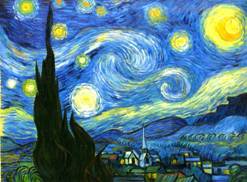
Have you ever seen a real night sky that looks like Van Gogh’s Starry Night? I hope not! So, why would an artist paint the sky this way? Perhaps I can answer that with another question. When you’re happy, why do you sing instead of speaking? Or when you’re in love, why do you speak of roses and honey? When we do these things, we, too are artists. We’re using something that goes beyond a mere scientific description in order to communicate our feelings more powerfully than straightforward words can. So consider for a moment that Van Gogh might not have been hallucinating (产生幻觉的) on the night he painted this. Maybe he felt something so powerful that he had to go beyond the familiar to express it.
I hope I’m reminding you of something you already know as I describe the experience of being outside at night under a crystal clear sky that makes everything seem clean and refreshing. So you look up. And suddenly you see the sky that you’ve seldom seen before. It’s not just the same old dark night sky tonight. Instead, the blackness is a deep, rich blue that is more bottomless than any ocean. The stars are not spots of light but brilliant, magical diamonds that dance like tiny angels. In just this special moment, the sky is somehow alive, and it seems to speak to you silently about the meaning of infinity (无限).
Now look at the painting again. Can you see something of what makes this such a famous and well-loved image? But there’s more here than that. Van Gogh painted this while he was quite struck down by a mental disease. It is natural to imagine that he frequently battled the fear that he would never escape his prison to true freedom. It is natural for us to imagine this because each of us has faced our own personal prison, whether it be disease, the loss of a loved one, serious financial problems … In such moments it is tempting to give up to despair (绝望) and collapse in hopelessness.
Looking at this painting, I imagine Van Gogh in just such a moment of despair, when he is struck by the memory of one of those amazing night skies. He recalls the sense that he is not alone, that there is a living, infinite world with rich colorful creatures and scenes all around.
And so the sky flows across the canvas (画布) full of vitality (活力) and power. The stars don’t just sparkle; they explode. Looking closer, we notice that the earth itself seems to respond to the movement in the sky, forming its own living waves in the mountain and rolling trees. In the sleepy village, the windows of the houses glow (发光) with the same light that brightens the universe. The giant trees at the left seem to capture the joy by stretching upwards toward the sky.
What a tremendous message of hope there is in this masterpiece! Even if our troubles persist, the world around us assures us that life is worth living. That’s what the angels sing about. Doesn’t it make you want to sing, too?
1.Looking at the painting Starry Night, we can see all the following except________.
A. The singing angels B. the giant trees
C. the sleepy village D. the sparkling stars
2.Van Gogh does NOT describe a feeling of ______ through the Starry Night.
A. happiness B. vitality C. power D. despair
3.The underlined word “prison” in the 3rd paragraph probably means ______.
A. trouble in one’s life B. mental illness
C. control from the authority D. a place where criminals are kept
4.What is the main purpose of this passage?
A. To explain how Van Gogh painted the Starry Night.
B. To tell us how to appreciate the Starry Night.
C. To prove Van Gogh was in a hallucinating state of mind while painting the picture.
D. To show us the beauty of the sky on a starry night.
Starry Night
Have you ever seen a real night sky that looks like Van Gogh’s Starry Night? I hope not! So, why would an artist paint the sky this way? Perhaps I can answer that with another question. When you’re happy, why do you sing instead of speaking? Or when you’re in love, why do you speak of roses and honey? When we do these things, we, too are artists. We’re using something that goes beyond a mere scientific description in order to communicate our feelings more powerfully than straightforward words can. So consider for a moment that Van Gogh might not have been hallucinating (产生幻觉的) on the night he painted this. Maybe he felt something so powerful that he had to go beyond the familiar to express it.
I hope I’m reminding you of something you already know as I describe the experience of being outside at night under a crystal clear sky that makes everything seem clean and refreshing. So you look up. And suddenly you see the sky that you’ve seldom seen before. It’s not just the same old dark night sky tonight. Instead, the blackness is a deep, rich blue that is more bottomless than any ocean. The stars are not spots of light but brilliant, magical diamonds that dance like tiny angels. In just this special moment, the sky is somehow alive, and it seems to speak to you silently about the meaning of infinity (无限).
Now look at the painting again. Can you see something of what makes this such a famous and well-loved image? But there’s more here than that. Van Gogh painted this while he was quite struck down by a mental disease. It is natural to imagine that he frequently battled the fear that he would never escape his prison to true freedom. It is natural for us to imagine this because each of us has faced our own personal prison, whether it be disease, the loss of a loved one, serious financial problems … In such moments it is tempting to give up to despair (绝望) and collapse in hopelessness.
Looking at this painting, I imagine Van Gogh in just such a moment of despair, when he is struck by the memory of one of those amazing night skies. He recalls the sense that he is not alone, that there is a living, infinite world with rich colorful creatures and scenes all around.
And so th e sky flows across the canvas (画布) full of vitality (活力) and power. The stars don’t just sparkle; they explode. Looking closer, we notice that the earth itself seems to respond to the movement in the sky, forming its own living waves in the mountain and rolling trees. In the sleepy village, the windows of the houses glow (发光) with the same light that brightens the universe. The giant trees at the left seem to capture the joy by stretching upwards toward the sky.
What a tremendous message of hope there is in this masterpiece! Even if our troubles persist, the world around us assures us that life is worth living. That’s what the angels sing about. Doesn’t it make you want to sing, too?
【小题1】Looking at the painting Starry Night, we can see all the following except________.
| A.The singing angels | B.the giant trees |
| C.the sleepy village | D.the sparkling stars |
| A.happiness | B.vitality | C.power | D.despair |
| A.trouble in one’s life | B.mental illness |
| C.control from the authority | D.a place where criminals are kept |
| A.To explain how Van Gogh painted the Starry Night. |
| B.To tell us how to appreciate the Starry Night. |
| C.To prove Van Gogh was in a hallucinating state of mind while painting the picture. |
| D.To show us the beauty of the sky on a starry night. |
Starry Night
 Have you ever seen a real night sky that looks like Van Gogh’s Starry Night? I hope not! So, why would an artist paint the sky this way? Perhaps I can answer that with another question. When you’re happy, why do you sing instead of speaking? Or when you’re in love, why do you speak of roses and honey? When we do these things, we, too are artists. We’re using something that goes beyond a mere scientific description in order to communicate our feelings more powerfully than straightforward words can. So consider for a moment that Van Gogh might not have been hallucinating (产生幻觉的) on the night he painted this. Maybe he felt something so powerful that he had to go beyond the familiar to express it.
I hope I’m reminding you of something you already know as I describe the experience of being outside at night under a crystal clear sky that makes everything seem clean and refreshing. So you look up. And suddenly you see the sky that you’ve seldom seen before. It’s not just the same old dark night sky tonight. Instead, the blackness is a deep, rich blue that is more bottomless than any ocean. The stars are not spots of light but brilliant, magical diamonds that dance like tiny angels. In just this special moment, the sky is somehow alive, and it seems to speak to you silently about the meaning of infinity (无限).
Now look at the painting again. Can you see something of what makes this such a famous and well-loved image? But there’s more here than that. Van Gogh painted this while he was quite struck down by a mental disease. It is natural to imagine that he frequently battled the fear that he would never escape his prison to true freedom. It is natural for us to imagine this because each of us has faced our own personal prison, whether it be disease, the loss of a loved one, serious financial problems … In such moments it is tempting to give up to despair (绝望) and collapse in hopelessness.
Looking at this painting, I imagine Van Gogh in just such a moment of despair, when he is struck by the memory of one of those amazing night skies. He recalls the sense that he is not alone, that there is a living, infinite world with rich colorful creatures and scenes all around.
And so the sky flows across the canvas (画布) full of vitality (活力) and power. The stars don’t just sparkle; they explode. Looking closer, we notice that the earth itself seems to respond to the movement in the sky, forming its own living waves in the mountain and rolling trees. In the sleepy village, the windows of the houses glow (发光) with the same light that brightens the universe. The giant trees at the left seem to capture the joy by stretching upwards toward the sky.
What a tremendous message of hope there is in this masterpiece! Even if our troubles persist, the world around us assures us that life is worth living. That’s what the angels sing about. Doesn’t it make you want to sing, too?
72. Looking at the painting Starry Night, we can see all the following except________.
A. the sparkling stars B. the giant trees
C. the sleepy village D. The singing angels
73. Van Gogh does NOT describe a feeling of _______ through the Starry Night.
A. happiness B. vitality C. power D. despair
74. The underlined word “prison” in the 3rd paragraph probably means _______.
A. mental illness B. trouble in one’s life
C. control from the authority D. a place where criminals are kept
75. What is the main purpose of this passage?
A. To tell us how to appreciate the Starry Night.
B. To explain how Van Gogh painted the Starry Night.
C. To prove Van Gogh was in a hallucinating state of mind while painting the picture.
D. To show us the beauty of the sky on a starry night.
The American population was the tallest in the world from about the American Revolution to World WarⅡ ― that’s a long time. The U.S. had a very resource rich environment, with game, fish and wildlife. In fact we have data on disadvantaged people in America, such as slaves. They were obviously among the most mistreated populations in the world, but given the resource abundance,and given the fact that the slave owners needed their work, they had to be fed relatively fairly well. So the slaves were taller than European peasants. It’s no wonder that Europeans were just flooding to America.
Americans today are no longer the tallest people in the world. After World WarⅡ,many Western and Northern European countries began to adopt favorable social policies. There is universal health insurance in most of these societies ― that, of course, makes a difference in health care. You can also consider income inequality in the U.S., since people who are at the low end of the totem pole (图腾柱) have considerable adversity making ends meet. I suspect the difference in height between Americans and Europeans is due to both diet and health care.
Americans today suffer from an additional problem: obesity (肥胖). If children are too well nourished, then they’re not able to grow best. There are certain hormones (荷尔蒙) that control the start of the adolescent (青春期的) growth and the start of adolescence. Nutrition is one of the factors, along with genetic and hormonal ones which are associated with the start of puberty (青春期). And if puberty comes too early, then the youth will peak out sooner, and will not become as tall in adulthood as someone who had better nutrition.Also, the overload of carbohydrates and fats in a fastfood diet may hinder (阻碍) the consumption of micronutrients necessary to growth.
63. The word “game” in Paragraph 1 refers to ______.
A. rich natural resources B. sports events to be held
C. activities played by kids D. animals hunted for food
64. Slaves in America were taller than European peasants because ______.
A. they were badly treated B. they did not do farm work
C. they had enough food to eat D. they enjoyed better health care
65. It is implied in the second paragraph that ______.
A. Europeans could make more money than Americans
B. welfare helps Europeans grow taller than Americans
C. average Americans used to be shorter than Europeans
D. people on the totem pole are leading a comfortable life
66. According to the third paragraph, overweight children in the U.S ______.
A. tend to eat more food to grow taller
B. will fail to grow into an ideal height
C. will grow taller than average children
D. tend to have better nutrition for growth
III. Reading Comprehension
Section A
Directions: For each blank in the following passages there are four words or phrases marked A, B, C and D. Fill in each blank with the word or phrase that best fits the context.
People with a positive attitude toward aging can adjust very well when individual circumstances change. Their positive outlook allows them to 50 to the inevitable physical and biochemical changes of the body that are associated with the natural 51 of aging. With a healthy outlook on the golden years, even unpredictable setbacks and disabilities can be managed 52 .
Individual genetic makeup (基因构造) explains the great 53 in the aging rate. Some seniors experience more challenges than others of the same age, and some seniors continue to function better than many younger people. But genetics only 54 about 30 percent of aging. Most of the changes we associate with age 55 factors such as diet and exercise habits; lifestyle issues, including over 56 of alcohol and tobacco, and psychological traits.
We can make healthy lifestyle choices by staying 57 both physically and mentally and by 58 a healthy diet. Some of the setbacks associated with advancing age such as 59 eyesight, loss of hearing, forgetfulness, weakness can be forestalled with some active intervention(干预).
Growing older does not always mean you see poorly. Many older people have 60 good eyesight well into their eighties and beyond. However, the single greatest contributor to vision loss is a lifetime of 61 to damaging ultraviolet (紫外线) radiation in sunlight.
Carotenoids(类胡萝卜素), a nutrient found in brightly colored vegetables and fruits, are powerful protectors against free-radical damage. Research shows that simply eating leafy greens and other foods rich in these protective nutrients can 62 vision loss.
Problems with hearing can create 63 and insecurity in later years. One of the major causes of age-related hearing loss is damage to the hair cells in the inner ear that transmit sounds to the brain. These hair cells and their nerve endings can be damaged by infections, genetic diseases, or treatment with certain drugs. The most common cause, 64 , is loud noise.
50. A. stick B. devote C. adapt D. lead
51. A. progress B. process C. program D. project
52. A. successfully B. purposefully C. unwillingly D. carefully
53. A. surprise B. variation C. increase D. possibility
54. A. relies on B. accounts for C. results from D. lies in
55. A. involve in B. relate to C. combine with D. substitute for
56. A. reputation B. enjoyment C. consumption D. encouragement
57. A. active B. calm C. efficient D. diligent
58. A. maintaining B. feeding C. surviving D. controlling
59. A. keen B. failing C. sharp D. remote
60. A. generally B. frequently C. relatively D. occasionally
61. A. contribution B. introduction C. explanation D. exposure
62. A. cure B. relieve C. reduce D. suffer
63. A. communication B. isolation C. competition D. occupation
64. A. therefore B. otherwise C. moreover D. however
湖北省互联网违法和不良信息举报平台 | 网上有害信息举报专区 | 电信诈骗举报专区 | 涉历史虚无主义有害信息举报专区 | 涉企侵权举报专区
违法和不良信息举报电话:027-86699610 举报邮箱:58377363@163.com