
题目列表(包括答案和解析)
Jogging outside has long been believed as helpful to both body and mind-and if nothing else, a form of stress release after a hard day at the office.
But new research suggests exercising outside could do more harm than good when it comes to your brain.
For jogging in busy, traffic-filled areas could actually cause mental decline(情绪下降).
Belgian researchers have found that people who live in a city and exercise outdoors have higher levels of inflammation(炎症) and lower scores on cognitive(认知的) tests than those who exercise outside in the suburbs.
In a study, they divided exercisers into two groups who exercised three times a week for 12 weeks, between midday and 1pm. One group alternated and walking in a busy , urban area-the other in a rural location.
The researchers, from Vrije Universiteit Brussel, then gave the subjects a test to measure their response time and attention span.
They found that high levels of air pollution prevented participants from getting some of the brain-boosting benefits of exercise, such as the ability to absorb new information and a reduced chance of mental health problems.
The city joggers also had significantly higher blood levels of some inflammation markers, Men's Health magazine reported.
This is important because inflammation in the brain is associated with mental illness.
US research found in November that higher level of air pollution in towns and cities is aging the brains of over-50s by up to three years,
Scientists have found that exposure(暴露) to higher levels of air pollution can lead to decreased(减少) brain power in over-50s.
In a study of almost 15,000 0lder adults, researchers at the US-based National Institute on Aging found fine air particulate matter(颗粒物质) may be an important environmental risk factor for reduced thought power, (The Daily Mail)
58. According to the passage, "in a rural location" means_______.
A. in a city B. in the countryside
C. in the urban area D. in a town
59. According to the passage, which of the following facts about jogging is NOT TRUE_______.
A. jogging in busy, traffic-filled areas could actually cause mental decline
B. jogging in a highly polluted area can lead to decreased brain power in over-50s.
C. jogging outside in the suburbs has lower scores on getting new information teststhan in a city
D. jogging in a area with fine air may be risky for reduced thought power.
60. The writer is trying to get readers to know that _______.
A. jogging outside might make you clever B. jogging outside might make you healthy
C. jogging outside might make you able D. jogging outside might make you stupid
Jogging outside has long been believed as helpful to both body and mind-and if nothing else, a form of stress release after a hard day at the office.
But new research suggests exercising outside could do more harm than good when it comes to your brain.
For jogging in busy, traffic-filled areas could actually cause mental decline(情绪下降).
Belgian researchers have found that people who live in a city and exercise outdoors have higher levels of inflammation(炎症) and lower scores on cognitive(认知的) tests than those who exercise outside in the suburbs.
In a study, they divided exercisers into two groups who exercised three times a week for 12 weeks, between midday and 1pm. One group alternated and walking in a busy , urban area-the other in a rural location.
The researchers, from Vrije Universiteit Brussel, then gave the subjects a test to measure their response time and attention span.
They found that high levels of air pollution prevented participants from getting some of the brain-boosting benefits of exercise, such as the ability to absorb new information and a reduced chance of mental health problems.
The city joggers also had significantly higher blood levels of some inflammation markers, Men's Health magazine reported.
This is important because inflammation in the brain is associated with mental illness.
US research found in November that higher level of air pollution in towns and cities is aging the brains of over-50s by up to three years,
Scientists have found that exposure(暴露) to higher levels of air pollution can lead to decreased(减少) brain power in over-50s.
In a study of almost 15,000 0lder adults, researchers at the US-based National Institute on Aging found fine air particulate matter(颗粒物质) may be an important environmental risk factor for reduced thought power, (The Daily Mail)
58. According to the passage, "in a rural location" means_______.
A. in a city B. in the countryside
C. in the urban area D. in a town
59. According to the passage, which of the following facts about jogging is NOT TRUE_______.
A. jogging in busy, traffic-filled areas could actually cause mental decline
B. jogging in a highly polluted area can lead to decreased brain power in over-50s.
C. jogging outside in the suburbs has lower scores on getting new information teststhan in a city
D. jogging in a area with fine air may be risky for reduced thought power.
60. The writer is trying to get readers to know that _______.
A. jogging outside might make you clever B. jogging outside might make you healthy
C. jogging outside might make you able D. jogging outside might make you stupid
Mary’s dime(一毛钱)
It was Sunday afternoon. I decided to clean up the room nicely so that my parents would feel 1 when they returned from a long ride! Then, I sat in the room, having nothing to do.
What else could I do? Then, with no reason, I suddenly 2 the pale face of that little beggar(乞丐) girl. I could see the glad light 3 her eyes when I put the dime in her little dirty hand.
How much I 4 that dime, too! Grandpa gave it to me a whole month ago, and I had kept it ever since in my red box upstairs, but those sugar apples looked so attractive, and were so 5 — only a dime a piece — that I wanted to have one.
I could imagine the little girl stood there in front of the 6 in her old dirty dress, looking at the 7 that were put all in a row in the window. I wonder what I should say, “Little girl, what do you want?” I gently asked. She felt 8 and looked straight at me, just as if(似乎)nobody had spoken so 9 to her before. She realized what I had meant, so she said seriously and sadly. “I was thinking how good one of those delicious hamburgers would 10 . I haven’t had anything to eat today.”
Now I thought to myself, “Mary Williams, you have had a good breakfast and a good lunch today, 11 this poor girl has not had a mouthful yet. You can give her your 12 . She needs it a great deal more than you do.”
I could not run away from that little girl’s sad, 13 look — so I dropped the dime right into her hand. How 14 the girl was! I am so glad I gave her the dime, 15 I had to go without the apple lying there in the window.
| 【小题1】 |
|
| 【小题2】 |
|
| 【小题3】 |
|
| 【小题4】 |
|
| 【小题5】 |
|
| 【小题6】 |
|
| 【小题7】 |
|
| 【小题8】 |
|
| 【小题9】 |
|
| 【小题10】 |
|
| 【小题11】 |
|
| 【小题12】 |
|
| 【小题13】 |
|
| 【小题14】 |
|
| 【小题15】 |
|
Mary’s dime(一毛钱)
It was Sunday afternoon. I decided to clean up the room nicely so that my parents would feel 1 when they returned from a long ride! Then, I sat in the room, having nothing to do.
What else could I do? Then, with no reason, I suddenly 2 the pale face of that little beggar(乞丐) girl. I could see the glad light 3 her eyes when I put the dime in her little dirty hand.
How much I 4 that dime, too! Grandpa gave it to me a whole month ago, and I had kept it ever since in my red box upstairs, but those sugar apples looked so attractive, and were so 5 — only a dime a piece — that I wanted to have one.
I could imagine the little girl stood there in front of the 6 in her old dirty dress, looking at the 7 that were put all in a row in the window. I wonder what I should say, “Little girl, what do you want?” I gently asked. She felt 8 and looked straight at me, just as if(似乎)nobody had spoken so 9 to her before. She realized what I had meant, so she said seriously and sadly. “I was thinking how good one of those delicious hamburgers would 10 . I haven’t had anything to eat today.”
Now I thought to myself, “Mary Williams, you have had a good breakfast and a good lunch today, 11 this poor girl has not had a mouthful yet. You can give her your 12 . She needs it a great deal more than you do.”
I could not run away from that little girl’s sad, 13 look — so I dropped the dime right into her hand. How 14 the girl was! I am so glad I gave her the dime, 15 I had to go without the apple lying there in the window.
1. A.disturbed B.unhappy C.satisfied D.interested
2. A.saw B.remembered C.forgot D.described
3. A.filling B.protecting C.attracting D.touching
4. A.hated B.loved C.missed D.noticed
5. A.valuable B.meaningful C.expensive D.cheap
6. A.market B.library C.store D.bookshop
7. A.dresses B.magazines C.books D.candies
8. A.surprised B.excited C.pleased D.worried
9. A.happily B.kindly C.angrily D.sadly
10. A.taste B.sound C.feel D.smell
11. A.since B.so C.and D.but
12. A.apple B.hamburger C.dime D.candy
13. A.proud B.angry C.calm D.hungry
14. A.grateful B.unlucky C.lonely D.friendly
15. A.unless B.if C.though D.because
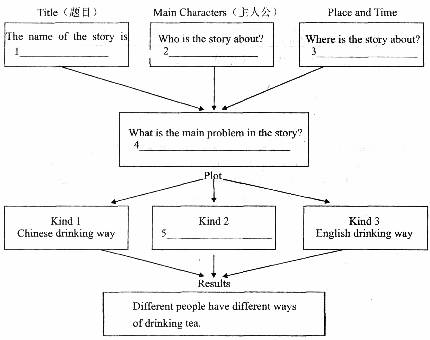
How to drink tea
All around the world,people drink tea.But tea does not mean the same thing to everyone.
In China,for example,tea is always served(招待)when people get together.The Chinese drink
it at any time of day at homes or in teahouse.They prefer their tea plain,with nothing else in it.
Tea is also important in Japan.The Japanese have a special(特别的)way of serving tea called a tea ceremony(仪式).It is very old and full of meaning.Everything must be done in a special way in the ceremony.There is even a special room for it in Japanese homes.
Another tea—drinking country is England.In England,the late afternoon is ‘‘tea time”.Almost everyone has a cup of tea then.The English usually make tea in tea-port and drink it with cream and sugar.They also eat cakes,cookies and little sandwiches at teatime.
Different people have different ways of drinking tea.
湖北省互联网违法和不良信息举报平台 | 网上有害信息举报专区 | 电信诈骗举报专区 | 涉历史虚无主义有害信息举报专区 | 涉企侵权举报专区
违法和不良信息举报电话:027-86699610 举报邮箱:58377363@163.com