
题目列表(包括答案和解析)
Some countries never have snow and some have only a little on the top of very high mountains. In the north of England, there is quite a lot of snow every winter, but in the south of England, there is usually little.
Where a student from a warm country comes to England in autumn for the first time, he feels cool at first. There are often dark clouds; grey sky and cold rain in England in autumn, and most students from warm countries do not like these.
But snow is different. Though (尽管) it is cold. It is also beautiful. Perhaps, after several dark mornings, the student wakes up one day, and there is a lot of light in his room. He thinks "Is it so late?" and jumps out of the bed. But no. it is not very late. He looks out of the window and there is snow on the ground and on the houses and everywhere. The light of his room comes from the clean beautiful snow.
1. In which part of England is there much snow in winter ?
A. In the east B. In the south C. In the west D. In the north
2. In the autumn of England. we cannot often see.
A. strong winds B. dark clouds C. grey sky D. cold rain
3. In England both snow and autumn rain are
A. beautiful B. clean C. cold D. heavy
4. Why does the student ask himself "Is it so late?"
A. Because it's really late. B. Because he has some work to do
C. Because it is bright in the room D. Because he usually gets up early
5. Which of the following is right?
A. Every country in the world has snow in winter.
B. Many people in the world haven't seen snow.
C. It is often very warm in the autumn of England.
D. Foreign students like the weather in England in autumn.
A sign is another kind of language. Here are some of them that you can see on the roads.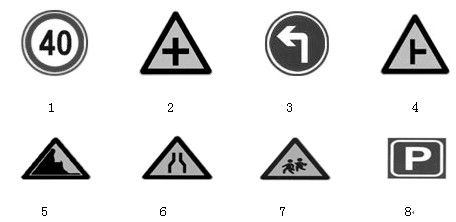
Number One is a sign with the number forty on it. When driver see this sign, they must not go at more than forty kilometers one hour. We see this sign when we are getting near a town. Number Two is a sign that we’re near a crossing. We must drive carefully. Number Three is a sign that there is a bend (弯道) on the road. Again, we must drive slowly and carefully. It is not safe to go round a bend very fast. Number Four is a sign that there is another road coming in from the right. There is a junction(交叉点) at this place.
Number Five is a sign that there is a dangerous mountain road and Number Six is a sign that the road gets narrow. Drivers must go slowly and carefully when they see these signs. Number Seven is a sign that there is a school at the side of the street or the road. Perhaps there are children going to or leaving school. So drivers must look carefully and go slowly. Number Eight is a sign with a letter “P” on it. The letter “P” means “Parking”. At some places, there are signs “NO PARKING” or “NO WAITING”. If a driver leaves his car near one of these signs, a policeman may come and write down the number of his car.
【小题1】. At the place where you see Sign 1, ________.
| A.you are already out of the town |
| B.you still have forty kilometers to go |
| C.there must be a town forty kilometers away |
| D.there must be many houses and buildings not far away |
| A.two roads cross | B.the road gets narrow |
| C.there are no traffic lights | D.people can cross the road |
| A.either of signs 2 and 3 | B.all of signs 3, 5, 6 and 7 |
| C.each of the eight signs | D.any of signs 3, 6, 7 and 8 |
| A.near Sign 8 at any time |
| B.near a sign with “NO PARKING” on it |
| C.near Sign 3 in the daytime |
| D.near a sign with “NO WAITING” if there’re no police there |
| A.show drivers the way | B.stop cars going too fast |
| C.make driving even safer | D.learn another kind of language |

| A.you are already out of the town |
| B.you still have forty kilometers to go |
| C.there must be a town forty kilometers away |
| D.there must be many houses and buildings not far away |
| A.two roads cross | B.the road gets narrow |
| C.there are no traffic lights | D.people can cross the road |
| A.either of signs 2 and 3 | B.all of signs 3, 5, 6 and 7 |
| C.each of the eight signs | D.any of signs 3, 6, 7 and 8 |
| A.near Sign 8 at any time |
| B.near a sign with “NO PARKING” on it |
| C.near Sign 3 in the daytime |
| D.near a sign with “NO WAITING” if there’re no police there |
| A.show drivers the way | B.stop cars going too fast |
| C.make driving even safer | D.learn another kind of language |
A sign is a kind of language.Here are some of them that you can see on the roads.
Number one is a sign with the number“thirty”on it.When drivers see this sign.they must not go at a speed of more than thirty kilometers an hour.We see this sign when We are getting near towns.Number two means that we’re near a crossing.We must drive carefully.Number three is a sign that there is a bend(转弯)in the road.Again,We must drive slowly and carefully.It is not safe to go round a bend very fast.Number four is a sign that there is another road in from the right.There is a junction(交叉点)at this place.Number five is a sign that there is a hill and Number six is a sign that the road gets narrower.Drivers must go slowly and carefully.Number seven has the word“SCHOOL”on it.This is a sign that there is a school at the side of the street or the road.Perhaps there are children going to or leaving school,so drivers should look carefully and go slowly.Number eight is a sign with the letter“P”on it.The letter“P”means “Parking”.In some places.there are the signs saying“NO PARKING”or“NO WAITING”.If a driver leaves his ear near one of these signs,a policeman may come and write down the number of his car.

1.At places where you see sign l ,___________.
A.you are already out of the town
B.you still have thirty kilometers to go
C.there is a town thirty kilometers away
D.there are many houses and buildings not far away
2.Sign 2 stands near a place where________.
A.two roads cross B.people can cross the road
C.the road gets narrow D.there are no traffic lights
3.You have to drive not only slowly but al4 carefully when you see________.
A.each of the eight signs B.either of signs 2 and 3
C.all of signs 3,6,and 7 D.any of signs 3,6,7 and 8
4.A driver can leave his car__________.
A.near a sign with “NO PARKING” on it
B.near sign 8 at any time
C.near a sign with“NO WAITING”if there are no police there
D.near a sign with“P”0n it in the daytime
5.People put these signs on the roads to________.
A.show drivers the way B.stop cars
C.make driving safer D.learn another kind of language

湖北省互联网违法和不良信息举报平台 | 网上有害信息举报专区 | 电信诈骗举报专区 | 涉历史虚无主义有害信息举报专区 | 涉企侵权举报专区
违法和不良信息举报电话:027-86699610 举报邮箱:58377363@163.com