
题目列表(包括答案和解析)

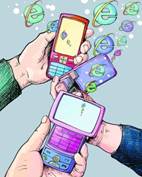
It's the end of class. When the bell rings, students of Luohu Foreign Languages School in Shenzhen quickly take out their cell phones. They want to log on* to their micro blogs to check the interesting things that have happened in the last hour.
Since last year, the trend* of micro blogging has swept the country. Recent surveys shows that most students in middle schools have a micro blog and some even update* their blogs over five times per day.
"We learn many fresh and interesting things on micro blogs and they have become popular topics in class," said Andy Liang, 14. "If you do not know about them, you are out of the loop."
It is also a great place for students to let out stress. "My parents always ask me to study all the time, and encourage me before exams, but it really adds pressure," said Simon Zhang, 15. "When I share these feelings on my micro blog, I get many replies from friends in the same situation, which makes me feel better."
But parents are worried that micro blogging could be a waste of time. Some misleading messages may even cause danger to kids, they said.
Mr. Shen, a professor at the China Education Association, suggests parents not worry too much as long as kids are not crazy about micro blogging. Maybe it can become a window for parents to understand their children. "If parents can read their children's micro blogs, they'll know their thoughts, thus leading to better communication and solutions to problems," he said. He also gives some tips for kids.
---Don't micro blog for more than one hour a day.
---Never micro blog in class.
---Try to talk face to face with people from time to time.
---Be critical*. Don't trust all the messages on a micro blog.
【小题1】The underlined part "out of the loop" in the passage probably means .
| A.not popular | B.not excited | C.unhealthy | D.unlucky |
| A.feel sad | B.let out stress | C.add pressure | D.make friends |
| A.make kids crazy while logging on to it |
| B.bring a lot of misleading messages |
| C.become a window to understand young kids |
| D.lead to worse communication |
| A.It's good for kids to micro blog for more than one hour a day. |
| B.Kids should trust all the messages on a micro blog because they are useful. |
| C.The trend of micro blogging has swept the country since five years ago. |
| D.Kids should try to talk face to face with people, not just micro blogging. |
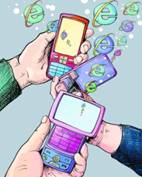
It's the end of class. When the bell rings, students of Luohu Foreign Languages School in Shenzhen quickly take out their cell phones. They want to log on* to their micro blogs to check the interesting things that have happened in the last hour.
Since last year, the trend* of micro blogging has swept the country. Recent surveys shows that most students in middle schools have a micro blog and some even update* their blogs over five times per day.
"We learn many fresh and interesting things on micro blogs and they have become popular topics in class," said Andy Liang, 14. "If you do not know about them, you are out of the loop."
It is also a great place for students to let out stress. "My parents always ask me to study all the time, and encourage me before exams, but it really adds pressure," said Simon Zhang, 15. "When I share these feelings on my micro blog, I get many replies from friends in the same situation, which makes me feel better."
But parents are worried that micro blogging could be a waste of time. Some misleading messages may even cause danger to kids, they said.
Mr. Shen, a professor at the China Education Association, suggests parents not worry too much as long as kids are not crazy about micro blogging. Maybe it can become a window for parents to understand their children. "If parents can read their children's micro blogs, they'll know their thoughts, thus leading to better communication and solutions to problems," he said. He also gives some tips for kids.
---Don't micro blog for more than one hour a day.
---Never micro blog in class.
---Try to talk face to face with people from time to time.
---Be critical*. Don't trust all the messages on a micro blog.
1.The underlined part "out of the loop" in the passage probably means .
A. not popular B. not excited C. unhealthy D. unlucky
2.Micro blog made Simon when he shared his feelings and got replies on his micro biog.
A. feel sad B. let out stress C. add pressure D. make friends
3.We can know from Mr. Shen that micro blogging can .
A. make kids crazy while logging on to it
B. bring a lot of misleading messages
C. become a window to understand young kids
D.lead to worse communication
4.Which statement is TRUE according to the passage?
A. It's good for kids to micro blog for more than one hour a day.
B.Kids should trust all the messages on a micro blog because they are useful.
C.The trend of micro blogging has swept the country since five years ago.
D. Kids should try to talk face to face with people, not just micro blogging.
Many children use the Internet to get useful knowledge and information, and to relax in their free time. But some of them are not using in a good way. Here are some rules to make sure you are safe and have fun on the Internet.
Make rules for Internet use with your parents. For example, when you can go online, for how long and what activities you can go online.
Don’t give your password (密码) to anyone else, and never leak out the following information---your real name, home address, age, school, phone number or other personal information.
Check with your parents before giving out a credit (信用) card number.
Never send a photo of yourself to someone in e-mail unless your parents say it’s OK.
Check with your parents before going into a chat room. Different chat rooms have different rules and attract different kinds of people. You and your parents must make sure it’s a right place for you.
Never agree to meet someone you met on the Internet without your parent’s permission (允许). Never meet anyone you met on line alone.
Always remember that people online may not be who they say they are. Treat everyone online as strangers.
If something you see or read online makes you uncomfortable, leave the site. Tell a parent or teacher right away.
Treat other people as you’d like to be treated. Never use bad language.
Remember—not everything you read on the Internet is true.
【小题1】 If you want a true friend on the Internet , you can ____________ .
| A.tell the people what your name is . |
| B.meet the people on line alone. |
| C.write an e-mail about yourself . |
| D.get your parent’s permission. |
| A.give password to others |
| B.get useful knowledge and information |
| C.give out a credit card number |
| D.go into a chat room as they’d like to |
| A.give away | B.leave out |
| C.give out | D.put away |
| A.read anything on the Internet |
| B.relax in your free time |
| C.have a face-to face meeting with anyone you met online |
| D.treat other people as you’d like to be treated |
| A.How to use Computers |
| B.Surfing on the Internet |
| C.Information on the Interne |
| D.Internet Safety Rules |
Many children use the Internet to get useful knowledge and information, and to relax in their free time. But some of them are not using in a good way. Here are some rules to make sure you are safe and have fun on the Internet.
Make rules for Internet use with your parents. For example, when you can go online, for how long and what activities you can go online.
Don’t give your password (密码) to anyone else, and never leak out the following information---your real name, home address, age, school, phone number or other personal information.
Check with your parents before giving out a credit (信用) card number.
Never send a photo of yourself to someone in e-mail unless your parents say it’s OK.
Check with your parents before going into a chat room. Different chat rooms have different rules and attract different kinds of people. You and your parents must make sure it’s a right place for you.
Never agree to meet someone you met on the Internet without your parent’s permission (允许). Never meet anyone you met on line alone.
Always remember that people online may not be who they say they are. Treat everyone online as strangers.
If something you see or read online makes you uncomfortable, leave the site. Tell a parent or teacher right away.
Treat other people as you’d like to be treated. Never use bad language.
Remember—not everything you read on the Internet is true.
1. If you want a true friend on the Internet , you can ____________ .
A. tell the people what your name is .
B. meet the people on line alone.
C. write an e-mail about yourself .
D. get your parent’s permission.
2.It’s good for children to ________ on the Internet.
A. give password to others
B. get useful knowledge and information
C. give out a credit card number
D. go into a chat room as they’d like to
3. The underlined phrase “leak out” in the third paragraph may mean “________.”
A. give away B. leave out
C. give out D. put away
4.If your parents don’t agree, never ________.
A. read anything on the Internet
B. relax in your free time
C. have a face-to face meeting with anyone you met online
D. treat other people as you’d like to be treated
5. This passage is mainly about “________”.
A. How to use Computers
B. Surfing on the Internet
C. Information on the Interne
D. Internet Safety Rules
湖北省互联网违法和不良信息举报平台 | 网上有害信息举报专区 | 电信诈骗举报专区 | 涉历史虚无主义有害信息举报专区 | 涉企侵权举报专区
违法和不良信息举报电话:027-86699610 举报邮箱:58377363@163.com