
A.had been too“去过 .had gone to“已经去了 .这是初中部分很重要的两个词组.中国学生特别容易混淆.而这里的意思说“我们去过我家附近的所有的学校. 查看更多


题目列表(包括答案和解析)


I will never forget the very moment that caused me to leave my gift behind because I wanted the gift that my older sister Maria had.

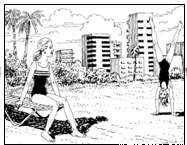
My family was spending a week at the beach. One morning, Maria went to the beach early, but I stayed behind to finish a drawing of a seashell. After finishing the drawing, I walked to join Maria. She was a top gymnast (体操运动员). Her show was perfect as she wheeled along the beach. The beauty of that sight froze me, and I decided immediately that I too would become a gymnast like her.

I knew that I had never been very good at sports. However, when I told my parents I wanted to take a gymnastics class, they agreed with me in surprise. The next week, I went to a beginners’ class.

   If only my parents had talked me out of this misguided plan! Five minutes into the first class, it was clear that I didn’t have the gift of a gymnast. But I kept at it.

   During this time, drawing and painting—which had been my two favorites—all but left my mind. It must have been hurting for my family as they watched my hopeless efforts. I blindly decided to be like Maria. I just would not give up.

   At the same time, on the advice of Ms. White, my art teacher, I hurriedly handed in my seashell drawing for an art contest in our town. One night as I was having a hard time practicing, the phone rang. It was Ms. White. “Alice, you won the contest!” she said loudly.

 “Really?” was all I could reply.

“Yes,” Ms. White said. “They’re going to give you a prize. And that’s not all. The winner is also accepted into Wildale’s Summer Fine Arts Institute.” I couldn’t believe what I heard. Only a handful of young artists were accepted each summer.

That night I didn’t go back into the living room to continue practicing. Gymnastics was Maria’s gift, not mine. It had taken me a while, but I realized that I had a gift of my own.

1.Alice wanted to be a gymnast because ________.

A. she had been good at sports                  B. her sister’s show was perfect

C. she hated drawing and painting               D. her parents wanted her to do so

2. How did Alice feel about learning gymnastics at last?

A. Satisfied.           B. Worried.             C. Hopeful          D. Regretful.  

3. From the story, we can infer that ________.

A. Alice’s parents disagreed with her choice of gymnastics

B. Alice did not realize her gift in drawing and painting at first

C. Alice spent a hard time preparing for the art contest in the town

D. Alice couldn’t believe the news that she got the prize for painting

4. What does the writer want to tell us according to the passage?

A. We should value our own gifts.           B. It takes time to find one’s gifts.

C. We could develop different gifts.        D. It’s never too late to show our gifts.


查看答案和解析>>

根据汉语意思完成句子 。

1.我将考虑当一名老师而不是工人。    
       I'll _____ becoming a teacher_____a worker.
2.我去过长城好几次了。
      I     __     _____to the Great Wall several times.
3.如果你去说英语的国家旅游,学英语是必要的。    
     If you travel to _____countries, it is necessary _____English.
4.游览那个水上公园最好的方法是乘船。    
     The best way            the water park is _____a boat.
5.他们作为交换生在新加坡学习英语已一年了。    
     They have been learning English as              in Singapore   __    a year.

查看答案和解析>>

完形填空。
     Recently, how teachers should criticize (批评) students __1__ reported in the news. It is because of
 a new __2__ from the Ministry of Education. It says that the head teachers have rights to criticize their
 students "in a proper way".
     Many teachers welcome the rule. They say the move will help teachers __3__ educate students.
 "Today's teachers are afraid it will hurt students' pride," said Ms Yang, "Most of the students are single
 children, and their __4__ are very protective."
     Yang once criticized two boy students who had fought in her class. __5__ next day, the boys'
 parents went to the headmaster and said that Yang had been too hard on their boys. Since then, she has
  been very careful __6__ criticizing students.
     But some teachers think the rule is too general (宽泛的). What is a "proper manner"? They ask. Here
  is __7__ students have to say.
     Wen Wen is a Junior 2 student __8__ Changsha. She says that when her teachers criticize students,
 they do not use harsh (刺耳的) words. Most of her classmates __9__ this kind of criticism.
    Guo Xiaoyu, a __10__ Beijing student thinks it is better to criticize a student in private (私下)."I don't
  like teachers criticizing me in front of the whole class.  I lose face," she said.
(     ) 1. A.have been    
(     ) 2. A.idea          
(     ) 3. A.well          
(     ) 4. A.parents      
(     ) 5.A.A            
(     ) 6. A.with          
(     ) 7. A.that          
(     ) 8. A.in          
(     ) 9. A.like          
(     ) 10.A.15 years old  
B. has been      
B. plan          
B. good          
B. teachers      
B.The            
B. to            
B. when          
B.at            
B. accept        
B. 15-year-old    
C. have        
C. rule        
C. better      
C. friends      
C./          
C. for          
C. what        
C.on          
C. mind        
C. 15 year old  
D. was            
D. reason        
D. easier        
D. classmates    
D.One            
D. about          
D. how            
D.of            
D. reply          
D.15-years-old    

查看答案和解析>>

A year ago,I paid no attention to English idioms (习语), though my teacher told us the importance again and again. But soon, the importance of English idioms was shown in an amusing experience.
One day, I happened to meet an Englishman on the road, and soon we began to talk. As I was talking about how I was studying English, the foreigner seemed to be surprised. Gently shaking his head,shrugging his shoulders, he said,“You don’t say!” “You don’t say!” I was puzzled. I thought , perhaps this is not a right topic. “Well, I’d better change the topic.” So I said to him. “Well, shall we talk about the Great Wall? By the way, have you ever been there?” “Certainly, everyone back home will laugh at me if I leave China without seeing it. It was wonderful.” He was deep in thought when I began to talk like a tourist guide. “The Great Wall is one of the wonders in the world. We are very proud of it.” Soon I was interrupted (打断) again by his words: “You don’t say!” I couldn’t help asking, “Why do you ask me not to talk about it?” “Well, I didn’t ask you to do so,” he answered, greatly surprised. I said, “Didn’t you say ‘you don’t say’?” Hearing this, the Englishman laughed to tears. He began to explain, “ ‘You don’t say’ actually means ‘really!’ It is an expression of surprise. Perhaps you don’t pay attention to English idioms.” I realized I had made a fool of myself. Since then I have been more careful with idiomatic expressions. Remember: what the English teachers said is always right to us students

  1. 1.

    A year ago, I paid no attention to English idioms because______.

    1. A.
      I had no interest in them
    2. B.
      English idioms were very difficult
    3. C.
      I did not realize the importance of them
    4. D.
      my teacher didn’t tell us the importance of them
  2. 2.

    At first, on hearing “You don’t say,” I thought the foreigner meant______.

    1. A.
      I had talked too much
    2. B.
      I had to stop talking
    3. C.
      he was not interested in the topic
    4. D.
      he was only interested in the Great Wall
  3. 3.

    “… was shown in an amusing experience.” The word “amusing” probably means______.

    1. A.
      interesting
    2. B.
      important
    3. C.
      terrible
    4. D.
      unlucky
  4. 4.

    Which of the following is TRUE according to the passage?

    1. A.
      The Englishman wanted me to act as his guide
    2. B.
      The Englishman left China without seeing the Great Wall
    3. C.
      The Englishman wanted to see the Great Wall after I talked about it
    4. D.
      The Englishman visited the Great Wall and thought it worth visiting
  5. 5.

    After the Englishman explained the idiom,______.

    1. A.
      I felt very silly
    2. B.
      the Englishman became a real fool
    3. C.
      I became more carefully in everything
    4. D.
      I thought the Englishman had made me a fool

查看答案和解析>>

阅读理解。
     I will never forget the very moment that caused me to leave my gift behind because I wanted the gift that
my older sister Maria had.
     My family was spending a week at the beach. One morning, Maria went to the beach early, but I stayed
behind to finish a drawing of a seashell. After finishing the drawing, I walked to join Maria. She was a top
gymnast (体操运动员). Her show was perfect as she wheeled along the beach. The beauty of that sight froze
me, and I decided immediately that I too would become a gymnast like her.
     I knew that I had never been very good at sports. However, when I told my parents I wanted to take a
gymnastics class, they agreed with me in surprise. The next week, I went to a beginners' class.
     If only my parents had talked me out of this misguided plan! Five minutes into the first class, it was clear
that I didn't have the gift of a gymnast. But I kept at it.
     During this time, drawing and painting-which had been my two favorites-all but left my mind. It must
have been hurting for my family as they watched my hopeless efforts. I blindly decided to be like Maria. I just
would not give up.
     At the same time, on the advice of Ms. White, my art teacher, I hurriedly handed in my seashell drawing
for an art contest in our town. One night as I was having a hard time practicing, the phone rang. It was Ms.
White. "Alice, you won the contest!" she said loudly.
     "Really?" was all I could reply.
     "Yes," Ms. White said. "They're going to give you a prize. And that's not all. The winner is also accepted
into Wildale's Summer Fine Arts Institute." I couldn't believe what I heard. Only a handful of young artists
were accepted each summer.
     That night I didn't go back into the living room to continue practicing. Gymnastics was Maria's gift, not
mine. It had taken me a while, but I realized that I had a gift of my own.
1. Alice wanted to be a gymnast because ________.
A. she had been good at sports
B. her sister's show was perfect
C. she hated drawing and painting
D. her parents wanted her to do so
2. How did Alice feel about learning gymnastics at last? 
A. Satisfied.
B. Worried.
C. Hopeful.
D. Regretful.
3. From the story, we can infer that ________.
A. Alice's parents disagreed with her choice of gymnastics
B. Alice did not realize her gift in drawing and painting at first
C. Alice spent a hard time preparing for the art contest in the town
D. Alice couldn't believe the news that she got the prize for painting
4. What does the writer want to tell us according to the passage?
A. We should value our own gifts.
B. It takes time to find one's gifts.
C. We could develop different gifts.
D. It's never too late to show our gifts.

查看答案和解析>>


同步练习册答案