
题目列表(包括答案和解析)
| A.阅者以其言戆戆:愚直 |
| B.至此户口渐蕃蕃:多 |
| C.卒定谳,论罪如律论:议论 |
| D.复欲于计典黜之黜:罢免。 |
| A.罢无益之费架梁之椽,多于机上之工女 |
| B.守备黄镇中以非刑杀人臣以神遇而不以目视 |
| C.为之言于总督,乃已吾为公取彼一将 |
| D.屡请于上官,乞豁除而刀刃若新发于硎 |
| A.③④⑥ | B.①②⑤ | C.①②⑥ | D.③④⑤ |
| A.初任昌化县知县时,陶元淳厘定赋役,裁减额外的赋税,减轻了百姓负担,使百姓“相率以力耕为业”,发展了当地农业生产,城中人口得以增多。 |
| B.在任崖州知州时,守备黄镇中违法杀人,陶元淳依法审案被诬陷,总督下令琼州总兵“会讯”。陶元淳得知后上书申辩,总督终因陶元淳的倔强而赦免了他。 |
| C.在陶元淳初审黄镇中违法杀人的案子时,黄镇中命令披甲操刀的士兵冲人衙¨以武力相威逼,陶元淳全无惧色,拍案怒斥,黄镇中“气慑”而退。 |
| D.陶元淳力行节约,生活俭朴,为官时平日所吃,只是“韭一束”;他喜欢与读书人交往,常常与他们讨论问题到三更半夜也不知疲倦。 |
完成句子。(10分)
【小题1】请注意我下面要讲的话。
Please pay what I’m going to say.
【小题2】剧院里几乎没人了,是吗?
There are people in the theater, there?
【小题3】那个人使我想起了我的小学语文老师。
The man me my Chinese teacher in the primary school.
【小题4】当我起床时,爸妈已经去上班了。
When I got up, my parents to work.
【小题5】球迷们看到贝克汉姆时,他们是那么的兴奋,不由得大喊大叫。
When the football fans saw Beckham, they got excited they cried out.
Dreams can happen in any of the four stages of sleep. The most memorable and clearest dreams happen in the last stage of sleep (also known as REM sleep). The sleep cycle repeats about four to five times every night. So you can see how a person has several different dreams in one night. Most people only remember dreams that happen closer to the morning when they are about to wake up. That you can’t remember those dreams does not mean they never happened.
The stages in the sleep cycle are organized by the changes in different brain activities.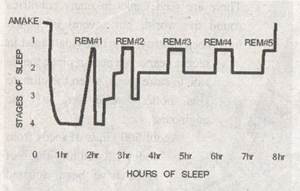
Stage 1: You are entering into light sleep. In this stage, your eyes move rapidly. We call this NREM. The body gets relaxed and your body temperature lowers. Your heart rate lowers, too. The body is preparing to enter into deep sleep.
Stage 2: Also characterized by NREM. In this stage, the body temperature and heart rate drop again. You are completely asleep.
Stage 3: Still in the NREM stage, this is a deeper sleep still.
Stage 4: In this stage of sleep, your eyes move back or forward. We call it REM sleep. This stage happens at about 90-100 minutes after the beginning of sleep. Your blood pressure rises, heart rate speeds up. The majority of your dreams happen in this stage.
These stages repeat themselves throughout a night’s sleep.
【小题1】 Dreams can happen in ___________.
A. Stage 1 and 2 B. Stage 3 and 4 C. every stage
【小题2】Which of the following sentences is TRUE according to the passage?
A. These stages will happen once or twice one night.
B. Most people only remember the dreams that happen when they are about to wake up.
C. If one can’t remember his dreams, he never dreams at all.
【小题3】What will happen in Stage 2?
A. Eyes move rapidly. B. People enter into light sleep. C. Heart rate drops.
【小题4】The first REM sleep happens about ___________ after the starting of sleep.
A. 1 to 2 hours B. 2 to 3 hours C. 10 minutes
【小题5】The passage is mainly about ___________.
A. the stages of sleep B. types of dreams C. remembering dreams
| A.【甲】文所记叙的是强国和弱国之间的一场外交斗争,最后弱国取得胜利的故事。 |
| B.【乙】文所记叙的是荆轲刺秦王的经过:他拿着匕首,追赶秦王,而其余臣子则袖手旁观。 |
| C.【乙】文中记载了秦国的一条法律:带刀的侍卫一般不上殿,上殿的臣子不能带刀。 |
| D.【甲】【乙】两文在人物刻画上均用了对比的方法,其中【乙】文用秦武阳的“色变振恐”衬托出荆轲的沉着冷静。 |
Laboratory work is your chance to learn science firsthand. It can be fun but you must be careful to prevent injury. Listen closely when your teacher reads and explains the rules before your first lab lesson.
LABORATORYRULES
Throughout the lesson
·Do not enter the science lab without the teacher’s permission.·No food or drinks are to be alowed in the science lab.
Before the Experiment
·Read al instructions carefuly before every experiment.
·Prepare al apparatus(仪器)and arrange them so that you wil not knock them over while doing the experiment.
During the Experiment
·If you are unsure of how to use any apparatus or how to operate, ask your teacher for help.·Never smel or taste chemicals unless your teacher gives permission.
After the Experiment
·Wash al apparatus after use and return them to the places where they were.
·Throw waste materials in proper waste baskets. First Aid
·Report al accidents to your teacher immediately.
·If you spil( 溅 出 )any chemicals onto your body or clothing, wash with plenty of water and report to your teacher.
1. Your teacher wil probably tel you the rules above _____ the first lab lesson.
A. before B. since C. during D. after
2. Before every experiment, you should _____.
A. taste the chemicals first
B. clean al the apparatus
C. read al instructions carefuly
D. report al the accidents to the teacher
3. When you are not sure how to use al apparatus, _____.
A. try them on your own
B. read the rules carefuly
C. ask your teacher for help
d. put them back
4. It is clear that you can _____.
A. bring food into the lab
B. enter the lab anytime
C. smel chemicals as you like
D. learn science directly in the lab
5. If you get chemicals on the clothing, you can find ways to solve it in the part _____.
A. Before the Experiment
B. First Aid
C. During the Experiment
D. After the Experiment
湖北省互联网违法和不良信息举报平台 | 网上有害信息举报专区 | 电信诈骗举报专区 | 涉历史虚无主义有害信息举报专区 | 涉企侵权举报专区
违法和不良信息举报电话:027-86699610 举报邮箱:58377363@163.com