
题目列表(包括答案和解析)
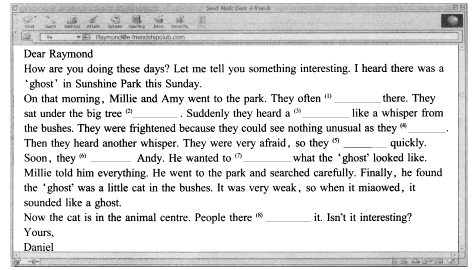
Daniel is writing to Raymond, However,he is not sure how to use some words and phrases.Help him complete the e-mail using the correct forms of the words and phrases from the box below.
as usual chat find out noise
run away run into take care of turn around
Creighton Carvello was called the Memory Man. He could remember hundreds of playing cards and pages of the telephone numbers in only a few seconds.
Creighton was born in India in 1944. He was the middle child of five and his father worked on the railways. In 1949, the Carvello family returned to England and settled(定居) in Middlesbrough, where Creighton spent the rest of his life. His father first noticed his great talent when, aged 7, he started to memorize information from cigarette cards with pictures of planes and cars.
After leaving school, Creighton developed his talent by memorizing more and more information. He soon became popular as he performed in clubs to show his great memory. He remembered the telephone number of anyone called Smith who lived in the Middlesbrough area. He first got into the record books in his thirties. He travelled around the world, showed up on television and amazed the audience with his memory.
Creighton was a man of many talents, including writing songs, drawing and telling jokes.
In his last years, Creightton moved to care home. The old people there would test his memory with questions such as naming what day of the week they were born on. Only days before he died, one lady gave her date of birth, July 29, 1921 and Creighton immediately replied, “Friday”. He died on November 18, 2008.
【小题1】What was Creighton most famous for?
a. His songs b. His jokes c. His drawing d. His memory
【小题2】How many children were older than Creighton in his family?
a. Two b. Three c. Four d. One
【小题3】What happened when Creighton was five?
a. He left school. b.He first got into the record books.
c.His family returned to England. d.His father first noticed his great talent.
【小题4】Which of the following is TRUE according to the passage?
a. Creighton spent the rest of his life in India.
b. Creighton was forced(强迫) to memorize things by his father.
c. Creighton played the piano in clubs after leaving school.
d. Creighton was a talented man.
【小题5】What can we learn from the last paragraph?
a. Creighton didn’t have a family.
b. Creighton died young because he memorized too many things.
c. Creighton died at the age of 60.
d. Creighton still had a good memory several days before he died.
Creighton Carvello was called the Memory Man. He could remember hundreds of playing cards and pages of the telephone numbers in only a few seconds.
Creighton was born in India in 1944. He was the middle child of five and his father worked on the railways. In 1949, the Carvello family returned to England and settled(定居) in Middlesbrough, where Creighton spent the rest of his life. His father first noticed his great talent when, aged 7, he started to memorize information from cigarette cards with pictures of planes and cars.
After leaving school, Creighton developed his talent by memorizing more and more information. He soon became popular as he performed in clubs to show his great memory. He remembered the telephone number of anyone called Smith who lived in the Middlesbrough area. He first got into the record books in his thirties. He travelled around the world, showed up on television and amazed the audience with his memory.
Creighton was a man of many talents, including writing songs, drawing and telling jokes.
In his last years, Creightton moved to care home. The old people there would test his memory with questions such as naming what day of the week they were born on. Only days before he died, one lady gave her date of birth, July 29, 1921 and Creighton immediately replied, “Friday”. He died on November 18, 2008.
1.What was Creighton most famous for?
a. His songs b. His jokes c. His drawing d. His memory
2.How many children were older than Creighton in his family?
a. Two b. Three c. Four d. One
3.What happened when Creighton was five?
a. He left school. b.He first got into the record books.
c.His family returned to England. d.His father first noticed his great talent.
4.Which of the following is TRUE according to the passage?
a. Creighton spent the rest of his life in India.
b. Creighton was forced(强迫) to memorize things by his father.
c. Creighton played the piano in clubs after leaving school.
d. Creighton was a talented man.
5.What can we learn from the last paragraph?
a. Creighton didn’t have a family.
b. Creighton died young because he memorized too many things.
c. Creighton died at the age of 60.
d. Creighton still had a good memory several days before he died.
I was in my third year of teaching writing at Ralph High School in New York, when one of my students, 15-year-old Mikey, gave me a note from his mother. It explained his absence from class the day before:
"Dear Mr. McCort, Mikey's grandmother, who is eighty years of age, fell down the stairs from too much coffee and I kept Mikey at home to take care of her and his baby sister so I could go to my job. Please excuse Mikey and he'll do his best in the future. P.S. His grandmother is OK."
I had seen Mikey writing the note at his desk. l said nothing. Most parental-excuse notes I received were penned by my students. The writers of those notes didn't realize that honest excuse notes were usually boring: "Peter was late because the alarm clock didn't go off."
The students always said it was hard putting 200 words together on any subject, but when they produced excuse notes, they were excellent. So I decided to give the first class to study the art of the excuse note.
“Today I'd like you to write 'An Excuse Note from Adam to God' or 'An Excuse Note from Eve to God'. "Heads went down. Pens raced across paper. They had to be asked to go to lunch by their friends.[来源:学|科|网Z
The next day everyone had excuse
notes. Heated disc ussions
followed. But suddenly I saw the headmaster at the door. He entered the
classroom and walked up and down, looking at papers, and then said. "I'd
like you to see me in my office." My heart sank,
ussions
followed. But suddenly I saw the headmaster at the door. He entered the
classroom and walked up and down, looking at papers, and then said. "I'd
like you to see me in my office." My heart sank,
When I stepped into his office, he came to shake my hand and said, "I just want to tell you that lesson, that task, was great. Those kids were writing on the college level. Thank you."
1.What did the writer do when he found the students dishonest?
A. He reported them to the headmaster.
B. He lectured them hard on honesty.
C. He had them take notes-n class.
D. He helped improve their writing skills.
2.We can learn that when Mikey was absent from the class, he was____.
A. somewhere enjoying himself
B. taking care of his baby sister
C. looking after his grandmother
D. studying the art of the excuse note
3.How did the writer usually find out his students' parental excuse notes were dishonest?
A. They were written in boring words.
B. He called their parents and found out the truth.
C. They were more like stories than facts.
D. The handwriting clearly looked like children's.
4.Which of the following is true?
A. The writer has many years of teaching experience.
B. The students are good at writing excuse notes.
C. The headmaster was angry with the writer.
D. Most of the excuse notes were written by the parents.
5.Which of the following best describes the writer as
a tea cher?
cher?
A. Honest. B. Strict. C. Hardworking. D. Wise.
湖北省互联网违法和不良信息举报平台 | 网上有害信息举报专区 | 电信诈骗举报专区 | 涉历史虚无主义有害信息举报专区 | 涉企侵权举报专区
违法和不良信息举报电话:027-86699610 举报邮箱:58377363@163.com