
题目列表(包括答案和解析)
阅读下面的短文,并根据短文后的要求答题。
According to a new survey, students’ safety has become a big problem. Nearly 50% of students say they are worried about robbery on the way to and from school. Now in many big cities in China, some schools have taught an unusual lesson: self-protection. Students like this lesson because there are no exams or boring classes. And they can learn how to save lives and know how to stop danger before it really happens.
Chen Haoyu, a teacher at Beijing No. 25 Middle School, gives young students advice on how they should deal with danger.
If you are robbed
Keep calm. If you cannot cry for help or run away, give the robber your money. Try to remember what the robber looks like and tell the police later.
If you are in a traffic accident
If a car hurts you, you should remember the car number. If it is a bicycle, try to call your parents before you let the rider go. This is because you don’t know how seriously you are hurt.
If it is raining hard and there is lightning
Don’t stay in high places and stay away from trees.
When there is a fire
Get away as fast as you can. Put wet things on your body and try to find an exit. Do not take the lift.
If someone is drowning
If you can’t swim, don’t get into the water. Cry out for help.
Remember that danger is never as far away as you think. Take care of yourself at all times!
1.将文中划线句子翻译成汉语:
根据短文内容回答问题。
2.Why do students like the self-protection lesson?
3.How many suggestions for dealing with danger did Chen Haoyu give ?
______________________________________________________________
4.What should you do when there is a fire?
____________________________________________________________________.
5.The best title for this passage might be
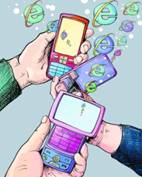
It's the end of class. When the bell rings, students of Luohu Foreign Languages School in Shenzhen quickly take out their cell phones. They want to log on* to their micro blogs to check the interesting things that have happened in the last hour.
Since last year, the trend* of micro blogging has swept the country. Recent surveys shows that most students in middle schools have a micro blog and some even update* their blogs over five times per day.
"We learn many fresh and interesting things on micro blogs and they have become popular topics in class," said Andy Liang, 14. "If you do not know about them, you are out of the loop."
It is also a great place for students to let out stress. "My parents always ask me to study all the time, and encourage me before exams, but it really adds pressure," said Simon Zhang, 15. "When I share these feelings on my micro blog, I get many replies from friends in the same situation, which makes me feel better."
But parents are worried that micro blogging could be a waste of time. Some misleading messages may even cause danger to kids, they said.
Mr. Shen, a professor at the China Education Association, suggests parents not worry too much as long as kids are not crazy about micro blogging. Maybe it can become a window for parents to understand their children. "If parents can read their children's micro blogs, they'll know their thoughts, thus leading to better communication and solutions to problems," he said. He also gives some tips for kids.
---Don't micro blog for more than one hour a day.
---Never micro blog in class.
---Try to talk face to face with people from time to time.
---Be critical*. Don't trust all the messages on a micro blog.
1.The underlined part "out of the loop" in the passage probably means .
A. not popular B. not excited C. unhealthy D. unlucky
2.Micro blog made Simon when he shared his feelings and got replies on his micro biog.
A. feel sad B. let out stress C. add pressure D. make friends
3.We can know from Mr. Shen that micro blogging can .
A. make kids crazy while logging on to it
B. bring a lot of misleading messages
C. become a window to understand young kids
D.lead to worse communication
4.Which statement is TRUE according to the passage?
A. It's good for kids to micro blog for more than one hour a day.
B.Kids should trust all the messages on a micro blog because they are useful.
C.The trend of micro blogging has swept the country since five years ago.
D. Kids should try to talk face to face with people, not just micro blogging.

Mr. King works in a shop and drives a car for the manager. He drives carefully and can keep calm when 16 danger. And he escaped from several accidents. The manager 17 him more and the traffic policemen often speaks highly of him.
Mr. Baker,one of his friends,works in a factory outside the city. It’s far from his house and he has to go to work by bus. As the street is 18 in the morning, sometimes he’s late for the work. His manager warns the young man that he will be sent away 19 he gets to his office on time. He hopes to buy a car,but he hasn’t enough 20 . He decides to buy an old one. One day, he went to the second-hand market and at last he chose a beautiful but cheap car. He said he wanted to try the car,the seller agreed. He 21 Mr King and asked him to help him at once.
Mr. King examined(检查) the car and then drove it away. It was early in the morning and there were few cars in the street. At first he drove slowly and it 22 well. Then he drove fast. And when he reached a crossing,the lights turned 23 . He tried to stop it, but he failed and 24 hit an old woman who was crossing the street. A policeman told him to stop,but the car went on until it hit a big tree by the road.
“Didn’t you hear me?” the policeman asked angrily.
“Yes, I did,sir,” said Mr King,“ 25 it doesn’t listen to me,can it obey(听从)you?”
1.A. looking B. reaching C. facing D. getting
2.A. gives B. pays C. needs D. believes
3.A. crowded B. quiet C. empty D. full
4.A. until B. unless C. when D. if
5.A. time B. experience C. friends D. money
6.A. called B. found C. visited D. invited
7.A. looked B. traveled C. seemed D. worked
8.A. red B. green C. up D. out
9.A. hardly B. heavily C. nearly D. mostly
10.A. Although B. Since C. While D. For
Martin is an American boy. He is eight years old. His parents 41 _ five years ago and he is now living with his grandmother in New York.
One morning, Jimmy , one of his classmates, came to his home with an exercises book in his hand. Jimmy lives in a house not far from Martin's. They often go to school together.
"Would you help me with this maths problem?" Jimmy said as soon as he came into the room. "It's too hard for me and I can't work it out."
"Let me try, " Martin said. "I 42 it isn't too hard for me. "
Martin tried his best but he couldn't work it out, 43 .
"If we had a small computer, all the problems would be 44 for us to do. " Jimmy said.
"A small computer . . . , " Martin thought for a minute, then he said, "I've got an idea. We can 45 one in a shop. "
"A computer is very 46 , and we don’t have enough money. "
"That's OK, " said Martin. "We can ask the new president (总统) 47 some money. He said he would help anyone in trouble. I' m sure he will help us. He is very rich, you know."
So they decided to write a letter to the new president. Soon the letter was finished and they hurried to the post office.
In front of the post office stood a small box. They 48 the letter into the box carefully and went home happily.
The next morning, they 49 the post office on their way to school. They found 50 , the box was not a post box but trash-box (果皮箱).
|
1. |
|
|
2. |
|
|
3. |
|
|
4. |
|
|
5. |
|
|
6. |
|
|
7. |
|
|
8. |
|
|
9. |
|
|
10. |
|
Ask three people to look out the same window at a busy street corner and tell you what they see. Chances are you will receive three different answers. Each person sees the same scene(场景), but each perceives(察觉)something different about it.
Perceiving goes on in our minds. Of the three people who look out the window, one may say that he sees a policeman giving a motorist a ticket(罚单). Another may say that he sees a rush-hour traffic jam at the intersection. The third may tell you that he sees a woman trying to cross the street with four children in tow(拉着). For perception(感知) is the mind’s interpretation of what the senses—in this case our eyes—tell us.
Many psychologists(心理学家) today are working to try to determine just how a person experiences or perceives the world around him. Using a scientific approach, these psychologists set up experiments in which they can control all of the factors. By measuring and charting the results of many experiments, they are trying to find out what makes different people perceive totally different things about the same scene.
1.Perceiving is an action that takes place _____.
|
A.in our eyes |
|
B.only when we think very hard about something |
|
C.only under the direction of a psychologist |
|
D.in every person’s mind |
2.People perceive different things about the same scene because ____.
|
A.they see different things. |
|
B.they can not agree about things |
|
C.some have better eyesight |
|
D.none of these |
3.Psychologists study perception by _____.
|
A.setting up many experiments. |
|
B.asking each other what they see. |
|
C.looking out of windows. |
|
D.Studying people’s eyes. |
4.The best title for this article is _____.
|
A.How We See |
|
B.Learning About Our Minds Through Science |
|
C.What Psychologists Perceive |
|
D.How To Become An Experimental Psychologist |
湖北省互联网违法和不良信息举报平台 | 网上有害信息举报专区 | 电信诈骗举报专区 | 涉历史虚无主义有害信息举报专区 | 涉企侵权举报专区
违法和不良信息举报电话:027-86699610 举报邮箱:58377363@163.com