
题目列表(包括答案和解析)
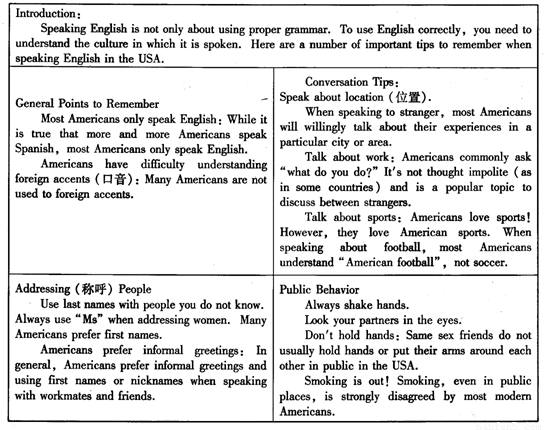
1. What is necessary to know when we speak English besides using grammar?
A. Introduction. B. The culture. C. Grammar. D. Topics.
2. "When speaking to a stranger, ask them where they are from and then make a connection (联系) with that place" can be used as a sentence to_______.
A. speak about location B. talk about sports
C. address people D. talk about work
3. We can learn from the text that_______.
A. Americans shake hands when greeting same sex friends
B. different sex friends should hold hands when first meeting
C. when you speak to others, it's polite to look into their eyes
D. smoking is not allowed in the modem United Sates
4. What would be the best title for the text?
A. American English Tips. B. Language Differences.
C. The Different Language Culture. D. American Customs.
To save yourself from embarrassment (尴尬), it’s good to read a few books or research online about the culture and customs of the country you plan to visit.
Clothing: Wearing shorts in public is generally not acceptable in most parts of the world, including some European countries.
Greetings: Handshake is a usually accepted form of greeting, although in some countries, like Japan, a traditional bow(鞠躬) is preferred. Be careful how you talk with someone; don’t use first names unless you are invited to do something.
Language/Gestures: learn some polite expressions (hello-goodbye-thank you) and relax. English is pretty common worldwide, especially in tourist areas and you can always use body language to get your message across. However, some Americans gestures have different meanings in other countries. For example, in Bulgaria, shaking your head usually means “yes”; shaking it “vertically” means “ no”.
Food/Drink: you may find yourself looking down at a local delicious snake soup in china, sheep’s eyes in Saudi Arabia… and wonder what to do; especially you are guests in someone’s home. Be brave, take small bites, and pretend it tastes like something you like. Remember that some Buddhists don’t eat beef, and Muslims don’t eat pork. If you are eating with Muslims, never touch food with left hand (the left hand is for bathroom use).
Conversations: if you know the history and culture of the country, you will be confident. The French are angry at the classic American question: “What do you do for a living?” and so on.
1.You should learn about _______ of the country if you want to go to another country.
A.the people and the food
B.the culture and customs
C.the language and people
D.the behavior and conversations
2.A Japanese meet you for the first time, he/ she will ________.
A.shake hands with you B.hug with you
C.kiss you D.bow to you
3.In Bulgaria, shaking your head usually means______________.
A.yes B.no C.victory D.calm down
4.Which of the following isn’t right?
A.You can’t wear shorts in public in most parts of the world.
B.You can use body language to communicate with people.
C.You can use your left hand to touch food when you eat with Muslims.
D.You can get along well with people you visit if you know their culture and customs well.
阅读短文,根据意思,判断所给句子的正误。正确的写T,错误的写F。
“How are you?” is a nice question. It’s a friendly way that people in the U.S.A greet(问候) each other. But “How are you?” is also a very unusual(不寻常的) question. It’s a question that often doesn’t need an answer. The person who asks“ How are you?” hopes to hear the answer “Fine”, even if the person’s friend isn’t fine. The reason is that “How are you?” isn’t really a question and “Fine” isn’t really an answer. They are simply (只)other ways of saying “Hello” or “Hi”.
Sometimes, people also don’t say exactly(确切) what they mean. For example, when someone asks “Do you agree?”, the other person might think, “No, I disagree. I think you’re wrong...”But it isn’t very polite to disagree so strongly(强烈地), so the other person might say “I’m not sure.” It’s a nicer way to say that you don’t agree with someone.
People also don’t say exactly what they are thinking when they finish talking with other people.For example, many talks on the phone finish when one person say “I’ve to go now.” Often, the person who wants to hang up(挂)says: “Someone’s at the door.” “Something is burning (烧)on the stove(炉).” The excuses(借口) might be real(真的), or not. Perhaps the person who wants to hang up simply doesn’t want to talk any more, but it isn’t polite to say that. The excuse is more polite, and it doesn’t hurt (伤)the other person.
Whether they are greeting each other, talking about an idea, of finishing a talk, people don’t say exactly that they are thinking. It’s an important way that people try to be nice to each other, and it’s part of the game of language.
【小题1】“How are you?” is another way of saying "Hello." or" Hi."
【小题2】It is polite to say" No. I disagree. I think you are wrong, "if you don’t agree with others.
【小题3】When someone says "I have to go now "On the phone,it means he wants to go on talking.
【小题4】"Someone is at the door." may be an excuse for finishing a talk.
【小题5】Sometimes people don't say exactly what they are thinking about just because they try to be nice to each other.
“How are you?” is a nice question. It’s a friendly way that people in the U.S.A greet each other. But “How are you?” is also a very unusual question. It’s a question that often doesn’t need an answer. The person who asks“ How are you?” hopes to hear the answer “Fine”, even if the person’s friend isn’t fine. The reason is that “How are you?” isn’t really a question and “Fine” isn’t really an answer. They are simply other ways of saying “Hello” or “Hi”.
Sometimes, people also don’t say exactly what they mean. For example, when someone Asks “Do you agree?”, the other person might think, “No, I disagree. I think you’re Wrong...”But it isn’t very polite to disagree so strongly, so the other person might say “I’m not sure.” It’s a nicer way to say that you don’t agree with someone.
People also don’t say exactly what they are thinking when they finish talking with other people. For example, many talks over the phone finish when one person say “I’ve to go now.” Often, the person who wants to hang up gives and excuse: “Someone’s at the door.” “Something is burning on the stove.” The excuses might be real, or not. Perhaps the person who wants to hang up simply doesn’t want to talk any more, but it isn’t polite to say that. The excuse is more polite, and it doesn’t hurt the other person.
Whether they are greeting each other, talking about an idea, of finishing a talk, people don’t say exactly that they are thinking. It’s an important way that people try to be nice to each other, and it’s part of the game of language.
1.“How are you?” is another way of saying "Hello." or" Hi."
2. It is polite lo say" No. I disagree I think you are wrong, "if you don’t agree with others.
3.When someone says "I have to go now "On the phone.it means he wants to go on talking.
4."Someone is at the door." may be an excuse for finishing a plume can.
5. Sometimes people don't say exactly what they are thinking about just became they try to be nice to each other.
湖北省互联网违法和不良信息举报平台 | 网上有害信息举报专区 | 电信诈骗举报专区 | 涉历史虚无主义有害信息举报专区 | 涉企侵权举报专区
违法和不良信息举报电话:027-86699610 举报邮箱:58377363@163.com