
题目列表(包括答案和解析)
One afternoon, my son came home from school and asked me, “Are all people the same even if their skin color is different?” I thought for a moment, then I said, “I’ll explain. Let’s go to a fruit store first. I have something interesting to show you.”
At the store, I told him that we needed to buy apples. And we bought some red apples, green apples and yellow apples.
After we got home, I told Adam, “It’s time to answer your question.” I put one of each type of apple on the table: first a red apple, followed by a green apple and then a yellow apple. Then I looked at Adam, who was sitting on the other side of the table.
“Adam, people are just like apples. They come in different colors, shapes and sizes. See, some may not even look as delicious as others.” As I was talking, Adam was examining each one carefully.
Then, I took each of the apples and peeled them, placing them back on the table, but in a different place.
“OK, Adam, tell me which one is the red apple, the green apple and the yellow apple.”
He said, “I can’t tell. They all look the same now.”
“Take a bite(一口) of each one. See if that helps you tell which one is which.”
He took big bites, and then a huge smile came across his face. “People are just like apples! They are all different, but if you take off the outside, they’re pretty much the same on the inside.”
“Right,” I agreed. “Just like everyone has their own features but they are nearly the same.”
He completely got it. I didn’t need to say or do anything else.
Now, when I eat an apple, it tastes a little sweeter than before. What perfect fruit it is!
1. I took Adam to buy apples for .
A. supper B. his question C. a party D. a present
2. As soon as we got home, I put on the table.
A. all the apples B. three apples of different colors
C. three red apples D. three peeled apples
3.After Adam took big bites, he found they .
A. looked the same B. tasted good C. tasted the same D. weren’t delicious
4.In the end, Adam understood that .
A. people are much the same even if their skin color is different
B. people are different if their skin color is different
C. the apples look the same after they are peeled
D. apples of different colors taste different
5. I feel that apples taste a little sweeter than before because .
A. they are delicious enough B. they are perfect fruit for thinking
C. they are safe fruit D. my son falls in love with them
Doing experiments can be interesting, and you may try the following experiments at home. Make sure that you’ll do them with an adult.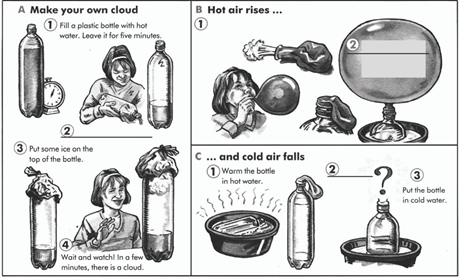
【小题1】How many experiments are there in the pictures?
| A.Six. | B.Five. | C.Three. | D.Two. |
| A.a, b, c | B.a, c, b | C.b, a, c | D.c, a, b |
| A.Some ice. | B.Some water. |
| C.Some ice and water. | D.A cloud and some water. |
| A.It will be bigger. | B.It will be broken. |
| C.It won’t change. | D.It will be in the bottle. |
Indian boy Piscine Patel is troubled by his first name. It sounds like a rude word, and his classmates laughed at him. He decides to change his name to “Pi”.
But Pi’s name problems are nothing compared to what is waiting for him.
Pi’s father owns a zoo. He decides to move to Canada. The family, together with all the zoo animals, set sail across the Pacific. One day, a huge storm hits the ship. The next morning, Pi finds his family has sunk with the ship. He is the only person still alive.
He finds himself on a lifeboat with several animals, one of which is a tiger called Richard Parker. Soon, all the animals are killed and Pi is left alone with the tiger.
As the tiger becomes hungrier, Pi starts to fish to feed him. Otherwise, he himself will become the food.
The boy and the tiger develop an amazing relationship on the sea. Although he feels hopeless, Pi never gives up. After 227 days, the lifeboat finally lands on a beach in Mexico, but Richard Parker runs away into the forest.
The ship company finds Pi and asks what happened. Pi tells them about Richard Parker but the company doesn’t believe him. Pi then tells another story in which there is no tiger, but some other shocking details(细节).
Is there really another story? If so, which one is the truth? Maybe you will have your own answer after watching The Life of Pi(《少年派的奇幻漂流》), the latest 3D movie from American Chinese director Ang Lee.
1.What’s the first trouble of the Indian boy Piscine Patel?
A.His classmates laughed at his name.
B.His family set sail across the Pacific to Canada.
C.A huge storm hits the ship with his family.
D.The tiger nearly killed him on the lifeboat.
2.Why are all the other animals on the lifeboat killed? Because .
A.they are hunted by others
B.they are eaten by the tiger
C.they are sunk under the sea
D.they are killed and cooked by Pi
3.The passage mainly tells us .
A.how Pi’s lifeboat sank in the sea
B.how the tiger ran away from the sea to the forest
C.what happened to Pi on the lifeboat with a tiger
D.what happened to the animals in Pi’s father’s zoo
4.Which would be true according to the passage?
A.The tiger was killed at last.
B.Pi was saved by another ship.
C.The ship company believed Pi’s tiger story
D.Pi told two stories in the movie.
Indian boy Piscine Patel is troubled by his first name. It sounds like a rude word, and his classmates laughed at him. He decides to change his name to “Pi”.
But Pi’s name problems are nothing compared to what is waiting for him.
Pi’s father owns a zoo. He decides to move to Canada. The family, together with all the zoo animals, set sail across the Pacific. One day, a huge storm hits the ship. The next morning, Pi finds his family has sunk with the ship. He is the only person still alive.
He finds himself on a lifeboat with several animals, one of which is a tiger called Richard Parker. Soon, all the animals are killed and Pi is left alone with the tiger.
As the tiger becomes hungrier, Pi starts to fish to feed him. Otherwise, he himself will become the food.
The boy and the tiger develop an amazing relationship on the sea. Although he feels hopeless, Pi never gives up. After 227 days, the lifeboat finally lands on a beach in Mexico, but Richard Parker runs away into the forest.
The ship company finds Pi and asks what happened. Pi tells them about Richard Parker but the company doesn’t believe him. Pi then tells another story in which there is no tiger, but some other shocking details(细节).
Is there really another story? If so, which one is the truth? Maybe you will have your own answer after watching The Life of Pi(《少年派的奇幻漂流》), the latest 3D movie from American Chinese director Ang Lee.
【小题1】What’s the first trouble of the Indian boy Piscine Patel?
| A.His classmates laughed at his name. |
| B.His family set sail across the Pacific to Canada. |
| C.A huge storm hits the ship with his family. |
| D.The tiger nearly killed him on the lifeboat. |
| A.they are hunted by others |
| B.they are eaten by the tiger |
| C.they are sunk under the sea |
| D.they are killed and cooked by Pi |
| A.how Pi’s lifeboat sank in the sea |
| B.how the tiger ran away from the sea to the forest |
| C.what happened to Pi on the lifeboat with a tiger |
| D.what happened to the animals in Pi’s father’s zoo |
| A.The tiger was killed at last. |
| B.Pi was saved by another ship. |
| C.The ship company believed Pi’s tiger story |
| D.Pi told two stories in the movie. |
What do you think of a forest, what do you see? Just trees? Or do you see many other things, such as singing birds, colorful plants and wild flowers?
The forest is a whole of its own. It is full of many different living things. But even though they are all different, they have one thing in common: they all need each other in order to live on.
The trees feed the forest "people" by making food in their leaves; by using sunlight to join water and minerals from the soil and air. Their deep network of roots joins the soil together and stops it from dying out, making it possible for living things to live in it.
Human beings are like the living things in the forest. We need one another in order to live. We need the farmers to grow our food, railroad and truck drivers to bring it to our shops and clerks (售员)to sell it to us. We need people to prepare our food and cook it and others to take our waste things away. Then, of course, we need doctors, nurses, government leaders, mailmen, telephone operators, and many others.
We also need other human beings in another way. We need people for friendship, to talk over our problems, exchange ideas. Think how lonely and unhappy you would be if you lived all alone.
Life is a matter of giving and taking. We need to help other people as much as we need other people to help us. Think what a good feeling you have when you have done something for someone else. You know, being a volunteer is so great!
1.According to the text, colorful plants and flowers live on______.
A. the leaves of the trees B. water and minerals
C. the soil and air D. all of the above
2.It is the ________ that make it possible for living things to live in the forest.
A. birds B. trees C. plants D. farmers
3.According to the writer, human beings are_______the forest "people".
A. like B. dislike C. unhappy with D. different from
4.The writer mainly wants to tell us ________.
A. we need people for friendship
B. the forest is a whole world of its own
C. we need one another in order to live on
D. the forest is full of different living things
5.Which one is the relationsh ip
(关系) between a forest and your life?
ip
(关系) between a forest and your life?
A. We are trees in the forests.
B. We like the living things in the forest.
C. We need farmers to grow our food in the forest.
D. We are the same as the forest: we need each other to live on.
湖北省互联网违法和不良信息举报平台 | 网上有害信息举报专区 | 电信诈骗举报专区 | 涉历史虚无主义有害信息举报专区 | 涉企侵权举报专区
违法和不良信息举报电话:027-86699610 举报邮箱:58377363@163.com