
题目列表(包括答案和解析)
阅读图表,从每题所给的ABC三个选项中,选出最佳答案回答问题或完成句子。(共5小题,每小题2分)
1. What time is shown on this clock?
A. Five to eight
B. Five past eight.
C. Eleven past eight.
 2.If
you can't find your wallet,
2.If
you can't find your wallet,
you should ______.
A. tell your parents
 B. ask
Jack about
B. ask
Jack about
C. ask Ms. Chang about it
3. If you want to work for Shaoyang TV - News, you can _______.
A. write a letter
B. make a call
 C.
send an e-mail
C.
send an e-mail
4. What does this sign mean?
A. Please don't make any noise
B. This is NO.1.
C. I'm thirsty
5. Look at the front wall please. ______ means that this way is for a disabled person to go through.


A B C


Which sign shows you can’t go through ?
 | |||||||
 |  | ||||||
 | |||||||
A B C D
The secret in re-remembering is to allow the full power of your memory to flow freely without “trying” to remember any one specific (特定的) thing.
I recently sat down to a relaxed and enjoyable dinner with some friends. At the beginning of the meal, a friend told us that his car had just been broken into and his briefcase (公文包) had been stolen. He was frustrated (懊恼的) because his diary and a number of other items (物品) important to him were in the briefcase. He said he could remember only four items that were in his stolen briefcase, that he knew there were many more, that he had to give a full report to the police within two hours, and that the more he tried to remember the more blocked he became.
Several of us at the table who were familiar with Memory Principles (规则) then took him through the following exercise: instead of continuing to allow him to think of what he could not remember, we asked him when he had last had his briefcase open. It turned out that it was at the office just before he left work, at which point he suddenly remembered that he had put two important magazine articles in the briefcase. We then asked him when he had last had the briefcase open before leaving home for work. It turned out to have been the night before, and he remembered having put in two more articles as well as a tape recorder, in preparation for the following morning. Finally we asked him to describe the inner (内部的) design of his briefcase, and as he went through a detailed description, he remembered pens, pencils, letters and a number of other items that he had completely “forgotten” before.
Within 20 minutes, he remembered 18 additional items.
The secret is to “forget about” whatever you are trying to remember and “relive” all experiences that connect in any way with the item you are trying to remember. This method works at once almost in all cases, and takes the form of a created Mind Map around the “missing” center.
This memory method, like the others, improves your memory as well as your creativity, and in addition gives you confidence when you realize that, no matter what you have forgotten, there is still a chance to solve any memory mystery (谜团)!
58. Which of the following shows how the man remembered the items according to the passage?
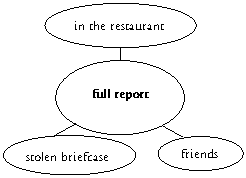 | 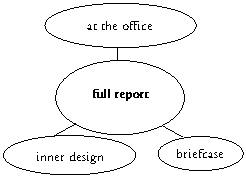 |
A. B.
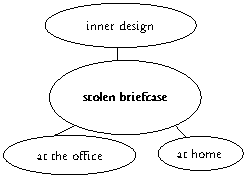 | 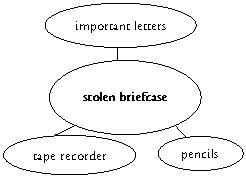 |
C. D.
59. What does the underlined word “relive” mean in the passage?
A. go through again B. get out of
C. get used to again D. pay attention to
60. What can be the best title for the passage?
A. Forgetting — You can never really forget
B. Drawing — The better way to remember things
C. Re-remembering — Remember what you have forgotten
D. Replacing — Forgetting something instead of remembering
Last night I was driving from Harrisburg to Lewisburg, a distance of about 80 miles. It was late, I was late, and I was driving 31_________.
At one point along an open highway, I came to a crossroads with a traffic light. I was 32_________ on the road by now, but as I came near the light, it turned 33_________, and I braked to a stop. I looked left, right, and behind me. Nothing. Not a car, no suggestion of headlights, 34_________ there I sat, waiting for the light to 35_________, the only human being, for at least a mile in any 36_________.
I started wondering why I 37_________ to run the light. I was not afraid of being caught, because there was 38_________ no policeman anywhere around and there certainly would have been no 39_________ in going through it.
Much later that 40_________, after I’d met with a group in Lewisburg and had climbed into bed near midnight, the question of why I’d stopped for that light 41_________ me. I think I stopped 42_________ it’s part of a contract(契约) we all have with each other. It’ s not only the law, but it’s an agreement we have, and we trust each other to follow 43_________: we don’t go through red lights.
We do 44_________ we say we’ll do. We show up when we say we’ll show up.
I was so 45_________ of myself for stopping for that red light. And as no one would ever have known what a good person I was on the road from Harrisburg to Lewisburg, I had to tell s someone.
1. A.fast B.slowly C.carefully D.hard
2. A.late B.alone C.worried D.afraid
3. A.green B.yellow C.red D.dark
4. A.and B.or C.so D.but
5. A.return B.change C.start D.continue
6. A.attention B.background C.direction D.information
7. A.refused B.decided C.prepared D.forgot
8. A.hardly B.luckily C.usually D.clearly
9. A.danger B.excuse C.space D.energy
10. A.moment B.night C.afternoon D.morning
11. A.depended on B.looked forward to C.stayed away from D.came back to
12. A.though B.unless C.because D.until
13. A.me B.it C.him D.us
14. A.what B.how C.why D.that
15. A.tired B.ready C.proud D.sorry
湖北省互联网违法和不良信息举报平台 | 网上有害信息举报专区 | 电信诈骗举报专区 | 涉历史虚无主义有害信息举报专区 | 涉企侵权举报专区
违法和不良信息举报电话:027-86699610 举报邮箱:58377363@163.com