
题目列表(包括答案和解析)
Great young stars make Chinese people proud, like Yao Ming in the NBA, and Liu Xiang in track and field(田径). Now maybe we can add one more name: Ding Junhui.
The teenage player has become China’s hero at snooker(斯诺克).
Two days after his 18th birthday, Ding reached the top of the 2005 World Snooker China Open on Sunday. He’s the second youngest ever to win a world ranking title(排名赛冠军)!
In the final, Ding beat the world champion 9:5. He came from far behind to win.
“I didn’t feel nervous because I just looked at it as a practice match,” said Ding. “I was able to learn from the other players.”
Ding doesn’t talk much. Besides snooker, he hasn’t many outside interests. He says he doesn’t want anyone to beat him at snooker.
He has been in Britain since he was 16. He can play with the world’s best players there. He practices many hours a day.
“Every game is so different for me. I have to think a lot before I win. That’s why I enjoy snooker so much,” he said.
1. Liu Xiang is famous as a _______ player.
A. basketball B. football C. track and field D. tennis
2. Ding Junhui was born in _______.
A. 1987 B. 1990 C. 1997 D. 2005
3. Ding Junhui didn’t feel nervous because ________.
A. he didn’t want to win B. he would be the first in the match
C. he regarded it as a practise match D. he was’t interested in the match
4. From the passage, we know that Ding _______.
A. is a man with few words B. has many outside interests
C. is good at basketball D. never learns from others
5. Ding has been in Britain since he was 16 so that _______.
A. he can practise his English
B. he can make many friends there
C. he can play with the world’s best players there.
D. he loves Britain
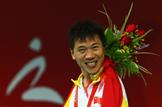
He Junquan is a Chinese swimmer and has won many Paralympic(残奥会) gold medals. Born in Jingmen, Hubei province, He Junquan was a healthy boy. But one day at the age of three, he climbed up to the high-voltage electricity(高压线) box and lost both of his arms forever. He became a disabled boy!
From then on he learnt to do everything with his feet: writing, eating, getting dressed and taking things. Seeing other pupils swimming in the river, he jumped in, too. Without arms, he suffered a lot in the river at the beginning. But he finally learnt to balance himself in water and could swim much faster than the other pupils. Once he even saved a little boy who fell into the water and couldn’t swim. His father was so happy to see that this son had a talent in swimming.
In 1995, He Junquan became a real swimmer. He practices swimming for more than four hours every day. Since 1996, he has won more than twelve gold medals of the world class. At the 2008 Summer Paralympics, he won a silver medal. Reporting on the competition at the 2008 Games, Will Swanton of the Sydney Morning Herald wrote:
“The Water Cube has been a sight for sore(气愤的) eyes. China’s He Junquan, with no arms, was leading the 50m backstroke(仰泳) final. … He came to the finish— and had to crash into the wall with his head. As he slowed down to lessen(减少) the impact(撞击力), Brazilian Daniel Dias hit the wall first with a hand. You’ve never heard a silence like it.”
【小题1】What happened to He Junquan when he was three?
| A.He climbed up the tree but failed onto the ground. |
| B.He saved a little boy who fell into the river and couldn’t swim. |
| C.He climbed up to the high-voltage electricity box and lost his two arms. |
| D.He began to practice swimming in the swimming pool with the other children. |
| A.With his feet. | B.With his mouth. |
| C.With his legs. | D.With his hands. |
| A.Only one. | B.Less than four. | C.About ten. | D.More than twelve. |
| A.He Junquan should not take part in the 2008 Games. |
| B.Daniel Dias didn’t hit the wall first at the 2008 Games. |
| C.The match was a little unfair for He Junquan because he had no arms. |
| D.He Junquan swam a little faster than Daniel Dias but he won a gold medal. |
| A.A Terrible Accident. | B.A Disabled Boy. |
| C.An Unforgettable Experience. | D.A Hero without Arms. |
The first way to make friends is to smile. When you smile, people think you are __1___ and easy to talk to. It may not be easy at first to smile. But, you can practice in the mirror(镜子). When you look at yourself, think if you’d like to __2___ to your smiling face or your usual face. Of course the smiling face. Most people stay away from an __3___ face.
One easy way to start a conversation with someone is to say __4___ nice about them. For example, you could talk about an interesting __5___ to a teacher’s question, good match at the ball field, pretty shirt, etc…. Think about how great you feel when someone says something nice to you. Doesn’t it make you want to __6___ talking to that person?
Ask your new friends questions about themselves. Such as: “Who’s their favorite singer?” “Where do they live, who’s their teacher?” “What do they do after school?” … etc. They are all good questions to start a __7___.
When someone asks you a question, do have an answer for them. If you don’t __8___ who your favorite singer is, or what your hobbies are, think about it. There’s nothing that will __9___ a conversation quicker than a shrug(耸肩) for an answer.
Shy kids often have some trouble with complements. When someone says something nice, shy kids often say nothing. This leaves the other person __10___ if they said something wrong. The best and easiest reply to a complement is a simple “thank you”.
| 【小题1】 |
|
| 【小题2】 |
|
| 【小题3】 |
|
| 【小题4】 |
|
| 【小题5】 |
|
| 【小题6】 |
|
| 【小题7】 |
|
| 【小题8】 |
|
| 【小题9】 |
|
| 【小题10】 |
|
湖北省互联网违法和不良信息举报平台 | 网上有害信息举报专区 | 电信诈骗举报专区 | 涉历史虚无主义有害信息举报专区 | 涉企侵权举报专区
违法和不良信息举报电话:027-86699610 举报邮箱:58377363@163.com