
题目列表(包括答案和解析)
Many Chinese students find it difficult to learn English. But not Chinese, because Chinese is their mother tongue. Actually Chinese is much 1 to learn than English.
Still some students in other countries can speak Chinese very 2 .If you didn’t see them, you would 3 them for Chinese. What makes them 4 ?
“For me, conversation is the most helpful. I try to 5 in Chinese. If you only listen to what others speak, you’ll be good at 6 , but if you talk as much as you can, you’ll find you can speak good 7 ,” said Jenny Brown, an English girl 8 who is now studying Chinese at Beijing University(北京大学). She is interested in Chinese and its 9 .
Chinese is different from English, 10 we can use the same way in learning them.
1. A. easier B. difficult C. better D. worse
2. A. good B. well C. bad D. badly
3. A. think B. find C. look D. know
4. A. worried B. happy C. successful D. bored
5. A. sing B. write C. learn D. speak
6. A. reading B. sleeping C. speaking D. playing
7. A. Chinese B. Japanese C. English D. language
8. A. she B. her C. what D. who
9. A. world B. language C. country D. people
10. A. so B. and C. also D. but
| 阅读理解。 | ||||||||||||||||||
People in different countries greet each other in different ways. Here are some.
| ||||||||||||||||||
| 1. In which country do men sometimes pat each other on the back? | ||||||||||||||||||
| A. The Philippines. B. Finland. C. Korea. D. The United States. | ||||||||||||||||||
| 2. Which of the following is TRUE? | ||||||||||||||||||
| A. People shake hands whenever they meet in the United States. B. In Philippines, friends shake hands as the everyday greeting. C. Finns greet each other with a bow. D. In Korea, the first name comes before the family name. | ||||||||||||||||||
| 3. Of the five pictures above (a, b, c, d, and e), which is the same way to greet each other in the four countries? | ||||||||||||||||||
| A. d B. c C. b D. a | ||||||||||||||||||
| 4. In this passage, all the following are mentioned EXCEPT ______. | ||||||||||||||||||
| A. kisses B. hugs C. smiles D. handshakes | ||||||||||||||||||
| 5. What does the writer want to tell us in the passage? | ||||||||||||||||||
| A. Different ways of greeting. B. Four countries. C. Friends and family members. D. Languages. |
A greeting is a way of saying "Hello" to someone. People in different countries greet each other in different ways. Here are some.
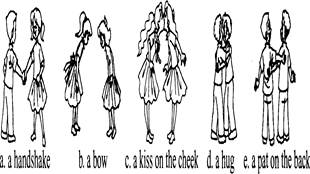
World Greetings
|
Philippine |
The everyday greeting for friends is a handshake for both men and women. Men sometimes pat each other on the back. |
|
Japan |
When people meet for the first time, they usually bow. In business, people also shake hands. In formal situations, people often exchange business cards. When you give a business card, give it with two hands. This is polite. Special note: In Japan, a smile can have different meanings. It usually means that the person is happy, or that the person thinks something is funny. But it can also mean that the person is embarrassed. |
|
New Zealand |
Usually, both men and women shake hands when they meet someone for the first time. Fun fact: If you see two people pressing their noses together, they are probably Maori. The Maori are the native people of New Zealand. This is their traditional greeting. |
|
Brazil |
Men often shake hands when they meet for the first time. When women meet, they kiss each other on the cheek. Women also kiss male friends to say hello. When you shake hands, look at the person in the eyes. This shows interest and friendliness. |
1.In this passage, which of the following is NOT mentioned?
A.Kisses. B.Hugs. C.Bows. D.Handshakes.
2.Of the five pictures above (a, b, c, d and e), which is the same way to greet each other in the four countries?
A.a B.b C.c D.d
3.Which of the following is TRUE according to the passage?
A.Both men and women shake hands in Brazil when they meet.
B.Japanese won't smile until they feel very happy.
C.The Maori often press their noses together to greet each other.
D.In Philippine, people shake hands only when they meet for the first time.
A greeting is a way of saying "Hello" to someone. People in different countries greet each other in different ways. Here are some.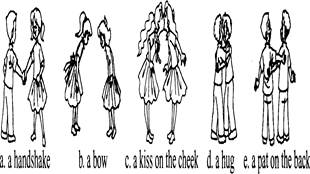
World Greetings
| Philippine | The everyday greeting for friends is a handshake for both men and women. Men sometimes pat each other on the back. |
| Japan | When people meet for the first time, they usually bow. In business, people also shake hands. In formal situations, people often exchange business cards. When you give a business card, give it with two hands. This is polite. Special note: In Japan, a smile can have different meanings. It usually means that the person is happy, or that the person thinks something is funny. But it can also mean that the person is embarrassed. |
| New Zealand | Usually, both men and women shake hands when they meet someone for the first time. Fun fact: If you see two people pressing their noses together, they are probably Maori. The Maori are the native people of New Zealand. This is their traditional greeting. |
| Brazil | Men often shake hands when they meet for the first time. When women meet, they kiss each other on the cheek. Women also kiss male friends to say hello. When you shake hands, look at the person in the eyes. This shows interest and friendliness. |
| A.Kisses. | B.Hugs. | C.Bows. | D.Handshakes. |
| A.a | B.b | C.c | D.d |
| A.Both men and women shake hands in Brazil when they meet. |
| B.Japanese won't smile until they feel very happy. |
| C.The Maori often press their noses together to greet each other. |
| D.In Philippine, people shake hands only when they meet for the first time. |
A greeting is a way of saying "Hello" to someone. People in different countries greet each other in different ways. Here are some.

World Greetings
| Philippine | The everyday greeting for friends is a handshake for both men and women. Men sometimes pat each other on the back. |
| Japan | When people meet for the first time, they usually bow. In business, people also shake hands. In formal situations, people often exchange business cards. When you give a business card, give it with two hands This is polite. Special note: In Japan, a smile can have different meanings. It usually means that the person is happy, or that the person thinks something is funny. But it can also mean that the person is embarrassed. |
| New Zealand | Usually, both men and women shake hands when they meet someone for the first time. Fun fact: If you see two people pressing their noses together, they are probably Maori. The Maori are the native people of New Zealand. This is their traditional greeting. |
| Brazil | Men often shake hands when they meet for the first time. When women meet, they kiss each other on the cheek. Women also kiss male friends to say hello. When you shake hands, look at the person in the eyes. This shows interest and friendliness. |
51. In which country do men sometimes pat each other on the back?
A. Philippine. B. Brazil. C. Japan. D. New Zealand.
52. In this passage, which of the following is NOT mentioned?
A. Kisses. B. Hugs. C. Bows. D. Handshakes.
53. Of the five pictures above (a, b, c, d and e) , which is the same way to greet each other in the four countries?
A. a B. b C. c D. d
54. Which of the following is true, according to the passage?
A. Both men and women shake hands in Brazil when they meet.
B. Japanese won't smile until they feel very happy.
C. The Maori often press their noses together to greet each other.
D. In Philippine, people shake hands only when they meet for the first time.
55. What does the writer mainly want to tell us in the passage?
A. Different ways of greetings. B. Four countries.
C. Some fun facts. D. Some special notes.
湖北省互联网违法和不良信息举报平台 | 网上有害信息举报专区 | 电信诈骗举报专区 | 涉历史虚无主义有害信息举报专区 | 涉企侵权举报专区
违法和不良信息举报电话:027-86699610 举报邮箱:58377363@163.com


