
题目列表(包括答案和解析)
Tony Buzan’s grades were going down at university. Disappointed with his low marks, he went to the library to find a book on how to use his brain. He was directed to the medical section. Confused, he said to the librarian, “I don’t want to take my brain out, I just want to learn how to use it.” Her reply was simple: “There’s no book on that.”
“I thought to myself,” says Buzan, “if I buy a little radio, I get an instruction manual (说明书). If I buy a microwave, I get an instruction manual. But for the most important machine in the world, no instruction manual?”
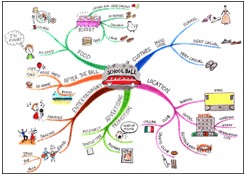
Fifty years later, Buzan has become the world’s leading speaker on the brain and learning. In the late 1960s, he invented the mind map, a visual representation of thought processes.
This kind of thinking has become a popular tool for planning, organizing, problem solving, and communicating across the world. He has since authored and co-authored over 100 books that have appeared in more than 30 languages.
“I think in most cases, people use less than 1 percent of their brains,” he says.
But how do you expand this 1 percent? How do you become the best student you can be?
According to Buzan, the answer is simple. You take a section of whatever it is that you are trying to learn, he says, and you read it for its essence (精髓、要素). Then you make a mind map of all the important details. For a truly effective mind map, you start with a colored image in the center of your page. Draw the first image that comes to mind on the topic you are mind mapping. Branch off from your central image and create one of your main ideas. From your main branches draw some sub-branches and from those sub-branches you can draw even more branches. He emphasizes that you should use plenty of images and colors as these help with memory recall and encourage creativity.
By using this visual format (形式), according to Buzan, your mind will begin to make associations that will help you remember more information for longer periods of time.
Buzan believes that traditional note-taking methods, such as lists and summaries, do not stimulate the brain’s recall capacity or ability in the same way. Because of this, students will often find themselves locked away in their rooms for hours, trying hard to memorize separate details. Buzan believes that for a more effective and lasting way of studying, you must first understand how your brain works.
“Everyone is born smart,” he says. “You just have to learn how to learn.”
1.What is the main purpose of the first two paragraphs?
A.To show that Tony Buzan was worried about his study.
B.To invite us to think about the importance of manuals.
C.To prove that the mind map is a useful tool for the brain.
D.To show why Tony Buzan studies the brain and learning.
2.What does the word “stimulate” mean in the passage?
A.Excite. B.Improve. C.Encourage. D.Affect.
3.What can we infer from the passage?
A.If we learn the mind map, we will become the best student.
B.The mind map will help your brain connect separate details.
C.The mind map will be more effective if we put more details in it.
D.We will solve the problem if we make connections between ideas.
4.What is the best title for the passage?
A.How to make the mind map?
B.Is the mind map widely used?
C.Can your memory be mapped?
D.Is the mind map helpful in thinking?
People have different ways of greeting each other. They might shake hands (握手), kiss or hug (拥抱). But do you ever wonder how dogs say hello?
If you are a dog lover, you already know the answer to this question. When you arrive home, your dog jumps up into your lap (大腿前部). It wags (摇摆) its tail, and sometimes gives you wet kisses.
Like humans, dogs have five senses (感觉): smell, touch, sight, hearing and taste. Humans use sight as the main sense for recognizing (认出) one another. But dogs have poor eyesight. They use smell to recognize others. A dog’s sense of smell is much better than a human’s. It is through its sense of smell that tells the differences between different people.
Dogs use smell to recognize other dogs, too. They tell the differences by the smell of pee (小便) and pooh (大便). When two dogs meet, they smell each other’s noses. Then they go side to side, and smell each other’s butts (屁股). By smelling its friend’s behind, a dog knows who it is with.
That is also why dogs smell everything they can on the road. By smelling grass, trees and signposts (路标), dogs know which other neighborhood dogs have been around.
【小题1】People have different ways of greeting each other except ______.
| A.hug | B.shaking hands | C.jump | D.kiss |
| A.They use eyes to recognize each other. | B.They use sound to recognize each other. |
| C.They use smell to recognize each other. | D.They use touch to recognize each other. |
| A.How the dogs eat things. | B.Dogs have five senses. |
| C.A dog knows who it is with by smelling. | D.Humans use sight to recognize each other. |
| A.Humans and dogs. | B.My favorite animal. |
| C.How do dogs say hello? | D.Cute dogs. |
Sunday is more like Monday than it used to be. Places of business that used to keep daytime “business hours” are now open late into the night. And on the Internet, the hour of the day and the day of the week have become irrelevant. A half century ago in the United states, most people experienced strong and precise dividing lines between days of rest and days of work, school time and summer time. Today the dividing lines are still there, but they seem not clear.
The law in almost all states used to require stores to close on Sunday; in most, it no longer does. It used to keep the schools open in all seasons except summer, in most, it still does. And whether the work week should strengthen its legal(法律的)limits, or whether it should become more changeable, is often debated(争论). How should we, as a society, organize our time? Should we go even further in relaxing the dividing lines of time until we live in a world in which every minute is much like every other?
These are not easy questions even to ask. Part of the difficulty is that we seldom recognize the “law of time” even when we meet it face to face. We know as children that we have to go to school a certain number of hours, a certain number of days, a certain number of years – but unless we meet the truant officer(学监), we may well think that we should go to school because of social custom and parents’ requirement rather than to the law. As adults we know “extra pay for overtime working” very well, but less familiar with the fact that what constitutes(构成)“overtime” is a matter of legal thing. When we turn the clock forward to start daylight – saving time, have we ever thought to ourselves: “Here is the law in action”? As we shall see, there is a lot of law that has great influence on how organize and use time: compulsory education law, overtime law, and daylight-saving law – as well as law about Sunday closing, holidays, being late to work, time zones, and so on. Once we begin to look for it, we will have no trouble finding a law of time to examine and assess.
【小题1】What does the underlined word “irrelevant” probably mean?
| A.Impossible. | B.Unacceptable. | C.Unimportant. | D.Disagreeable. |
| A.are unknowing of the law of time |
| B.fail to make full use of their time |
| C.welcome changeable working hours |
| D.enjoy working overtime for more pay |
| A.have to follow the law |
| B.need to find social customs |
| C.need to learn more knowledge |
| D.have to follow their parents’ requirement |
| A.Our life is governed by the law of time. |
| B.How to use time is not worth debating. |
| C.New ways of using time change our society. |
| D.Our time table is decided by social customs. |
Read the passage and fill in the blanks with proper words
Most people know that intelligence quotient (IQ. is important, but EQ is probably more important in daily life. When facing an exam, EQ helps us to manage our feelings. When getting along with friends or parents, EQ helps us to c 1. well.
EQ is shaped partly by genetics(基因.. You can see some babies are quiet, while others are not. B 2. , EQ is something you can learn for yourself. You can learn what different feelings might mean and how they relate to yourself and others. If we learn in the right way, our EQ can get better as we get older. Children with a high EQ usually have greater success with making friends. Having a high EQ needs a few different skills. Learning about these skills can help us to i 3. our EQ. But what are they? Let’s take a look!
1. Know yourself
Most people feel many different feelings t 4. the day. Some feelings like surprise last just a few seconds. Others, like happiness and sadness, may stay around much l 5. . Being able to recognize these everyday feelings is the most basic of all EQ skills.
2. Manage yourself
We all get angry. We all have disappointments. But we need to control it. It is not always the right time or place to express our feelings. When you are angry with someone, take a deep breath and s 6. count to 10. This way, you can calm down.
3. Encourage yourself
When you fail an exam, you may be disappointed. But there is something more effective you can do—learn to encourage yourself. It gives you the energy and c 7. to move on. It helps you to build a strong heart.
Galloway Wildlife Conservation Park is in the south of Scotland.
A collection of nearly 150 different animals from all over the world can be seen within the peaceful and natural setting. Galloway Wildlife Conservation Park is to provide a living shelter for small animals, to protect wildlife, to provide chances for the public to enjoy and learn about the area they live in. A main aim of the park is to protect endangered animals.
Facilities(设施) available to visitors mainly include restaurants, gift shops picnic areas, facilities for babies, facilities for disabled people free parking, etc.
There is a programme of improvement to condition for the animals, birds and visitors. Through the programme, the park plays an important part in the international effort to protect rare and endangered animals. Click here to see what improvement the park has to make.
As some of our animals are free in the park area, dogs and other pets are not allowed.
Open from 1st February to 30th October, 10:00 a.m to 6:00p.m.
|
Tickets |
|
|
Adult |
£ 6.50 |
|
Child |
£ 4.50(4-15 years old) |
|
Elderly |
£ 5.50 |
|
Family |
£ 20.00 (2 adults & 2 children) |
By buying a ticket to visit the park, you can help us do so much more so HELP SUPPORT CONSERVATION!
You can help us continue our work by making a donation here >>> SUPPORT
Contact us:
E-mail: infor@gallowaywildlife.co.uk Fax/Tel:01557 331645
1.You can visit Galloway Wildlife Conservation Park ___________.
A.at 9:00a.m on 7th December
B.at 11:00a.m on 7th December
C.at 9:00a.m on 7th September
D.at 11:00a.m on 7th September
2.How much should you at least pay if your family (five persons, including an elderly person, two adults and the ten-year-old twins) visit the park?
A. £24.50 B.£25.50 C.£26.50 D.£27.50
3.Which is TRUE according to the passage?
A.There are endangered animals in the park.
B.There aren’t any picnic areas in the park.
C.You can’t take the babies to the park.
D.You can visit the park with your dogs.
湖北省互联网违法和不良信息举报平台 | 网上有害信息举报专区 | 电信诈骗举报专区 | 涉历史虚无主义有害信息举报专区 | 涉企侵权举报专区
违法和不良信息举报电话:027-86699610 举报邮箱:58377363@163.com