
题目列表(包括答案和解析)
One day a man found a cocoon(茧) of a butterfly in the forest. He sat there for several hours and watched the butterfly. Suddenly a small opening appeared, and the butterfly made its great effort to force its body through that little hole. Then it seemed to stop making any progress. It appeared as if it had gotten as far as it could and it could go no further.
So the man decided to help the butterfly. He cut off the remaining bit of the cocoon so that the butterfly could come out easily. But to his surprise, the butterfly got a heavy body and very small wings when it came out of the cocoon.
The man continued to watch the butterfly because he expected that the body would grow smaller at any moment and the wings would become larger and be able to fly. But neither happened! In fact, the butterfly spent the rest of its life crawling (爬) around with a heavy body and small wings. It was never able to fly.
The man was in his kindness, but he did not understand the nature rules. Before the butterfly came out of the cocoon, fluid(流体) from its body must be forced into its wings, and then it would be ready for flying. It must have a hard struggle (拼搏) to get through the small opening to get its freedom from the cocoon.
Sometimes struggles are exactly what we need in our life. If God allowed us to go through our life without any difficulties, it would make us fail. We would not be as strong as we could have been; we could never fly.
1.What was the butterfly doing at the beginning of the story ?
A.It was trying to make a cocoon for itself.
B.It was struggling to get out of its cocoon.
C.It was flying among the trees in the forest.
D.It was crawling around quietly on the ground.
2.The man cut off the remaining bit of the cocoon
A.to take the butterfly home
B.to help the butterfly come out easily
C.to kill the butterfly
D.to stop the butterfly growing bigger
3.What do you think of the man?
A.Patient but cruel.
B.Careful and wise.
C.Kind but unwise.
D.Brave and funny.
4.What does the last paragraph(段落) tell us?
A.Struggles are sometimes necessary in our life.
B.Nothing is difficult if we put our heart into it.
C.Every good deed will come back with good result.
D.The greatest happiness in the world is to help others.
5.What is the best title for the story?
A.The Love for the Cocoon.
B.The Joy of Helping Each Other.
C.The Lesson of the Cocoon.
D.The Expectation for the Butterfly.
 To prepare Chinese students for the world, and international students for China To prepare Chinese students for the world, and international students for ChinaOur Special Program One of the earliest MBA programs in China IMBA program One of the largest business administration (管理)schoolmate networks in China Colorful courses taught by famous teachers Effective learning to put theories (理论) in management and practice together
Address; Room 0614, School of Business, Renmin University of China, 59 Zhongguancun Avenue, Beijing, 100872, CHINA Email: imba@ mc. edu. cn Telephone; +8610 62514665 Fax: +8610 82509167 For more information, please visit www. rbs. org. cn/mba/en |
| Study in the UK at Castle College Nottingham SPIIPP Pre-Masters( 硕士预备班) (September and January start) A one year course with a promise to enter Nottingham Trent University on successful completion Pre-Programme (September start) Preparation for A-Levels( 英国高级证书考试) or International Foundation Programmes ( Maths and Science) English as a Foreign Language Flexible(Mtr§rMj) start & finish dates Study from 8—36 weeks For further information: Email: minima. nguyen@ castlecollege. ac. ok Web: www. castlecollege. ac ok/international |
| A.Full-time MBA (Chinese) | B.Part-time MBA( Chinese) |
| C.International MBA(English) | D.Human Resource |
| A.Either September or January. | B.September. | C.January. |
| D.Any time when he is free. |
| A.Students all over the world can choose to study the IMBA program. |
| B.A student from Britain can enter Castle College Nottingham to study a foreign language. |
| C.Li Ming, who will have a month’s vacation, can choose to study English at Castle College Nottingham. |
| D.The MBA program is the earliest in China. |
| A.English as a Foreign Language |
| B.Pre-Programme at Castle College Nottingham |
| C.The IMBA programme at Renmin University of China, School of Business |
| D.Castle College Nottingham |
| A.www. castlecollege. ac. uk/international |
| B.minhha. nguyen@ castlecollege. ac. uk |
| C.www. rbs. org. cn/mfea/en |
| D.imba@ rue. edu. cn |
We use the Internet for many things: business, shopping, writing letters, talking to people, finding information, and so on. In recent years, a new kind of English has grown on the Internet. There’s no real word for it yet, so we’ll call it e-talk. People don’t like typing too much. To save time, they turn phrases (短语) into a few letters called acronyms(首字母缩略词). Acronyms are often used in chat rooms.
Some of them are:
BTW(by the way) BRB (be right back)
LOL (laughing out loud) IMO (in my opinion)
People also use many abbreviations. They are shortened forms of words. Some common abbreviations are:
info (information) puter (computer) pic (picture) sec (second)
We usually don’t see people when we communicate on the Net, so people have new ways to show feelings. Most people use their keyboards to draw “feeling”, such as:
: ) (happy) :-( (sad) ; : P (joking) : O (surprised)
These days, many forums have picture feelings. For example:
happy  sad
sad  angry
angry  cool
cool 
There are even whole new words, like ‘newbie’ (someone who is new on a chat board or forum). When you write something bad about someone else, it’s called ‘flaming’ the person.
It takes time to get used to e-talk. Also, different groups in the Net have their own special ways of communicating. Newbies sometimes have to ask other people what they mean. As the Internet grows, e-talk will continue to grow and change.
【小题1】 Why do people type acronyms?
| A.To show their feelings. |
| B.To make jokes. |
| C.Because people can type them quickly. |
| D.In this way, newbies won’t understand them. |
| A.The person is happy about getting a new computer. |
| B.The person has to go away from their computer. |
| C.The person is angry at somebody. |
| D.The person is sad that his computer is having problems. |
| A. | B. | C.LOL | D.BRB |
| A.keep changing |
| B.stay the same |
| C.be used by people on the telephone |
| D.be easy for newbies to understand |

Recent research from the Pew Internet Project suggests that 90% of Americans aged from 12 to 17 use the Internet, and 51% of those teens use social networks. However, there are many possible problems with social networking sites and the teenagers who use them.
Apart from the social advantages, social networking sites can be used to record school research, develop artistic talents and experiment with other forms of subject creation. They provide a way to communicate with others who share the same interests and to get helpful advice on ongoing projects.
Along with these advantages come some dangers. For example, most social networking sites are open to all, especially MySpace, which is the most popular social network among teens in America. It means that they could be put in unpleasant and frightening situations.
A greater danger is that teens may become objects of the people with secret purposes. The secrecy of some social networking sites makes it easy for dangerous people to find young teens and invite them into dangerous conversations. It’s easy for them to pretend as teens and draw children into dangerous real-world communication as well. Then further hurt might be on its way.
Another danger is identity stealing, which can happen when teens share too much information about their names, dates of birth and locations.
Therefore, it’s very important to make sure teens are safe when they use social networks.
Many of the same rules that work for online chat work for these sites:
※ Don’t use your real name.
※ Don’t give out personal information to people you don’t know. A last name and a town are enough for a bad guy to find where you are.
※ Don’t believe that people are who they say to be.
※ Immediately end any communication that makes you uncomfortable and report it to a parent.
Only if you are sure of your safety, can you enjoy the fun brought by social networking. Besides, trying to deal with all problems on your own can lead to terrible results. Remember, asking your parents or school officials for help doesn’t mean you are unable to do anything but wiser than many others.
【小题1】How many dangers of using social networks are mentioned in the passage?
| A.2. | B.3. | C.4. | D.5. |
| A.students could be put into unreal situations on the Internet |
| B.teenagers are facing unknown dangers on the social networks |
| C.Internet provides more social websites to American teenagers |
| D.social networks are very popular among teenagers in America |
| A.the dangers are similar when chatting online and surfing social networks |
| B.more than half American teenagers aged from 12 to 17 use social networks |
| C.teens who ask for help are wiser when meeting problems on social networks |
| D.there are more disadvantages than advantages for teens to use social networks |
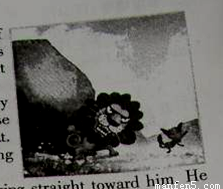
Like most cultures around the world, the Zulu people of Africa tell stories that have animals as heroes. These stories are meant to entertain, but they are also used to teach important lessons to children. This is one of those stories.
One hot afternoon, Jackal was walking along the rocky road sniffing (嗅) the ground. He was hoping to smell a mouse or a lizard (蜥蜴), or something else that would be good to eat. He was so much lost in sniffing that he wasn’t really paying attention to what was around himself.
Suddenly, Jackal looked up to see his neighbor, Lion, walking straight toward him. He did not have enough time to get away. Jackal had played many tricks (捉弄) on Lion over of something quickly.
“Help! Help!” cried Jackal as he quickly jumped upon a large rock hanging over the road. “The rocks are falling down, and I can’t hold them much longer. We shall both be crushed (压碎) if you do not do your best to hold these rocks back, Lion”
At once, Lion pushed his strong shoulder against the rocks to keep them from moving any further. “I’ll just run over here to get something to stop the rocks,” shouted Jackal as he ran away to safety. Lion stayed leaning against the unmoving rocks for quite a long time before he realized that Jackal had tricked him yet again!
1.Why was Jackal sniffing the ground?
A. To play with Lion. B. To push upon a rock
C. To run after a mouse D. To look for something to eat.
2.What does the underlined word ‘leaning’ mean?
A. supporting B. sleeping C. running D. sitting
3.Why did Jackal cry for help?
A. Because Lion was rushing to him.
B. Because he was caught under a rock.
C. Because he got an idea to get away from Lion.
D. Because he saw a large rock moving toward him.
4.What lesson does the story teach us?
A. Trust your friend, trust yourself.
B. Work hard, and you’ll succeed.
C. Help others when they are in trouble.
D. Try to find a quick way out when in trouble.
湖北省互联网违法和不良信息举报平台 | 网上有害信息举报专区 | 电信诈骗举报专区 | 涉历史虚无主义有害信息举报专区 | 涉企侵权举报专区
违法和不良信息举报电话:027-86699610 举报邮箱:58377363@163.com