
题目列表(包括答案和解析)
Three rich men were traveling together to a poor village.
The first rich man 31 all his money with the villagers and left.
The second rich man gave the 32 all his food. He thought money would be of little use to them. He made sure that each villager would have enough 33 to last for some time and then he left.
The third rich man traveled through the village 34 stopping. The other two rich men knew about this and talked about 35 with each other. They thought the third rich man was not
36 at all.
However, two days later, they 37 the third rich man again. He was traveling even more
38 , but his wagons(马车) were now 39 with useful farming tools and seeds(种子), instead of money or food. He gave the things out and 40 to teach the poor villagers how to use them.
This happened a long time ago, 41 we can see the very same thing happening today, too. Some people 42 give things that they have, but they don’t know what would really be 43
to those in need. And there are other people. They don’t 44 what others think of them. Instead, they try to 45 the best way to help those who are in great need of help. They give them something much more valuable than money.
31. A. sold B. stole C. shared D. received
32. A. parents B. villagers C. old D. rich
33. A. gold B. food C. clothes D. money
34. A. in B. towards C. without D. at
35. A. me B. us C. him D. them
36. A. sad B. strong C. clever D. kind
37. A. beat B. wondered C. met D. asked
38. A. quickly B. quietly C. suddenly D. softly
39. A. filled B. put C. played D. built
40. A. enjoyed B. began C. caused D. hoped
41. A. so B. then C. while D. but
42. A. only B. still C. almost D. nearly
43. A. different B. useful C. expensive D. heavy
44. A. hear of B. know about C. care about D. look for
45. A. find B. plan C. invent D. stop
Have you ever had the strange feeling that you were being watched? You turned around and, sure enough, someone was looking right at you!
Parapsychologists (灵学家) say that humans have a natural ability to sense when someone is looking at them. To research whether such a “sixth sense” really exists, Robert Baker, a psychologist (心理学家) at the University of Kentucky, did two experiments.
In the first one, Baker sat behind unknowing people in public places and stared at the backs of their heads for 5 to 15 minutes. The subjects(受试者)were eating, drinking, reading, studying, watching TV, or working at a computer. Baker made sure that the people could not tell that he was sitting behind them during those periods. Later, when he questioned the subjects, almost all of them said they had no sense that someone was staring at them.
For the second experiment, Baker told the subjects that they would be stared at from time to time from behind in a laboratory setting. The people had to write down when they felt they were being stared at and when they weren’t. Baker found that the subjects were no better at telling when they were stared at and when they weren’t.
Baker concludes that people do not have the ability to sense when they’re being stared at. If people doubt the outcome of his two experiments, said Baker, “I suggest they repeat the experiments and see for themselves.”
【小题1】The aim of the two experiments is to ________.
| A.explain when people can have a sixth sense |
| B.show how people act while being watched in the lab |
| C.study whether humans can sense when they are stared at |
| D.prove why humans have a sixth sense |
| A.value | B.result | C.performance | D.connection |
| A.could tell when they were stared at and when they weren’t. |
| B.could tell when they were stared at but couldn’t tell when they weren’t. |
| C.couldn’t tell when they were stared at but could tell when they weren’t. |
| D.couldn’t tell when they were stared at or when they weren’t. |
| A.People are born with a sixth sense. |
| B.The experiments support parapsychologists’ idea. |
| C.The subjects do not have a sixth sense in the experiments. |
| D.People have a sixth sense in all places. |
完形填空(共12分,每小题1分)
阅读下面的短文,掌握其大意,然后从短文后各题所给的A、B、C、D四个选项中,选择最佳选项。
Haircuts from the Heart
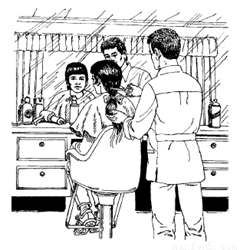
Even though Rebecca didn't enjoy having long hair, still, month after month for two and a half years, Rebecca let her hair grow until it nearly reached her waist. At the right time, 1 would donate(捐献)her beautiful hair to a group in Palm Springs, Florida called Locks of Love.
Locks of Love is a special 2 called a charity(慈善机构). The members of this group work to help others in need. 3 the healthy cut hair that Rebecca sends them, they will have a wig(假发) made for a child who needs it. Children who need wigs are those who 4 all their hair because of illness or as a side effect from certain medicines they have to 5 . Rebecca's hair will be used to help replace the 6 that another child has lost. It will also replace some of the bad feelings that child may have from not having hair.
The day finally came to cut her long hair. Rebecca had chosen a beauty 7 in her city that gave to the Locks of Love program. The hairstylist who worked there took the time to make sure Rebecca's hair was cut and packaged properly .
First the hairstylist made sure that Rebecca's hair was clean, dry, and not damaged by chemicals. The hairstylist also made sure that the cut hair would be at least ten inches long. Then he cut Rebecca's hair. Rebecca had 8 to have her cut hair bundled into a ponytail(绑成马尾辫). She took great 9 in placing the cut ponytail into a plastic bag and then an envelope to be mailed to Locks of Love. Finally as her reward, Rebecca's 10 hair was styled.
Now with short hair, Rebecca made another important decision. She decided to let it grow long again. 11 she will give it to Locks of Love. Judging from last time, she 12 it will take about three years. Even though Rebecca no longer has long hair, she certainly has a big heart.
1. A.it B.she C.he D.you
2. A.organization B.invitation
C.discussion D.conversation
3. A.Keeping B.Buying C.Using D.Holding
4. A.cut B.mail C.style D.lose
5. A.take B.meet C.drink D.show
6. A.medicine B.time C.chance D.hair
7. A.shop B.bank C.office D.school
8. A.forgotten B.prepared C.chosen D.accepted
9. A.care B.pride C.interest D.effort
10. A.long B.clean C.short D.dry
11. A.Again B.Never C.Perhaps D.Clearly
12. A.expected B.realized C.reminded D.p redicted
Have you ever had the strange feeling that you were being watched? You turned around and, sure enough, someone was looking right at you!
Parapsychologists (灵学家) say that humans have a natural ability to sense when someone is looking at them. To research whether such a“sixth sense”really exists, Robert Baker, a psychologist (心理学家) at the University of Kentucky, did two experiments.
In the first one, Baker sat behind unknowing people in public places and stared(盯着)at the backs of their heads for 5 to 15 minutes. The subjects(受试者)were eating, drinking, reading, studying, watching TV, or working at a computer. Baker made sure that the people could not tell that he was sitting behind them during those periods. Later, when he questioned the subjects, almost all of them said they had no sense that someone was staring at them.
For the second experiment, Baker told the subjects that they would be stared at from time to time from behind in a laboratory setting. The people had to write down when they felt they were being stared at and when they weren’t. Baker found that the subjects were no better at telling when they were stared at and when they weren’t.
Baker concludes that people do not have the ability to sense when they’re being stared at. If people doubt the outcome of his two experiments, said Baker,“I suggest they repeat the experiments and see for themselves.”
【小题1】The aim of the two experiments is to ________.
| A.explain when people can have a sixth sense |
| B.study how people act while being watched in the lab |
| C.study whether humans can sense when they are stared at |
| D.prove why humans have a sixth sense |
| A.value | B.result | C.performance | D.connection |
| A.could tell when they were stared at |
| B.could tell where they weren’t stared at |
| C.couldn’t tell who they were stared at or who they stared at |
| D.couldn’t tell when they were stared at or when they weren’t |
| A.People are born with a sixth sense. |
| B.The experiments support parapsychologists’ idea. |
| C.The subjects do not have a sixth sense in the experiments. |
| D.People have a sixth sense in all places. |
Have you ever had the strange feeling that you were being watched? You turned around and, sure enough, someone was looking right at you!
Parapsychologists (灵学家) say that humans have a natural ability to sense when someone is looking at them. To research whether such a “sixth sense” really exists, Robert Baker, a psychologist (心理学家) at the University of Kentucky, did two experiments.
In the first one, Baker sat behind unknowing people in public places and stared at the backs of their heads for 5 to 15 minutes. The subjects(受试者)were eating, drinking, reading, studying, watching TV, or working at a computer. Baker made sure that the people could not tell that he was sitting behind them during those periods. Later, when he questioned the subjects, almost all of them said they had no sense that someone was staring at them.
For the second experiment, Baker told the subjects that they would be stared at from time to time from behind in a laboratory setting. The people had to write down when they felt they were being stared at and when they weren’t. Baker found that the subjects were no better at telling when they were stared at and when they weren’t.
Baker concludes that people do not have the ability to sense when they’re being stared at. If people doubt the outcome of his two experiments, said Baker, “I suggest they repeat the experiments and see for themselves.”
1.The aim of the two experiments is to ________.
A.explain when people can have a sixth sense
B.show how people act while being watched in the lab
C.study whether humans can sense when they are stared at
D.prove why humans have a sixth sense
2.The underlined word “outcome” in the last paragraph most probably means ________.
A.value B.result C.performance D.connection
3. In the second experiment, the subjects _________.
A.could tell when they were stared at and when they weren’t.
B.could tell when they were stared at but couldn’t tell when they weren’t.
C.couldn’t tell when they were stared at but could tell when they weren’t.
D.couldn’t tell when they were stared at or when they weren’t.
4.What can be learned from the passage?
A.People are born with a sixth sense.
B.The experiments support parapsychologists’ idea.
C.The subjects do not have a sixth sense in the experiments.
D.People have a sixth sense in all places.
湖北省互联网违法和不良信息举报平台 | 网上有害信息举报专区 | 电信诈骗举报专区 | 涉历史虚无主义有害信息举报专区 | 涉企侵权举报专区
违法和不良信息举报电话:027-86699610 举报邮箱:58377363@163.com