
题目列表(包括答案和解析)
A 10-year-old boy decided to study judo (柔道), although he had lost his left arm in a car accident.
The boy began lessons with an old Japanese judo teacher, Mr. Tanaka. The boy was doing well, but his teacher had taught him only one move in three months of training.
“Mr. Tanaka,” the boy finally asked, “shouldn’t I be learning more moves?”
“This is the only move you know, but this is the only move you’ll ever need to know,” his teacher replied.
Several months later, Mr. Tanaka took the boy to his first tournament (锦标赛). The boy won his first three matches, using his one move to win. The boy was now in the finals, and was amazed by his own success.
This time, his opponent (对手) was bigger, stronger, and more experienced. The referee (裁判) wanted to stop the match.
“No,” the
teacher insisted, “let him continue.” Soon, his opponent lowered his guard. At
that moment the boy used his move to pin (钉住) him. The
boy won the match an d
became the champion.
d
became the champion.
On the way home, the boy and his teacher reviewed every match. Then the boy asked what was really in his mind.
“Mr. Tanaka, how did I win the tournament with only one move?”
“You won for two reasons,” his teacher answered. “First, you’ve almost mastered one of the most difficult throws in all of judo. And second, the only defense (防守) for that move is for your opponent to catch your left arm.”
The boy’s biggest weakness had become his biggest strength (优点).
1.The boy decided to study judo though ____________.
A.he was only ten years old
B.he would have an old teacher
C.he had lost his left arm in a car accident
D.he knew he was not clever
2.How did the boy feel when he was in the finals?
A.Proud. B.Surprised. C.Worried. D.Happy.
3.What can you infer (推断) from the passage?
A.The boy wasn’t doing well at first.
B.Mr. Tanaka is a good teacher because he knows his student’s strength and weakness.
C.The referee believed the boy would win.
D.The boy had predicted that he would win.
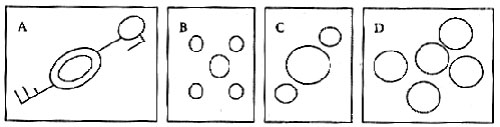
In the summer of 1978 an English man named Steven was driving his tractor through a field of wheat when he discovered something strange. Some of his wheat was lying on the ground. The flattened wheat formed(形成)a circle about six meters across . Around this circle were four smaller circles of flattened wheat.
Three years later a farmer who lived nearby discovered almost the same circles in one of his fields. These circles were larger—nearly 15 meters across . That same year , another English farmer discovered three circles of flattened wheat on his land—one large circle between two small circles. During the following years, farmers in England found circles in their fields more and more often.
The circles are called “crop circles” because they usually appear in fields of wheat or corn. The wheat in the circles lies on the ground but is never broken; it keeps on growing, and the farmers can later harvest it. Farmers always discover the crop circles in the morning, so the circles probably form at night. They appear only in the months from May to September. What causes the crop circles?
At first, people thought that some kids were making them as a joke, or that farmers were making them to attract tourists.(In fact, in 1991, two men said they made the circles themselves, but many scientists don’t believe them.) People tried to copy them: They tried to make circles exactly like the ones the farmers had found. They couldn’t do it. They couldn’t enter a field of wheat without leaving tracks, and they couldn’t flatten the wheat without breaking it.
Several times people reported seeing stranger objects near the fields where crop circles later appeared. Many people believe that these crop circles are the messages sent by living things from outer space(外层空间)or the marks left by their spaceships.
Scientists who have studied the crop circles try to find out what causes them. In the summer of 1990 some scientists spent three weeks in the part of England where many circles have appeared. They had all the latest high-tech equipment(最新高科技设备). The equipment—worth 1.8 million dollars—got nothing. But one night, as the scientists were watching a field, crop circles formed in the field behind them, which were quite different from the others. The scientists had neither seen nor heard anything.
When Steven discovered the crop circles on his land in 1978, he said, “It was just like something that had landed in the field from the air and gone back up again. I don’t know what to make of these things.”
Crop circles have appeared in England, Japan, the United States and Russia. Experts from all over the world have studied them, and they say what Steven said: They don’t know what to make of these things.
1.Which picture is probably the one formed in the field behind the scientists?
2.“Flattened wheat” means ___________.
A. broken wheat B. lying wheat
C. harvested wheat D. growing wheat
3.The passage is mainly about something ___________ .
A. that is done by living things from outer space
B. that cannot be solved but found all around the world
C. that cannot be made clear or understood
D. that is discovered and copied by the farmers

| A.broken wheat | B.lying wheat | C.harvested wheat | D.growing wheat |
| A.that is done by living things from outer space |
| B.that cannot be solved but found all around the world |
| C.that cannot be made clear or understood |
| D.that is discovered and copied by the farmers |
In the summer of 1978 an English man named Steven was driving his tractor through a field of wheat when he discovered something strange. Some of his wheat was lying on the ground. The flattened wheat formed(形成)a circle about six meters across . Around this circle were four smaller circles of flattened wheat.
Three years later a farmer who lived nearby discovered almost the same circles in one of his fields. These circles were larger—nearly 15 meters across . That same year , another English farmer discovered three circles of flattened wheat on his land—one large circle between two small circles. During the following years, farmers in England found circles in their fields more and more often.
The circles are called “crop circles” because they usually appear in fields of wheat or corn. The wheat in the circles lies on the ground but is never broken; it keeps on growing, and the farmers can later harvest it. Farmers always discover the crop circles in the morning, so the circles probably form at night. They appear only in the months from May to September. What causes the crop circles?
At first, people thought that some kids were making them as a joke, or that farmers were making them to attract tourists.(In fact, in 1991, two men said they made the circles themselves, but many scientists don’t believe them.) People tried to copy them: They tried to make circles exactly like the ones the farmers had found. They couldn’t do it. They couldn’t enter a field of wheat without leaving tracks, and they couldn’t flatten the wheat without breaking it.
Several times people reported seeing stranger objects near the fields where crop circles later appeared. Many people believe that these crop circles are the messages sent by living things from outer space(外层空间)or the marks left by their spaceships.
Scientists who have studied the crop circles try to find out what causes them. In the summer of 1990 some scientists spent three weeks in the part of England where many circles have appeared. They had all the latest high-tech equipment(最新高科技设备). The equipment—worth 1.8 million dollars—got nothing. But one night, as the scientists were watching a field, crop circles formed in the field behind them, which were quite different from the others. The scientists had neither seen nor heard anything.
When Steven discovered the crop circles on his land in 1978, he said, “It was just like something that had landed in the field from the air and gone back up again. I don’t know what to make of these things.”
Crop circles have appeared in England, Japan, the United States and Russia. Experts from all over the world have studied them, and they say what Steven said: They don’t know what to make of these things.
【小题1】Which picture is probably the one formed in the field behind the scientists?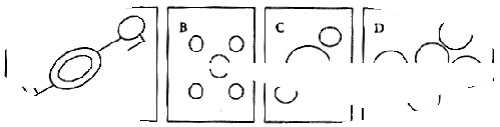
【小题2】“Flattened wheat” means ___________.
| A.broken wheat | B.lying wheat | C.harvested wheat | D.growing wheat |
| A.that is done by living things from outer space |
| B.that cannot be solved but found all around the world |
| C.that cannot be made clear or understood |
| D.that is discovered and copied by the farmers |
Once upon a time, a young man was standing in the middle of the town announcing that he had the most beautiful heart in the world. A large crowd gathered, and they al praised his heart for it was perfect.
Suddenly, an old man appeared and said, “Why ,your heart is not as beautiful as mine.”
The old man’s heart was ful of scars(伤疤). Some pieces of his heart were removed and some pieces from other people were put in, but they didn’t fit quite right. So there were several jagged(锯齿状的)edges. In fact, there were stil some holes in his heart where the pieces were missing.
The young man laughed,“Comparing yours with mine, mine is perfect and yours is a mess.”
“Yes,”said the old man. “But, every scar shows that I took out a piece of my heart and gave it to a person, and often he gave me a piece of his heart in return.”
“Why do you have some jagged edges in your heart?”asked the young man.“Because the shapes of the pieces weren’t the same.”“Then the holes?”“Sometimes I gave pieces of my heart away, and the other person hasn’t given back a piece of his, so … but I don’t care.”“How come?”“They remind me of the love we shared.”
The young man was deeply moved. He walked up to the old man, took a piece of his heart out and gave it to the old man.
The old man placed it in his heart, then took a piece from his old scarred heart and placed it in the wound(伤口)in the young man’s heart. It fitted, but not perfectly, as there were some jagged edges.
The young man looked at his heart, not perfect any more but more beautiful than ever.
How sad it must be to go through life with a whole untouched heart!
1. The young man stood in the town to _____.
A. meet the old man B. compare his heart with others’
C. show his beautiful heart D. give pieces of his heart to others
2. It’s clear that the old man was _____.
A. a sily man B. a humorous man
C. a wel-known man D. a kind-hearted man
3. We learn from the story that in the end the young man was _____.
A. lost B. moved C. hurt D. untouched
4. The old man said“… but I don’t care”means _____.
A. he didn’t expect others’return
B. he didn’t feel pain
C. he didn’t think it serious
D. he cared nothing
5.We can get more beautiful hearts by sharing _____
A. ideas B. scars C. love D. beauty
湖北省互联网违法和不良信息举报平台 | 网上有害信息举报专区 | 电信诈骗举报专区 | 涉历史虚无主义有害信息举报专区 | 涉企侵权举报专区
违法和不良信息举报电话:027-86699610 举报邮箱:58377363@163.com