
题目列表(包括答案和解析)
Every morning, the newspaper chief editor(主编) holds a meeting with the reporters. They discuss the main events(事件) of the day. Reporters are then sent to cover the events.
As soon as the reporters know what to write about, they get down to work. They telephone people and fix a time for a face-to-face interview with them. Sometimes they do telephone interviews. Checking information is very important. They go to the newspaper's own library to look up any information that they need. This is called “doing one's homework”.
At the same time, the picture editor decides which photographs will be used for the next day's paper. All the people who work on a newspaper must be able to work fast. Reporters have to stop working on one story and start working at once on the important new one. They must find out the new information as quickly as possible. Later in the day, everything is put together at the news desk. Reporters return, type their stories into the computer and hand them to the editor.
The chief editor decides which will be the most important story on the front page. Sometimes this will have to be changed if something more important happens late in the day. Other editors read the stories which the reporters have written and make any necessary changes.
Finally, there is no more time left for adding new stories, and the time for printing(印刷) the newspaper has come. This is done on fast-moving printing machines. The newspapers are then delivered(发送) by truck, plane or rail. Speed is important. People want to buy the latest newspaper; nobody wants to buy yesterday's.
1.What is the work in a newspaper office like?
A. Interesting and confusing B. Important and patient.
C. Particular and necessary. D. Fast and busy.
2.According to the passage, the right order for a reporter's work is ____________.
a. writing stories b. doing interviews c. joining in a discussion
d. doing homework e. handing stories to the editor
A. c-b-a-d-e B. c-d-e-a-b C. c-b-d-a-e D. c-a-d-b-e
3.The front page contents(内容) are decided by ___________.
A. the importance of the events
B. how well the stories are written
C. the knowledge of the chief editor
D. whether they are the latest
4.Word editors' work is to ____________.
A. help the chief editor with the morning discussion
B. decide when and how the papers can be printed
C. read the stories and make necessary changes
D. get together information from reporters and photographers
5.The best title for this passage is “____________”。
A. How a newspaper is produced B. How newspapers are delivered
C. What kind of papers readers like D. Whose work is more important
Do you know how to write an English letter and envelope?
When we write a letter in Chinese, we always put the date at the end of the letter. But it is different in English. We have to put it on the top of the right corner. And above the date, we also write the number of our house and the names of our street, city and country. To begin the letter, we always use the word like "Dear sir", "Dear Mr./Miss./Ms.…". To end the letter, we usually use words like "Yours","Yours ever" or "Truly yours".
Now read the following envelope, please.
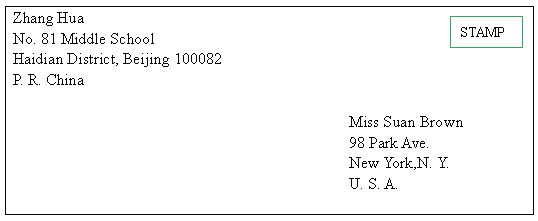
( )41."We have to put it on the top of the right corner." The word "it" here means_____.
A. the date B. the letter C. the passage
( ) 42. To what country will the letter be sent?
A. P.R. China B. China C. The United States
( ) 43. Who writes this letter?
A. Miss Susan Brown B. Zhang Hua C. You
( ) 44. From the passage, we know when we write an English letter, we should
put down our address _____.
A. at the end of the letter on the right
B. at the end of the letter on the left
C. at the top of the letter on the left
( ) 45. How do you begin your letter if you write to John Smith?
A. John Smith B. Mr. John C. Dear Mr. Smith
Dear Annie,
I have never written a letter to a newspaper before, I have just never felt the need to do such a thing. I have always felt I was quite able to do everything by myself. But now I know I was wrong.
Sometimes you really need help in life, I guess. And that’s why I’m writing this letter to you.
I have a happy family. I love my children and they love me . I’m a mother of three children. I know well how to bring up (带大)children, and two of them are already over twenty, so it is nothing new for me.
But now I have a serious problem:the Internet problem. My little son is just sixteen, and I feel he should do a lot of homework now , but he doesn’t seem to be interested in it . He can happily spend six or eight hours at a time on the Tnternet every day , He chats with pelple that he has never met before , but speaks little to us .He does lots of useless things on the Internet. And he sees red if you ask him to do his homework.
I just want him to be a good student . Now he seldomdoes his lessons at home. I’m afraid he will drop behind in his class soon. His father is a doctor , a very kind man . He never seems to be afraid of his father.
What can I do ?And don’t tell to talk to him. We’ve tried that and it didn’t work. But this is really a big problem in our family. I have tried everything I can think of . I
wonder how the Internet is so attractive(有吸引力的).You’re my last hope. Please tell me what I can do!
Yours,
Ellen Smith
( ) 1. Mrs Snith wrote to Annie because .
A. she often asked others for help
B. she thought she was a great mother
C. she didn’t know how to stop his son surfing the Internet
D. she didn’t know how the Internet was so attractive
( ) 2.What might NOT Mrs Smith’s son do on the Internet?
A. Send e-mails to his friends B. Prepare for his lessons
C. Chat with strange people D.Read the news
( ) 3. What does the phrase “he sees red”mean in this passage?
A. He feels sorry B.He feels happy
C. He becomes frightened D. He becomes angry
( ) 4. What do you think of Mr.Smith?
A. An irresponsible(不负责任的)father who nerver taught his son
B. A very excellent doctor who was busy with his work and had no time to teach
his son
C. A very kind man who loved his son
D.A man who always made his son be afraid of him but failed
Read the letter and ________ him.
A. passed it on to B. pass on it to C. pass it for D. pass it on
| 【小题1】 |
|
| 【小题2】 |
|
| 【小题3】 |
|
| 【小题4】 |
|
| 【小题5】 |
|
| 【小题6】 |
|
| 【小题7】 |
|
| 【小题8】 |
|
| 【小题9】 |
|
| 【小题10】 |
|
| 【小题11】 |
|
| 【小题12】 |
|
| 【小题13】 |
|
| 【小题14】 |
|
| 【小题15】 |
|
湖北省互联网违法和不良信息举报平台 | 网上有害信息举报专区 | 电信诈骗举报专区 | 涉历史虚无主义有害信息举报专区 | 涉企侵权举报专区
违法和不良信息举报电话:027-86699610 举报邮箱:58377363@163.com