
题目列表(包括答案和解析)
A young father was visiting an old neighbor. They were standing in the old man’s garden, and talking about children. The young man said,“How strict should parents be with their children?”
The old man pointed to(指着)a string (细绳) between a big strong tree and a thin young one.
“Please untie (解开) that string.” said the old man. “But first pull the string tight so that(以便于)the young tree is straight again.” The young man did so. He untied the string and only found that the young tree bent(弯)over to one side.
Then the old man said,“There, it is the same with children. You must be strict with them. But sometimes you must untie the string to see how they are getting on. If they are not yet able to stand alone,you must tie the string tight again. But when you find that they are ready to stand alone,you can take the string away.”
1.The story is about ____________.
A. how to take care of young trees
B. how strict parents should be with their children
C. how the young father should get on with his old neighbor
2. The young man untied the string ________________.
A. in order to throw it away
B. so that both of the trees wouldn’t grow straight
C. and found that the young tree bent over to one side
3.When could the string be taken away?
A. When the old man left.
B. When the young man untied it next time.
C. When the young tree grew strong enough.
4. At last the old man told the young man ________________.
A. that he should be strict with his children if they could not
stand alone
B. that he should always be strict with his children
C. that he should be hard on his children
5.We learn that the big strong tree and the thin young one are like _________.
A. the young father and the old neighbor
B. parents and their children
C. the old neighbor and the children of young father

Chairman Mao once said: “It is not hard to do one good deed. It is hard to do good deeds all your life.” Guo Mingyi, 52, a worker in Anshan, Liaoning, did just that. Over the past 20 years, Guo has donated 60,000 milliliters(毫升) of blood. That is the blood of 10 people put together.
Once, on a cold winter of 2009, Guo got a call from the hospital. The doctors told him that a patient needed a blood donation. Guo didn’t have time to eat lunch. He travelled in the snow to get to the hospital. When he finished donating the blood, he was so tired that he fell asleep on the hospital bed.
Guo and his family live a simple life. He and his wife and daughter live in a house of only 40 square meters. They don’t have a lot of money, but Guo saves money to support poor children. In the past 16 years, he has donated over 100,000 yuan to more than 180 poor students. When the parents met him, many cried. “He looks poorer than us,” they said.
Guo has also offered hands to thousands of workers, friends and strangers. His warm heart has moved many people. They call him a “Modern-Day Lei Feng”.
Recently, Chinese leaders called on people to learn from Guo. They say young people especially should learn his selfless devotion(无私奉献).But Guo said he did these things in order not to get famous. “It’s just that some people need some help, and there should be someone standing out to give them a hand,” he said.
【小题1】When was Guo Mingyi born in Anshan, Liaoning?
| A.In 1940 | B.In 1950 | C.In 1960 | D.In 1970 |
| A.Because they are good friends. |
| B.Because he had no money to eat lunch. |
| C.Because he wanted to sleep in the hospital |
| D.Because he wanted to help the patient very much. |
| A.He is a common businessman. |
| B.He has a very rich family. |
| C.He wants to be famous a lot. |
| D.He devotes what he has to helping others |
| A.To learn from Gou Mingyi’s selfless devotion. |
| B.To donate blood to the people in need. |
| C.To raise money for poor students. |
| D.To remember Lei Feng. |
| A.Sports news | B.Health care | C.People | D.Nature |
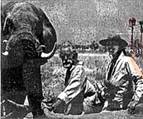
Dereck Joubert and his wife, Beverly, have made many films about wild animals in Africa. Their films and photographs are very popular and one of the photographs has been on the front cover of a National Geographic magazine.
A working day foe Dereck and Beverly starts very early-at 4:30 in the morning! That's when they get up and start filming. And it's a long day-they often work until 8:30 in the evening. In the winter it's very cold and in the summer it can be 40℃. Dereck always does the filming-Beverly never does that, and she doesn't write. But Dereck never takes photographs or records the sound. They work very well as a team, and they both believe we should shoot animals with cameras-not with guns!
When they have finished filming and taking photographs for the day, they have dinner and Dereck usually writes while Beverly looks at her photographs. At night, they usually sleep in a small tent, but they sometimes sleep in the Land Cruiser-when you're very close to wild animals, it's sometimes safer to sleep in the car.
Dereck and Beverly have also traveled around the world and given talks about their work. Dereck says that animals are not just something to look at-they play an important role. Beverly thinks the wild animals can teach us a lot about ourselves.
1. Dereck and Beverly start working ______.
A. at 4:30 in the morning B. at 4:30 in the afternoon
C. at 8:30 in the morning D. at 8:30 in the evening
2. Dereck and Beverly usually sleep ______ at night.
A. in a car B. in a tent C. in a house D. in a hotel
3. Beverly thinks the wild animals ______.
A. are something to look at B. are very popular
C. play an unimportant role D. can teach us a lot
| A.To give an example of a foreign language. |
| B.To show an example of creative methods. |
| C.To express worries about using Netspeak. |
| D.To lead in the topic of Netspeak. |
| A.Cynthia McVey points out teenagers can deal with Netspeak properly. |
| B.Geoffrey Nunberg believes Netspeakers can write Standard English. |
| C.David Crystal thinks Netspeak helps develop the habit of writing. |
| D.James Milroy says that language is changing and improving. |
| A.be fairly sure | B.be greatly surprised |
| C.think it a pity | D.find it interesting |
| A.Netspeak: A Widely-Used Language on Internet |
| B.Is Netspeak Harming the English Language? |
| C.Is Netspeak Helpful in Language Learning? |
| D.Netspeak: Advantages and Disadvantages |
In China , more and more middle school students are getting shorter sleeping time than before. Most students sleep less than nine hours every night, because they have much homework to do. Some homework is given by their teachers, and some by their parents. Also, some students don't know how to save(节省) time. They are not careful enough while they do their homework, so it takes them a lot of time. Some students spend too much time watching TV or playing computer games. They stay up (熬夜) very late. Some students have to get up early every morning on weekdays to get to school on time by bus or by bike. It can be a long way from home to school.
Schools and parents should cut down some of the homework so that our children can enjoy more than nine hours of sleep every night for their health. For children, we should make best use of(很好地利用) our time. When we have enough time for sleeping, we will find it much better for both our study and health.
1.What makes most students sleep less than nine hours every night?
A.Watching TV. B.Playing computer games.
C.Doing their homework. D.Doing housework.
2.Who else gives children some homework to do except their teachers?
A.Their parents. B.Other students.
C.The children themselves. D.Nobody else.
3.How many hours of sleep is good for students' health?
A.Less than 9 hours. B.Over 9 hours.
C.Only 9 hours. D.8 hours.
4.What would happen to a student who often goes to bed late and gets up early?
A.He would fall asleep in class.
B.He would do well in study.
C.He would finish his homework fast.
D.He would have good health.
5.Which of the following is NOT true?
A.Some students are so careless that they spend lots of time on their homework.
B.All the students stay up late for their homework.
C.Children should be given less homework.
D.Schools and parents should take care of children
湖北省互联网违法和不良信息举报平台 | 网上有害信息举报专区 | 电信诈骗举报专区 | 涉历史虚无主义有害信息举报专区 | 涉企侵权举报专区
违法和不良信息举报电话:027-86699610 举报邮箱:58377363@163.com