
题目列表(包括答案和解析)
Every morning, the newspaper chief editor(主编) holds a meeting with the reporters. They discuss the main events(事件) of the day. Reporters are then sent to cover the events.
As soon as the reporters know what to write about, they get down to work. They telephone people and fix a time for a face-to-face interview with them. Sometimes they do telephone interviews. Checking information is very important. They go to the newspaper's own library to look up any information that they need. This is called “doing one's homework”.
At the same time, the picture editor decides which photographs will be used for the next day's paper. All the people who work on a newspaper must be able to work fast. Reporters have to stop working on one story and start working at once on the important new one. They must find out the new information as quickly as possible. Later in the day, everything is put together at the news desk. Reporters return, type their stories into the computer and hand them to the editor.
The chief editor decides which will be the most important story on the front page. Sometimes this will have to be changed if something more important happens late in the day. Other editors read the stories which the reporters have written and make any necessary changes.
Finally, there is no more time left for adding new stories, and the time for printing(印刷) the newspaper has come. This is done on fast-moving printing machines. The newspapers are then delivered(发送) by truck, plane or rail. Speed is important. People want to buy the latest newspaper; nobody wants to buy yesterday's.
1.What is the work in a newspaper office like?
A. Interesting and confusing B. Important and patient.
C. Particular and necessary. D. Fast and busy.
2.According to the passage, the right order for a reporter's work is ____________.
a. writing stories b. doing interviews c. joining in a discussion
d. doing homework e. handing stories to the editor
A. c-b-a-d-e B. c-d-e-a-b C. c-b-d-a-e D. c-a-d-b-e
3.The front page contents(内容) are decided by ___________.
A. the importance of the events
B. how well the stories are written
C. the knowledge of the chief editor
D. whether they are the latest
4.Word editors' work is to ____________.
A. help the chief editor with the morning discussion
B. decide when and how the papers can be printed
C. read the stories and make necessary changes
D. get together information from reporters and photographers
5.The best title for this passage is “____________”。
A. How a newspaper is produced B. How newspapers are delivered
C. What kind of papers readers like D. Whose work is more important
Do you know how to write an English letter and envelope?
When we write a letter in Chinese, we always put the date at the end of the letter. But it is different in English. We have to put it on the top of the right corner. And above the date, we also write the number of our house and the names of our street, city and country. To begin the letter, we always use the word like "Dear sir", "Dear Mr./Miss./Ms.…". To end the letter, we usually use words like "Yours","Yours ever" or "Truly yours".
Now read the following envelope, please.
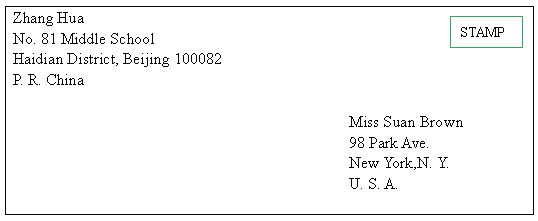
( )41."We have to put it on the top of the right corner." The word "it" here means_____.
A. the date B. the letter C. the passage
( ) 42. To what country will the letter be sent?
A. P.R. China B. China C. The United States
( ) 43. Who writes this letter?
A. Miss Susan Brown B. Zhang Hua C. You
( ) 44. From the passage, we know when we write an English letter, we should
put down our address _____.
A. at the end of the letter on the right
B. at the end of the letter on the left
C. at the top of the letter on the left
( ) 45. How do you begin your letter if you write to John Smith?
A. John Smith B. Mr. John C. Dear Mr. Smith
Children like to copy what they hear. They copy their parents, their friends and even the TV. This teaches them how to _1__ the language. Copying is also a good way for students to learn a second language. When you __2__ foreigners speak English, repeat what they say as well as you can.
Children don't practic e grammar,, but use the language to __3 things that they are interested in. They don't _4__ their vocabulary or poor grammar. They find ways to express themselves, and they do it successfully.
Students of English schools also pay attention to communication (交流). Look for __5_ to talk with people in English. If you can't find a _6__ to talk  to, talk with other students in English _7_. Start an English discussion group and talk about music, movies or anything that __8_ you.
Don't worry about _9__, what you want is to learn how to communicate easily. Remember that you can communicate successfully even with _10__small vocabulary.
1A.tell B.read C.write D.speak
2A.listen to B.listen C.hear of D.hear
3A.take exams B.talk with C.talk about D.tell to
4A.look like B.worry about C.take care of D.look after
5A.places B.questions C.chances D.changes
6A.video B.foreigner C.film D.people
7A.again B.instead C.only D.instead of
8A.interests B.improves C.allows D.troubles
9A.exams B.looking on C.making mistakes D.books
10A.an B.the C./ D.a
Food is very important. Everyone needs to 1 well if he or she wants to have a strong body. Our minds also need a kind of food. This kind of food is 2 . We begin to get knowledge(知识) even when we are very young. Small children are 3 in everything around them. They learn
4 while they are watching and listening. When they are getting older, they begin to 5 story books, science books..., anything they like. When they find something new, they love to ask questions and 6 to find out the answer.
What is the best 7 to get knowledge? If we learn 8 ourselves, we will get the most knowledge. If we are 9 getting answers from others and do not ask why, we never learn well. When we study in the right way, we will learn more and understand 10 .
|
1. |
|
|
2. |
|
|
3. |
|
4.
|
A.everything |
B.someone |
C.nothing |
D.anything |
|
5. |
|
|
6. |
|
|
7. |
|
|
8. |
|
|
9. |
|
|
10. |
|
It’s never easy to admit(承认)you are in the wrong. We all 1 to know the art of apology(道歉). Think how often you’ve done wrong. Then count how many 2 you’ve expressed clearly you were 3 . You can’t go to bed with an easy mind if you do 4 about it.
A doctor friend, Mr Lieb, told me about a man who came to him with different kinds of signs: headaches, heart trouble and insomnia(失眠症). 5 some careful exams, Mr Lieb found nothing wrong with him and said, “If you don’t tell me what’s 6 you, I can’t help you”.
The man admitted he was cheating(骗取) his brother of his inheritance(遗产). Then and there the clever doctor 7 the man write to his brother and 8 his money. As soon as the letter was put into the post box, the man suddenly cried.“Thank you ,” he said to the doctor, “I think I’ve got well.”
An apology can not only save a broken relationship(关系), but also make it 9 . If you can think of someone who should be 10 an apology from you, do something about in right now.
1. A.decide B.have C.need D.try
2. A.mistakes B.people C.ways D.times
3. A.sorry B.weak C.sad D.wrong
4. A.something B.anything C.nothing D.everything
5. A.Before B.After C.Till D.Since
6. A.hurting B.changing C.touching D.worrying
7. A.made B.helped C.let D.saw
8. A.gave B.kept C.returned D.paid
9. A.newer B.worse C.harder D.stronger
10. A.received B.given C.known D.forgotten
湖北省互联网违法和不良信息举报平台 | 网上有害信息举报专区 | 电信诈骗举报专区 | 涉历史虚无主义有害信息举报专区 | 涉企侵权举报专区
违法和不良信息举报电话:027-86699610 举报邮箱:58377363@163.com