
题目列表(包括答案和解析)
任务型阅读 (共l0空;每空l分,计l0分)
阅读下列短文,根据短文中的信息完成文后表格。(每空一词)
Small talk is pleasant conversation about common interests. The ability to make “small talk” is highly valued. But making small talk is difficult not only for English learners, but also for many native speakers of English. Most English learners may have difficulty discussing topics they are unfamiliar with because of lack of(缺少) suitable vocabulary.
Now that we understand the problem, the next step is to improve the situation. Here are some tips to improve small talk skills.
◆Do some research
Spend time on the Internet, books, magazines, TVs to special about the type of people you will meet, and this can make your conversations more interesting.
◆Use the Internet for specific vocabulary
This is a bit like doing research about other people. If you have a business conference, or are meeting people who share a common interest, make use of the Internet to learn specific vocabulary.
◆Ask yourself about your culture
Take time to make a list of common things that you will discuss when making small talk in your own culture. And then check to make sure that you have the English vocabulary to make small talk about those subjects.
◆Find common interests
Once you have a subject that interests both of you, keep to it! You can do this in many ways: discussing travel, discussing the school or friends, discussing the differences between your culture and the new culture.
◆Listen
Don’t get so worried about being able to communicate that you don’t listen. Listening carefully will help you understand and encourage those speaking to you. You might be nervous, but letting others express themselves will improve the quality of the discussion and give you time to think of an answer!
|
Title: To be a good small talker |
||
|
The problem you may have when making small talk |
__1__ have enough suitable vocabulary to cover most topics. |
|
|
The __2__ useful tips of improving small talk skills |
◆Doing some research |
Find some special information about the type of people you’ll meet by __3__ time on the Internet, books, and so on. |
|
◆__4__the Internet for specific vocabulary |
Learn specific words you may use when having a business conference or __5__ people ahead of time. |
|
|
◆Asking __6__ about your culture |
List out some common things that will be __7__ about in your own culture. |
|
|
Be sure to have the English words to discuss those subjects. |
||
|
◆Finding common interests |
Try to chat with each other about something you’re both __8__ in, such as travel, the school, the differences between different __9__. |
|
|
◆Listening |
Pay more attention to listening to others’ ideas in order to get __10__ understanding. |
|
|
|
|
|
阅读下列短文,根据短文中的信息完成文后表格。(每空一词)
Small talk is pleasant conversation about common interests. The ability to make “small talk” is highly valued. But making small talk is difficult not only for English learners, but also for many native speakers of English. Most English learners may have difficulty discussing topics they are unfamiliar with because of lack of(缺少) suitable vocabulary.
Now that we understand the problem, the next step is to improve the situation. Here are some tips to improve small talk skills.
◆Do some research
Spend time on the Internet, books, magazines, TVs to special about the type of people you will meet, and this can make your conversations more interesting.
◆Use the Internet for specific vocabulary
This is a bit like doing research about other people. If you have a business conference, or are meeting people who share a common interest, make use of the Internet to learn specific vocabulary.
◆Ask yourself about your culture
Take time to make a list of common things that you will discuss when making small talk in your own culture. And then check to make sure that you have the English vocabulary to make small talk about those subjects.
◆Find common interests
Once you have a subject that interests both of you, keep to it! You can do this in many ways: discussing travel, discussing the school or friends, discussing the differences between your culture and the new culture.
◆Listen
Don’t get so worried about being able to communicate that you don’t listen. Listening carefully will help you understand and encourage those speaking to you. You might be nervous, but letting others express themselves will improve the quality of the discussion and give you time to think of an answer!
| Title: To be a good small talker | ||
| The problem you may have when making small talk | __56__ have enough suitable vocabulary to cover most topics. | |
| The __57__ useful tips of improving small talk skills | ◆Doing some research | Find some special information about the type of people you’ll meet by __58__ time on the Internet, books, and so on. |
| ◆__59__the Internet for specific vocabulary | Learn specific words you may use when having a business conference or __60__ people ahead of time. | |
| ◆Asking __61__ about your culture | List out some common things that will be __62__ about in your own culture. | |
| Be sure to have the English words to discuss those subjects. | ||
| ◆Finding common interests | Try to chat with each other about something you’re both __63__ in, such as travel, the school, the differences between different __64__. | |
| ◆Listening | Pay more attention to listening to others’ ideas in order to get __65__ understanding. | |
There was once a farmer who lost his watch in his barn ( 仓库 ). The watch was only cheap but it was very ________ to him because it was a present from his father. After ________ the barn for a long time ,he gave up and asked for ________ from a group of children playing nearby.
He promised them that the person who ________ the watch would be rewarded ( 奖赏 ).
Hearing this , the children hurried inside the barn at once . They searched ________ but still could not find the watch . Just when the farmer was going to give up, a little boy went up to him and asked to be given another ________.
The farmer looked at him and thought , “ Why not ? ________, this kid does look honest .”
So the farmer sent the little boy back to the barn. After a while the little boy came out with the watch in his hand ! The surprised farmer asked the boy how he ________ where the rest had failed.
The boy ________ , “ I did nothing but sit quietly and listen for the sound of the watch .”
This shows us that sometimes a peaceful mind can think _______ than an excited one .
1.A. important B. expensive C. useless D. interesting
2.A. finding B. searching C. watching D. studying
3.A. money B. danger C. work D. help
4.A. saw B. found C. looked D. watched
5.A. somewhere B. anywhere C. nowhere D. everywhere
6.A. way B. chance C. lesson D. present
7.A. In all B. That’s all C. After all D. Above all
8.A. came B. knew C. succeeded D. stopped
9.A. spoke B. added C. talked D. replied
10.A. badly B. better C. worse D. Well
If you have a problem with speaking, you can do several things. Listen to English as much as possible. You can learn a poem(诗) or a song by heart. You can also learn more dialogues(对话). And practice speaking with your friends as much as you can.
Many people find it difficult to listen to English. The answer is to listen as much as you can. However, don’t do too much at one time. It is better to practice listening for five minutes every day. Don’t sit down and listen for an hour at a time. That’s too much! Do choose listening passages that are interesting and not too difficult. Choose(选择) tapes(磁带) on which the people speak clearly and not too fast. Take it easy, at first. Success with simple tapes at the beginning is the answer. Later on you can practice with tapes that are more difficult.
Finally, how can you learn to write well? How do you use little words like in, on, of and for? There are two answers to this. First, do some study with new words. Keep a list of verbs like look for, look after and so on. Second, read as much English as possible. There are many things that can’t be learnt. You must see them in books many times. Then you’ll be able to use them correctly(正确地) yourself. So, in order to write well, you must first learn to read much.
1.This passage is about English ______ .
|
A.spelling, listening, grammar and reading |
|
B.listening, speaking, reading and writing |
|
C.taking exams, pronunciation, reading and writing |
|
D.pronunciation, reading, listening and writing |
2.If you ______ , you can speak well.
|
A.learn more dialogues |
B.learn a poem or a song by heart |
|
C.practice speaking with your friends as much as you can |
D.all above |
3.Which of the following is right according to the passage?
|
A.It’s better to listen to English for a long time every day. |
|
B.At the beginning, you’d better choose the tapes on which the people speak quickly. |
|
C.At first you should begin with simple tapes for listening. |
|
D.Few people think it hard to listen to English. |
4.Which of the following ways can help you to improve(提高) your written English?
A. Buy books of writing practice. B. Read as much as possible.
C. Do some study with new words. D. Both B and C.
5.Which of the following is not right according to the passage?
|
A.Many people find it difficult to listen to English. |
|
B.Sit down and listen for an hour at a time. |
|
C.Learn a poem or a song by heart can improve your speaking. |
|
D.To improve speaking, you can practice speaking with your friends as much as you can. |
Here are some tips on listening. We hope it can help you in one way or another.
●Relax yourself.
Before you start to listen to something, You need to relax.
1 This will help you with your listening.
●Listen carefully to the first sentence.
2 For example, if eyou hear“Many shops in many parts of China have decided to take away all kinds of Japanese goods off their shelves, but some people say it’s not a good idea. Our reporter says…”,you know you will hear a piece of news, not a children’s story or a science report.
●Think when you’re listening.
3 For example, you can think of the following questions: What happened? When , where and how? What was the result and what does the speaker want to tell us? In this way, you may undersrand the passage better.
●Listen for important facts.
4 For example, if the passage is a science report, you should try to remember its findings , and how the scientists got their results.
●Don’t think about one or two words for too long.
You may hear some words that you don’t know. But don’t spend too much time on them.
5 But you can remember some words or sentences that you think are important, and you can use them when you’re answering the questions.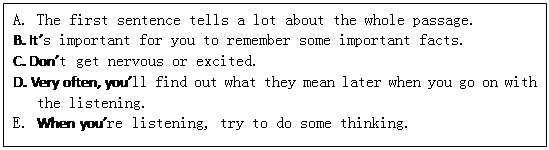
湖北省互联网违法和不良信息举报平台 | 网上有害信息举报专区 | 电信诈骗举报专区 | 涉历史虚无主义有害信息举报专区 | 涉企侵权举报专区
违法和不良信息举报电话:027-86699610 举报邮箱:58377363@163.com