
题目列表(包括答案和解析)
Complete the passage using‘between’,‘and’,‘from’,‘to’,‘before’,‘after’,‘until’.
It will be Sunday tomorrow, so I won't get up (1)________ 8:00 a.m. (2)________ breakfast, I will listen to the English tape (3)________ 8:30 a.m. to 9:00 a.m. I will watch Window of Children (4)________ I read my English book. My favourite film Home alone will be shown on TV (5)________ 10:00 a.m. and 12:00 a.m. I won't miss it.
(6)________ lunch, I need to have a sleep. I won't watch Music Heaven (7)________ I've finished some exercises. And then I will visit Sandy for some questions between 17:00 (8)________ 18:00. It is time for supper from 18:30 (9)________ 19:00 I think English News is helpful to me, so I won't miss it either. (10)________ I go to bed, I should do more exercises or my parents will be very angry.
| 听录音,选出一个你所听到的句子。 | |||
|
None of us is quite as healthy in mind as we seem, but neither is every unusual thing we do means we’re unhealthy. How to tell the difference? Start by reading the letters below, which have been analyzed by our experts.
(1) Lately, after I read an unusual word, I often can’t get it out of my head for days, sometimes weeks. I silently repeat it to myself, often spell it, and even wake up in the night with it ringing in my head. What’s wrong with my brain?
That sounds like a little obsession (着迷). Your brain feels that for some reason it must repeat this word. Unless it is taking up more than an hour of your day or really influencing your life, it is not serious. To stop it, leave it alone. If you really want to stop the repetition, set aside ten minutes a day to repeat the word over and over again. Do it so many times that you finally get sick of it.
(2) I sometimes have strange dreams when taking a short sleep, and I think they’re real when I wake up. Then, as I come around, I realize they aren’t. Is there something wrong with me?
What’s wrong is that you take short sleeps and most of us don’t! But are you mad? No. We all have strange dreams, and it’s normal, upon waking, to be fuzzy (模糊) for a little while or even not to remember where we are. What is not normal is if you don’t have these dreams.
(3) When people are eating, I can’t stand the sound of a fork or spoon knocking on a plate or bowl. I begin shaking and having a headache. I’m also sickened by the sound of people chewing with their mouths open. Is there something wrong with me?
It seems that there is something wrong with everyone else you know. How come they don’t eat with their mouths closed? At the least, you’re over sensitive (敏感) to little noise. You may also be troubled by a disorder in mind called misophonia. Try drawing your attention away from the noise. Pay attention to something else as hard as you can when you eat with your friends: the music in the background, the scene out the window, even what they’re talking about. You can train yourself to be less troubled by the noise.
(4) When I’m driving and have to cross a bridge, my heart starts racing and I feel light-headed. The fear that I’m going to pass out makes the whole situation worse. Am I crazy?
This sounds like an anxiety (忧虑), which can bring on heart illness and a real sense that you’re going to die. This kind of feeling is the body’s reaction to the possible danger in near future. To keep your anxiety from progressing, try the old method: breathing. When you feel your heart starting to race, take a deep breath in three or four times, and then let it out five or six times until you start to feel comfortable. You can also make a tape of your favourite song, and sing along as you cross the bridge.
56. What does the word analyzed mean in the first paragraph?
A. Divided into parts. B. Examined carefully.
C. Discussed in groups. D. Treated scientifically.
57. Which person described in the four letters has got something wrong?
A. The first two. B. No. 1 and No. 3.
C. The last two. D. No. 2 and No. 4.
58. What can we do when we have strange dreams after a short sleep?
A. It’s not necessary for us to do anything.
B. We can think about the dreams once again.
C. It’s a good idea to pay attention to other things.
D. We’d better go to see a doctor as early as possible.
59. From the passage, we can infer that ______.
A. we don’t need to worry about anything in mind
B. disorders in mind can be treated by ourselves
C. one must face all kinds of problems in life
D. if you are brave, nothing can trouble you
听力测试
A.听录音,在每组句子中选出一个你所听到的句子。
1.A.Your books are on the sofa.
B.What's your telephone number?
C.Rick takes the number 17 bus to his company every morning.
2.A.Where's the lost and found case?
B.The buses are dirty and crowded when it rains.
C.I need to take the video tape back to the store after school.
3.A.Do you have a volleyball, Barry?
B.In the future, humans will have less work to do.
C.Come and buy your clothes at Huaxing's great sale.
4.A.Please read aloud in class.
B.Could I invite my friends to the party on Saturday?
C.Our readers want to know something about famous people.
5.A.My aunt took us out to the park last week.
B.Running star Sandra Clark eats lots of healthy food.
C.Why not come over to my home on Wednesday evening?
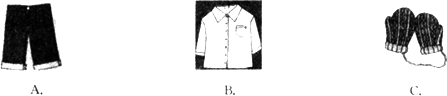
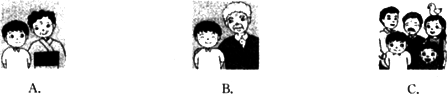
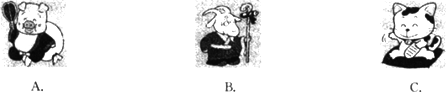
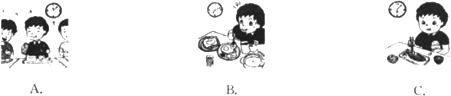
B.听录音,从每题A、B、C三幅图画中选出与听到的对话内容相符的一项。(5分)
6.
7.
8.
9.
10.
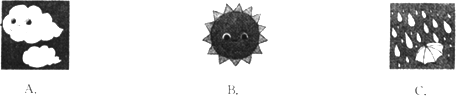
C.在录音中,你将听到一段对话及五个问题。请根据对话内容及问题选择正确答案。(5分)
11.A.He's out. B.He's at home. C.He's upstairs.
12.A.At the airport. B.At the train station. C.At his workplace.
13.A.New York. B.Sydney. C.Shanghai.
14.A.At 9∶00 in the morning. B.At 10∶00 today. C.At 11∶00 tomorrow.
15.A.Tom Green. B.Susan Smith. C.Bob White.
D.在录音中,你将听到一篇短文及五个问题。请根据短文内容及问题选择正确答案。(5分)
16.A.To New York. B.To Tokyo. C.To Paris.
17.A.By telegram. B.On the phone. C.On the Internet.
18.A.On January 29. B.On January 30. C.On January 31.
19.A.To have some work to do.
B.To see a movie.
C.To meet his old friends.
20.A.He put his things in his room.
B.He sent a telegram to New York.
C.He couldn't remember the name and address of his hotel.
湖北省互联网违法和不良信息举报平台 | 网上有害信息举报专区 | 电信诈骗举报专区 | 涉历史虚无主义有害信息举报专区 | 涉企侵权举报专区
违法和不良信息举报电话:027-86699610 举报邮箱:58377363@163.com